Class 8 English Chapter 11 – Harvest Hymn with easy NCERT Poorvi Notes and complete Book Solutions. Get a simple explanation, important concepts, questions and answers, and revision material to understand the chapter and prepare effectively for tests and exams.
Class 8 English Poorvi
Unit 4 – Environment
Harvest Hymn
Notes and Complete Book Solutions
Chapter Summary
Harvest Hymn is a poem by Sarojini Naidu. It is a song of praise and gratitude for the harvest. The poem presents the voices of men, women and all people who thank the divine forces connected with nature and farming.
The men praise Surya, the Sun, and Varuna, the rain-giving force. The women praise Prithvi, the Earth, which gives food and supports life. In the final stanza, all the voices praise the eternal divine and offer their lives and labour as tribute.
The poem shows the close relationship between farmers, nature, the harvest and the divine. It creates a joyful and thankful atmosphere through images of fields, fruits, rain, flowers, music and celebration.
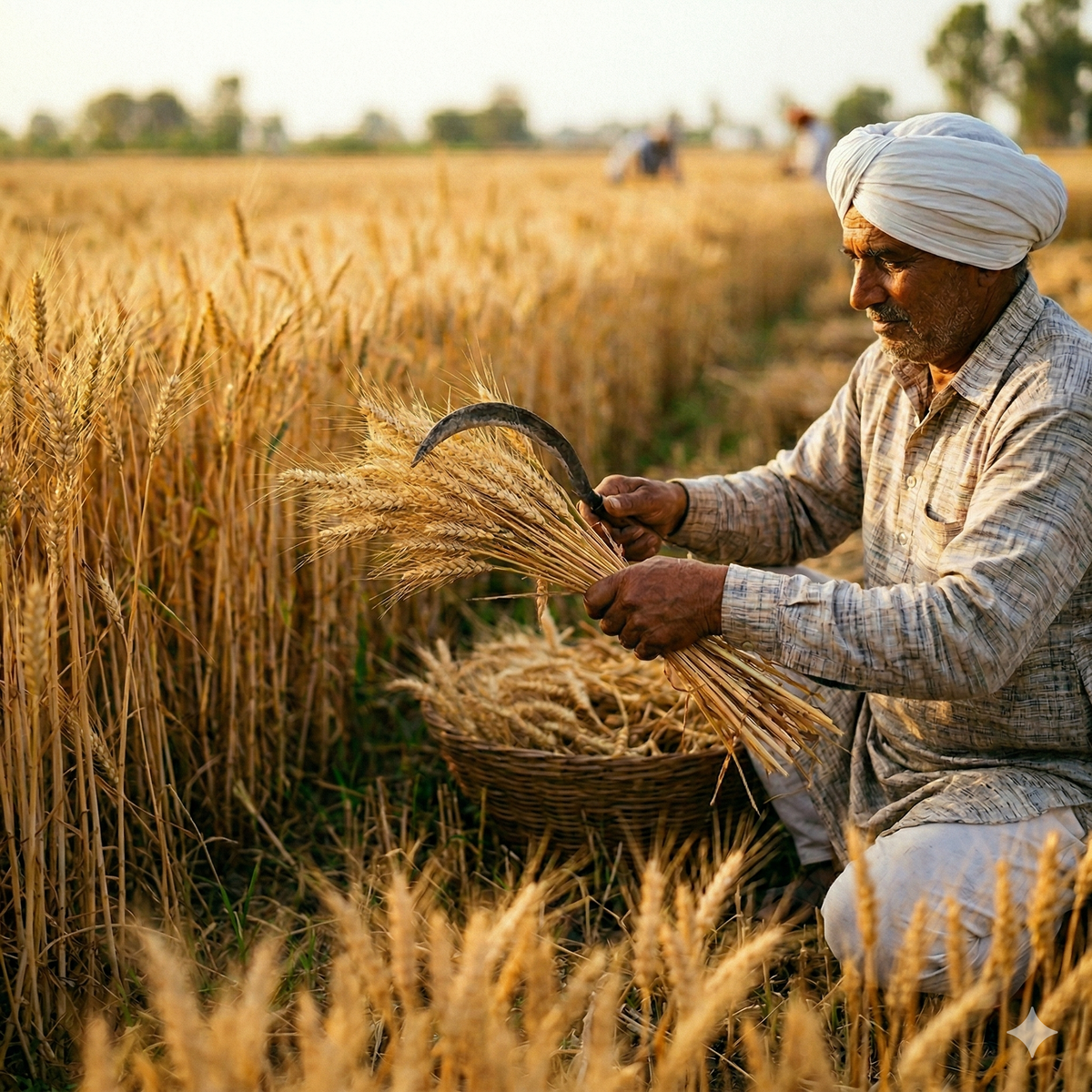
Men’s Voices:
Lord of the lotus, lord of the harvest,
Bright and munificent lord of the morn!
Thine is the bounty that prospered our sowing,
Thine is the bounty that nurtured our corn.
We bring thee our songs and our garlands for tribute,
The gold of our fields and the gold of our fruit;
O giver of mellowing radiance, we hail thee,
We praise thee, O Surya, with cymbal and flute.
Lord of the rainbow, lord of the harvest,
Great and beneficent lord of the main!
Thine is the mercy that cherished our furrows,
Thine is the mercy that fostered our grain.
We bring thee our thanks and our garlands for tribute,
The wealth of our valleys, new-garnered and ripe;
O sender of rain and the dewfall, we hail thee,
We praise thee, Varuna, with cymbal and pipe.
Women’s Voices:
Queen of the gourd-flower, queen of the harvest,
Sweet and omnipotent mother, O Earth!
Thine is the plentiful bosom that feeds us,
Thine is the womb where our riches have birth.
We bring thee our love and our garlands for tribute,
With gifts of thy opulent giving we come;
O source of our manifold gladness, we hail thee,
We praise thee, O Prithvi, with cymbal and drum.
All Voices:
Lord of the Universe, Lord of our being,
Father eternal, ineffable Om!
Thou art the Seed and the Scythe of our harvests,
Thou art our Hands and our Heart and our Home.
We bring thee our lives and our labours for tribute,
Grant us thy succour, thy counsel, thy care.
O Life of all life and all blessing, we hail thee,
We praise thee, O Bramha, with cymbal and prayer.
Sarojini Naidu
Important Words
| Word | Easy Meaning |
|---|---|
| hymn | A song of praise |
| munificent | Very generous |
| beneficent | Kind and helpful |
| bounty | Something given generously |
| tribute | Something offered to show respect |
| radiance | Bright light or glow |
| cherished | Loved and cared for |
| furrows | Long narrow lines made in soil for planting |
| garlands | Flowers joined together |
| opulent | Rich and abundant |
| manifold | Many or varied |
| ineffable | Too great to be described in words |
| succour | Help and support |
| counsel | Advice |
Who is Praised in the Poem?
| Speaker | Praised | Reason |
|---|---|---|
| Men | Surya | For sunlight and its role in the harvest |
| Men | Varuna | For rain and nourishment |
| Women | Prithvi | For giving food and supporting life |
| All Voices | Bramha | For life, creation, support and blessings |
Central Idea
The poem expresses gratitude to nature and the divine for providing sunlight, rain, fertile land, food and a successful harvest. It also respects the hard work of farmers and their dependence on nature.
(i) To whom do we offer a hymn?
(ii) When and where do we sing a hymn?
(iii) Why do we offer it?
Work in pairs. Read the sentences given below. Match the underlined archaic words in Column 1 with their meanings in Column 2. Share your answers with your classmates and teacher.
‘Thou art my friend, and I trust thee. Thy kindness is great, and everything that is mine is thine.’
| Column 1 | Column 2 |
|---|---|
| 1. thou | (iii) you (subject) |
| 2. art | (iv) are |
| 3. thee | (ii) you (object) |
| 4. thy | (v) your |
| 5. thine | (i) yours |
Under the golden 1. radiance of the evening sun, the villagers gathered to pay 2. tribute to their 3. cherished elder, who had dedicated his life to their well-being. His wise 4. counsel had guided generations, steering them through challenges. Known for his 5. munificent spirit, he never hesitated to share his resources generously.
2. tribute: respect
3. cherished: loved
4. counsel: advice
5. munificent: generous
1. The speakers recognise the lord’s kindness and praise him for nourishing the field.
2. The speakers praise the generosity of the creator of the universe who ensures a rich harvest.
3. The speakers devote their lives and work as a mark of respect to the lord and seek his support, wisdom, and care.
4. The speakers pay homage to the Earth and appreciate her role in supporting life, by dedicating their harvest.
1. The setting of the poem is a rural landscape, possibly during a __________________________ (harvest/religious) festival.
2. The tone of the poem is respectful and celebratory because it praises ___________________ (the men and women/nature and the Lord) with deep respect and gratitude.
3. In the line ‘Thou art our Hands and our Heart and our Home’, the letter ‘h’ is capitalised in ‘Hands’, ‘Heart’ and ‘Home’ because ___________________. (it represents the hard work of farmers/God resides in them)
• Bright and munificent lord of the morn!
• We bring thee our lives and our labours for tribute
imagery alliteration simile metaphor personification
| Column 1 | Column 2 | Column 3 |
|---|---|---|
| 1. sweet and omnipotent mother | (iii) the earth is being given human-like qualities | Personification |
| 2. The wealth of our valleys, new-garnered and ripe | (i) creates a clear description of the scene and appeals to the senses | Imagery |
| 3. Thou art the Seed and the Scythe | (ii) implied comparison of growth and reaping with beginning and end of all life | Metaphor |
| Column 1 | Answer |
|---|---|
| 1. Prithvi (the Earth) | (iii) fertile land, motherhood, nurturing—the source of all life |
| 2. Surya (the Sun) | (i) light, energy, life—representing the giver of warmth and prosperity |
| 3. Varuna (Rain) | (ii) mercy and nourishment—crucial for agriculture and sustenance |
1. “We bring thee our songs and our garlands for tribute…”
We bring thee our songs and our garlands for tribute,
The gold of our fields and the gold of our fruit;
O giver of mellowing radiance, we hail thee,
We praise thee, O Surya, with cymbal and flute.
(i) What does the act of bringing songs and garlands as tribute suggest about the people’s relationship with the divine?
A. They fear the gods and wish to calm them in any way possible.
B. They have a deep sense of reverence and gratitude towards the divine.
C. They are forced to perform rituals without understanding the divine.
D. They depend on the gods for their daily needs and activities.
(ii) Complete the following sentence suitably.
The word ‘gold’ in the phrases ‘the gold of our fields’ and ‘the gold of our fruit’ symbolises ________________.
(iii) How does the description ‘O giver of mellowing radiance’ help us understand Surya’s role in the harvest?
(iv) Fill in the blank by selecting the correct option from those given in the brackets.
The use of cymbal and flute signifies ________________. (joy and celebration/meditation and worship)
Lord of the Universe, Lord of our being,
Father eternal, ineffable Om!
Thou art the Seed and the Scythe of our harvests,
Thou art our Hands and our Heart and our Home.
(i) In the phrase ‘Lord of our being,’ what does the word ‘being’ most likely refer to?
A. Our physical body
B. Our entire existence
C. Our spiritual practices
D. Our earthly possessions
(ii) Identify whether the following statement is true or false.
The imagery of ‘the Seed and the Scythe’ symbolises the divine’s role as both the beginning (creation) and the end (harvest) of the agricultural cycle.
(iii) Identify the phrases from the extract that mean the following:
A. The divine as a timeless, everlasting presence
B. Beyond human comprehension or description
(iv) How do we know that these lines from the extract are spoken as a chorus?
1. Why do the farmers hail the God of rain?
2. What is being referred to as ‘wealth of our valleys’? Why?
3. State one reason why the women refer to the Earth as a ‘source of manifold gladness’.
4. Why does everyone in the poem offer their ‘labours for tribute’?
5. Why has the poet presented the poem as voices of men, women, and all voices?
6. How does the poet create the joyous atmosphere of rural India at harvesting time?
7. Why is the poem presented as a hymn?

| No. | Correct Use | Completed Name |
|---|---|---|
| 1. | (i) A tool with a long handle with metal teeth for collecting hay or leaves. | RAKE |
| 2. | (ii) A small hand tool used for digging and making shallow furrows. | TROWEL |
| 3. | (iii) A hand-held tool with a curved blade attached to a short handle. It is used for harvesting crops. | SICKLE |
| 4. | (iv) A tool pulled by oxen. It is used for turning over the soil in the field so that seeds can be sown or planted. | PLOUGH |
| 5. | (v) A farm tool having a flat rectangular blade attached to a long wooden handle used for digging the soil. | SPADE |
| 6. | (vi) A hand-held tool with a long-curved blade attached to a long handle used for cutting tall grass. | SCYTHE |
1. The king was beneficent to the poor because he took good care of them.
2. He was munificent towards the needy and donated a lot for their health care.
3. When he lost his job, all his friends gave him succour by supporting him with money.
4. When the sun’s rays came into the dark room, the whole room was full of radiance.
5. The little girl was speechless with ineffable joy when she got her birthday gift from her aunt.
1. morrow 2. hither 3. quoth
4. betwixt 5. yonder
2. hither – here or to this place
3. quoth – said
4. betwixt – between
5. yonder – over there
1. Rakesh was on his way home from school when he bought the cherries.
2. Rakesh was looking for Grandfather without finding him in any of his favourite places around the house.
3. Rakesh and Grandfather gazed at the tree as though it had performed a miracle.
The forms of tenses in the given statements are Simple Past Tense (1 and 3), Past Progressive Tense (2), and Past Perfect Tense (3).
Now, fill in the blanks with the correct form of Simple Past, Past Progressive, or Past Perfect Tenses of the verbs given in brackets. One example has been done for you.
(i) I was sitting (sit) with my grandparents in the garden, sharing the wonderful memories from my childhood. As we (ii) ______________ (talk), I (iii) ______________ (realise) how much wisdom they (iv) ______________ (impart) to me over the years. While I (v) ______________ (listen) to their stories for hours together, I (vi) ______________ (remember) the times we (vii) ______________ (spend) together planting flowers and learning about life. By the time I left, the sun (viii) ______________ (set), and I (ix) ______________ (feel) a deep sense of gratitude for the bond we (x) ______________ (nurture) through love, care, and countless memories.
(ii) were talking
(iii) realised
(iv) had imparted
(v) was listening
(vi) remembered
(vii) had spent
(viii) had set
(ix) felt
(x) had nurtured
• “Hey, not there,” said Grandfather, “I’ve sown mustard in that bed. Plant it in that shady corner, where it won’t be disturbed.”
• When Grandfather saw what had happened, he went after the woman and scolded her; but the damage could not be repaired.
• She did not try to avoid the tree: one sweep, and the cherry tree was cut in two.
Punctuation refers to the symbols used in writing to clarify meaning and separate sentences and their components. Proper punctuation ensures the clarity and flow of a text, guiding readers through its structure.
Common punctuation marks listed:
- Full stop (.)—ends a declarative sentence
- Comma (,)—separates components in a list, clauses, or phrases within a sentence
- Question Mark (?)—ends a direct question
- Exclamation Mark (!)—indicates strong emotion or emphasis
- Colon (:)—introduces a list, explanation or elaboration
- Semicolon (;)—connects closely related independent clauses or separates complex list items
- Apostrophe (’) — contractions and possession
- Quotation Marks (“ ”)—direct speech/quotations
- Dash (– or —)—emphasis or related thoughts
Now, punctuate the following paragraph appropriately.
every sunday roshni would visit her grandparents house on their farm
come sit grandpa would say patting the bench on their porch
roshni loved these moments where the world slowed down and stories flowed like magic grandma would bring tea her eyes twinkling with joy
im excited to hear about your younger days the adventures the lessons and the memories roshni said eagerly
grandpa smiled softly his wrinkled hands resting on the cane ah the old days… when everything was simple and happiness was all we had
roshni could feel the warmth of those memories he sat in silence bound not by words but by a timeless bond
Every Sunday, Roshni would visit her grandparents’ house on their farm.
“Come sit,” Grandpa would say, patting the bench on their porch.
Roshni loved these moments where the world slowed down and stories flowed like magic. Grandma would bring tea, her eyes twinkling with joy.
“I’m excited to hear about your younger days, the adventures, the lessons and the memories,” Roshni said eagerly.
Grandpa smiled softly, his wrinkled hands resting on the cane. “Ah, the old days… when everything was simple and happiness was all we had.”
Roshni could feel the warmth of those memories. He sat in silence, bound not by words but by a timeless bond.
| Event | Correct Number |
|---|---|
| 1. Transplanting of seedlings | 4 |
| 2. Ploughing of soil | 1 |
| 3. Threshing of grains | 6 |
| 4. Puddling of land | 2 |
| 5. Harvesting of paddy | 5 |
| 6. Irrigating the field | 3 |
| 7. Milling of rice | 7 |
1. What is the main step in preparing the soil for cultivation of rice?
(i) Ploughing the soil (ii) Clearing the soil (iii) Puddling the soil
2. How long does it take for rice seeds to grow into seedlings before being transplanted?
(i) 2–3 weeks (ii) 4–5 weeks (iii) 6–7 weeks
3. Why is drying rice grains important after threshing?
(i) To get rice seeds for plantation
(ii) To separate the rice grains easily
(iii) To store the rice grains for longer
• In the words given below the letter ‘n’ is silent when it appears with ‘m’ at the end of the word.
hymn, column, autumn, solemn
• In the words given below the letter ‘b’ is silent when it appears with ‘m’.
womb, tomb, bomb, climb, comb
hymn – him
column – kol-um
autumn – aw-tum
solemn – sol-em
womb – woom
tomb – toom
bomb – bom
climb – klime
comb – kome
Include the following:
- What is the dish called? Is it known by any other name in other parts of India?
- What ingredients are used to make the dish?
- How is the dish prepared?
- How is the dish served?
- What does the dish taste like?
- What is the special ritual related to the preparation of this dish?
- Describe any special memory associated with the preparation of this dish.
Good morning to all of you gathered here.
Today we are here to tell you about Khichdi, a simple and popular dish made in many parts of India during harvest celebrations.
It is prepared with rice, lentils, vegetables, spices and sometimes ghee. The ingredients are cooked together until soft. It is usually served hot with curd, pickle or vegetables.
Khichdi is soft, warm and tasty. It is also easy to prepare and share with family members.
Harvest festivals bring families together, and preparing traditional food is an important part of the celebration.
To conclude, traditional harvest dishes connect us with our food, farmers and culture.
Thank you for listening.
| Column 1 | Column 2 |
|---|---|
| Greet the audience | Good morning to all of you gathered here… |
| Introduce the members of your group and your topic | Today we, ____, ____ and ____ are here to tell you about… |
| Explain the structure of your presentation | We will start off with… Following this… The next point… Finally… |
| Speak about the first point | Let’s begin by… I’d like to start by… |
| Describe the details | Now I’ll move on to… Next… I’d like to now discuss… |
| Conclude your presentation | In conclusion, I’d like to say… To summarise… |
| Thank the audience | Thank you for listening. Thank you for your attention. |
- Education is the Key, Unlock Your Destiny!
- Protect the Environment Today for a Better Tomorrow
- Learn, Grow, Succeed
- Go Green by Keeping the Planet Clean
Your school wishes to express gratitude to the farmers who play an important role in providing us the food on our plates. Draft a creative slogan to be put up on the school notice board.
Farmers Feed the Nation — Respect Their Hard Work!
Remember to
- focus on the main idea to be expressed
- use simple language
- be concise—express yourself in a few words
1. Read the information on Pearl Millet given below.

| Information | Details |
|---|---|
| Common name | Bajra |
| English name | Spiked millet or Pearl millet |
| Vernacular names | Bajra, Bajree, Sajje, Kambu, Sajja |
| Energy | 347 Kcal per 100 grams |
| Protein | 10.9 g |
| Fat | 5.43 g |
| Carbohydrate | 61.8 g |
| Calcium | 27.4 mg |
| Iron | 6.4 mg |
| Uses | Khichdi, Roti, Upma, Idli, Khakhra, Parathas |
It is the sixth major cereal in terms of area and production and has the highest drought tolerance potential of all millets.
Health benefits: Reduces cholesterol, promotes bone health, may be useful in supporting heart health and is a fibre-rich food.
Use the link given below to know more about other kinds of millets.
(i) Find out if millets are a part of your cuisine.
(ii) Find recipes with millets and compile them into a booklet.
(iii) Create a recipe of your choice.
Ingredients: Bajra flour, warm water and a little salt.
Method: Mix the flour with warm water and make a soft dough. Prepare small rotis and cook them on a hot tawa. Serve hot with vegetables, curd or dal.
I would talk to an elder in my family and learn a traditional harvest song. I would write down the song, find out the festival associated with it and share its meaning with my classmates. All the collected songs could then be arranged into a class songbook.
| Question | Answer |
|---|---|
| Who wrote “Harvest Hymn”? | Sarojini Naidu |
| What is a hymn? | A song of praise |
| Who is Surya? | The Sun |
| Who is Varuna? | The rain-giving divine force |
| Who is Prithvi? | The Earth |
| What does the harvest represent? | Nature’s abundance and the result of farmers’ labour |
| What is the main message? | Be thankful to nature, the divine and the people whose labour provides food. |
The poem teaches us to respect farmers, value nature and be grateful for the food and resources that make life possible.
Prepare this worksheet to practise important questions and revision exercises from Chapter11. It will help you understand the chapter, revise key concepts, and prepare effectively for tests and exams.
Class 8 English Chapter 11, Harvest Hymn, Class 8 English Chapter 11 Notes, Harvest Hymn Notes and Solutions, Class 8 English Chapter 11 Book Solutions, Harvest Hymn Questions and Answers, NCERT Class 8 English, NCERT Class 8 English Poorvi, CBSE Class 8 English, Class 8 English Notes, Class 8 English Book Solutions, Class 8 English Study Material, Class 8 English Revision Notes, Harvest Hymn Class 8