Class 8 English Chapter 10 – The Cherry Tree with easy NCERT Poorvi Notes and complete Book Solutions. Get a simple summary, important concepts, questions and answers, and revision material to help understand the chapter and prepare for exams.
Class 8 English Poorvi
Unit 4 – Environment
The Cherry Tree – Ruskin Bond
The Cherry Tree is a beautiful story by Ruskin Bond about Rakesh, a young boy who plants a cherry seed and watches it grow into a strong tree.
Rakesh lives with his grandfather in Mussoorie. One day, after eating cherries, he keeps one seed. His grandfather tells him that if he wants luck, he should put the seed to some use. Rakesh plants it in a shady corner of the garden.
After some time, the seed grows into a tiny cherry tree. Rakesh begins to care for it. The tree faces many difficulties. A goat eats its leaves and later a woman accidentally cuts it in two while cutting grass. However, the tree does not die. It grows new shoots and becomes stronger.
As the years pass, both Rakesh and the cherry tree grow. The tree survives snow, insects and other difficulties. Finally, it produces beautiful pale pink blossoms. Rakesh and his grandfather feel amazed and proud.
At the end, Rakesh understands that the tree is special because they planted it themselves. The story teaches us about patience, care, hard work, growth, resilience and our close relationship with nature.

Author: Ruskin Bond
Genre: Short story
Main characters: Rakesh and his Grandfather
Setting: The Himalayan foothills near Mussoorie
Main idea: A small seed can grow into something beautiful when nature is given time and care.
Main Themes
- Love and care for nature
- Patience and perseverance
- Growth and development
- Bond between grandparents and grandchildren
- Respect for plants and living things
- Human connection with nature
Important Characters
Rakesh: A curious and caring boy who plants the cherry seed and watches the tree grow.
Grandfather: A wise and loving person who guides Rakesh and teaches him about nature, effort and patience.
Important Events
- Rakesh buys cherries from the Mussoorie bazaar.
- He keeps the last cherry seed.
- Grandfather tells him to plant the seed.
- The seed grows into a tiny tree.
- Rakesh waters and protects the tree.
- A goat eats its leaves.
- A woman cuts the tree in two.
- The tree grows again.
- The tree produces its first pink blossom.
- The tree becomes special to Rakesh and Grandfather because they planted it themselves.
I Work in pairs and answer the questions that follow. Share your answers with your classmates and teacher.
II What kind of trees do people plant in their homes? Why is it important to plant trees?
III Name some fruit trees that grow in your region. What type of conditions help these fruit trees to grow?
Rakesh was six years old when he bought cherries from the Mussoorie bazaar. He lived with his grandfather because there was no school in his village.
The Himalayan foothills had stony soil and cold winds, so fruit trees did not grow easily. Rakesh kept a cherry seed after eating the fruit.
Grandfather told him that luck becomes useful only when we put it to some use. Therefore, Rakesh planted the seed in a shady corner of the garden.
He forgot about the seed for some time. In spring, he discovered a tiny cherry tree. Grandfather told him to water it. Rakesh cared for it and surrounded it with pebbles.
The tree grew quickly during the monsoon. A goat ate its leaves, but Grandfather told Rakesh that cherry trees were tough.
I Arrange the events in order of occurrence in the story.
- Rakesh’s parents grew maize, rice, and barley in a village. (1)
- Rakesh was sent to live with his grandfather in Mussoorie. (2)
- Rakesh bought a bunch of cherries and ate most of them. (3)
- Rakesh kept rolling the last cherry seed in his mouth. (4)
- Rakesh pressed the cherry seed into the soft soil with his thumb. (5)
- Rakesh discovered that the small, well-rooted twig, had grown into a cherry tree. (6)
- Rakesh sprinkled water on the cherry tree and surrounded it with pebbles. (7)
- The cherry tree grew quickly after the rains arrived early. (8)
- A goat entered the garden and ate all the leaves of the young cherry tree. (9)
- Grandfather told Rakesh that cherry trees were tough. (10)
The cherry tree continues to face difficulties. A woman cutting grass accidentally cuts the tree in two. Rakesh thinks it may die, but the tree grows new shoots.
Rakesh also grows taller and stronger. He continues to care for the tree. Different insects and birds visit it.
The tree survives the winter snow and later produces its first pale pink blossom. In the following years, it becomes taller than Rakesh and even taller than Grandfather.
Bees visit its flowers and birds eat its cherries. Grandfather enjoys sitting under its shade.
At the end, Rakesh asks why this tree is so special when there are many trees in the forest. Grandfather explains that it is special because they planted it themselves.
I Complete the table given below based on your understanding of Part II of the story. One example has been done for you. Share your answers with your classmates and teacher.
| Cause | Effect |
|---|---|
| 1. A woman cut the cherry tree while cutting grass. | (i) Grandfather scolded the woman. |
| 2. Rakesh went to his village to help his parents with planting and ploughing. | (ii) Rakesh was thinner but stronger when he came back. |
| 3. A hairy caterpillar started eating the leaves of the cherry tree. | (iii) Rakesh removed the caterpillar and dropped it on a heap of dry leaves. |
| 4. A pale pink blossom appeared on the cherry tree. | (iv) Rakesh and Grandfather gazed at the tree as though it was a miracle. |
| 5. Rakesh tasted one of the small cherries during summer. | (v) He spat it out because it was too sour. |
I Read the given extracts and answer the questions that follow.
1. “Have a cherry, Grandfather,” he said, as soon as he saw his grandfather in the garden.
Grandfather took one cherry and Rakesh promptly ate the other two. He kept the last seed in his mouth for some time, rolling it round and round on his tongue until all the tang had gone. Then he placed the seed on the palm of his hand and studied it.
“Are cherry seeds lucky?” asked Rakesh.
“Of course.”
“Then I’ll keep it.”
“Nothing is lucky if you put it away. If you want luck, you must put it to some use.”
2. Winter came early. The cherry tree bent low with the weight of snow. Field-mice sought shelter in the roof of the cottage. The road from the valley was blocked, and for several days there was no newspaper, and this made Grandfather quite grumpy. His stories began to have unhappy endings.
In February it was Rakesh’s birthday. He was nine—and the tree was four, but almost as tall as Rakesh.
II Answer the following questions.
I Each word list has one word that does not match with the other words. Identify the odd word. One example has been done for you.
II Choose the most suitable taste words given in the box below and write against the food items that follow.
- The mango is sweet.
- The lemon is sour.
- Neem leaves are bitter.
- The pickle is tangy.
- The soup is salty.
III Choose the correct antonyms for the textual words given below from the box. There are two extra words that you will not need.
2. sturdy 6. grumpy
3. narrow 7. sheltered
4. warmth 8. special
- tender — hard
- sturdy — shaky
- narrow — wide
- warmth — coldness
- feasting — fasting
- grumpy — cheerful
- sheltered — unprotected
- special — ordinary
IV Read the following lines from the text and underline all the verbs and identify the form of tense.
- I was sitting (sit) with my grandparents in the garden.
- As we were talking (talk),
- I realised (realise) how much wisdom they
- had imparted (impart) to me over the years.
- While I was listening (listen) to their stories for hours together,
- I remembered (remember) the times we
- had spent (spend) together planting flowers and learning about life.
- By the time I left, the sun had set (set),
- and I felt (feel) a deep sense of gratitude for the bond we
- had nurtured (nurture) through love, care, and countless memories.
V Study the punctuation marks in the following sentences from the text.
Full stop: ends a statement.
Comma: separates words, phrases or clauses.
Question mark: ends a direct question.
Exclamation mark: shows strong feeling.
Colon: introduces an explanation or list.
Semicolon: connects closely related clauses.
Apostrophe: shows possession or contractions.
Quotation marks: show direct speech.
Dash: adds emphasis or separates related thoughts.
Every Sunday, Roshni would visit her grandparents’ house on their farm.
“Come sit,” Grandpa would say, patting the bench on their porch.
Roshni loved these moments where the world slowed down and stories flowed like magic. Grandma would bring tea, her eyes twinkling with joy.
“I’m excited to hear about your younger days, the adventures, the lessons and the memories,” Roshni said eagerly.
Grandpa smiled softly, his wrinkled hands resting on the cane. “Ah, the old days… when everything was simple and happiness was all we had.”
Roshni could feel the warmth of those memories. He sat in silence, bound not by words but by a timeless bond.
- 2. The son was surprised to know about the Appiko Movement.
- 3. The son agreed that the Chipko Movement was about people uniting to make an impact.
- 5. The mother was curious to hear about Saalumarada Thimakka.
- 7. The son found the information on Jadav Payeng wonderful.
I Work in pairs. Read aloud the following words from the text. Write the number of syllables in each word. Check your answers with your classmates and teacher.
| Word | Syllables | Break-up |
|---|---|---|
| mountains | 2 | moun-tains |
| grandfather | 3 | grand-fa-ther |
| tender | 2 | ten-der |
| disturbed | 2 | dis-turbed |
| caterpillar | 4 | cat-er-pill-ar |
| Himalayan | 4 | Hi-ma-la-yan |
| performed | 2 | per-formed |
| intention | 3 | in-ten-tion |
| slope | 1 | slope |
| newspaper | 3 | news-pa-per |
| favourite | 3 | fa-vour-ite |
II Speak about Van Mahotsav Diwas and its significance. Before you speak in the class or assembly, prepare yourself on the following points:
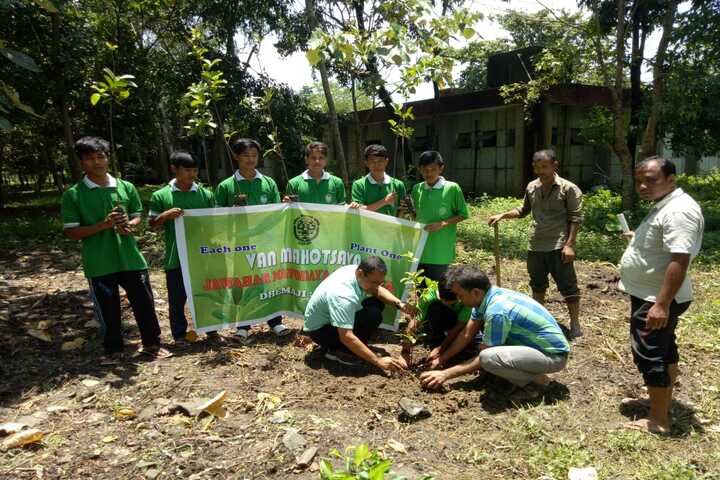
Now, complete the article for a magazine on ‘Trees–Our Lifeline’. Use the words and phrases given in the box below.
Moreover, our planet
reduces pollution
Additionally
would stop existing
ensures a better future
climate control
Trees–Our Lifeline
To conclude
If trees were not there
Answers:
- Trees–Our Lifeline
- would stop existing
- absorb carbon dioxide
- reduces pollution
- Additionally
- climate control
- If trees were not there
- Moreover, our planet
- To conclude
- ensures a better future
Trees–Our Lifeline
By – [Write your name and class]
Trees are essential for life on Earth. Without them, life as we know would stop existing. This is the reason why trees are our lifeline.
Trees provide us with food, shelter, and even medicine. Trees absorb carbon dioxide and release oxygen, helping us breathe. This process also reduces pollution and keeps the environment clean. Additionally, trees give us fruits, nuts, and other foods. Trees also help in climate control and prevention of soil erosion.
If trees were not there, the air would be polluted, and we would struggle to breathe. Moreover, our planet would be barren, lacking food, shelter, and life-giving greenery.
To conclude, trees are true friends. Protecting and planting trees ensures a better future for everyone on Earth. Therefore, we must act now to protect and plant more trees, preserving Earth’s green lifeline for future generations.
Rakesh saw the V-shaped formation of wild ducks flying northward.
Birds often fly in a V-shaped formation because it helps them use uplifting air currents and save energy while travelling long distances.
I Did you know that the banyan tree is the National Tree of India? Our country has age-old banyan trees. Some of them are:

II Kailash Sankhala, ‘The Tiger Man of India’, was an Indian biologist and conservationist. He carried out a census of the tigers in India in 1971. Later, because of his studies, he was appointed the first director of Project Tiger—an initiative to prevent the extinction of the Indian Tiger. He was awarded the Padma Shri in 1992.
Now, find more information about such Indian environmentalists and share with your classmates.
Saalumarada Thimakka: She is known for planting and caring for thousands of trees.
Jadav Payeng: He is known for creating and protecting a large forest in Assam through years of tree planting and environmental work.
Sunderlal Bahuguna: He was an environmentalist associated with the Chipko Movement and the protection of forests.
- Rakesh lived with his grandfather in Mussoorie.
- He planted a cherry seed after his grandfather advised him to use it.
- The seed grew into a cherry tree.
- The tree survived a goat, a grass cutter, snow and insects.
- Rakesh cared for the tree as it grew.
- The tree produced beautiful pink blossoms.
- Rakesh and the tree grew together.
- The tree was special because Rakesh and Grandfather had planted it themselves.
- The story teaches patience, care, perseverance and love for nature.
- Humans and nature share a close relationship.
Prepare this worksheet to practise important questions and revision exercises from Chapter10. It will help you understand the chapter, revise key concepts, and prepare effectively for tests and exams.
Class 8 English Chapter 10, The Cherry Tree, Class 8 English Chapter 10 Notes, The Cherry Tree Notes and Solutions, Class 8 English Chapter 10 Book Solutions, The Cherry Tree Questions and Answers, NCERT Class 8 English, NCERT Class 8 English Poorvi, CBSE Class 8 English, Class 8 English Notes, Class 8 English Book Solutions, Class 8 English Study Material, Class 8 English Revision Notes, The Cherry Tree Class 8 Worksheet