Class 7 Khel Yatra Unit 6 Chapter 4 – Prāṇāyāma with easy Notes, Solutions, Questions & Answers and Worksheet. Learn important concepts and practices related to Prāṇāyāma with simple Class 7 Khel Yatra study material.
Class 7 Khel Yatra
Chapter 4 – Prānāyāma
Notes, Easy Solutions and Activities
Reprint 2026–27 | Pages 196–213
Prānāyāma
Prānāyāma is the fourth aspect of Ashtāṅga Yoga. It is the practice of consciously controlling and directing our breath.
The word Prāṇāyāma comes from two words: ‘Prana’ means vital energy and ‘Yama’ means to control or extend.
Thus, Prānāyāma is a way by which we consciously control and direct our breath.
Why is Prānāyāma Important for Students?
Just like healthy food helps us stay physically fit, Prānāyāma practices can help keep the body energised and the mind calm.
It is especially helpful for students because it can support focus during studies, calmness during exams and energy for sports or daily activities.
Benefits of Prānāyāma
- Improves concentration.
- Helps us feel more energised.
- Reduces stress.
- Calms the mind.
Try practising Prānāyāma for a few minutes every morning.
Prānāyāma Practices
1. Sectional Breathing
Sectional breathing is a preparatory breathing practice for Prānāyāma. It corrects the wrong breathing pattern and increases the vital capacity of the lungs.
2. Nādīśuddhi Prānāyāma
Nādīśuddhi Prāṇāyāma is a simple and powerful technique that balances the flow of Prānā and cleans the subtle energy channels.
3. Bhrāmarī Prānāyāma
Bhrāmarī Prāṇāyāma is a calming technique which has a soothing effect on the mind and nervous system.
Bhrāmarī Prānāyāma with Shanmukhi Mudra
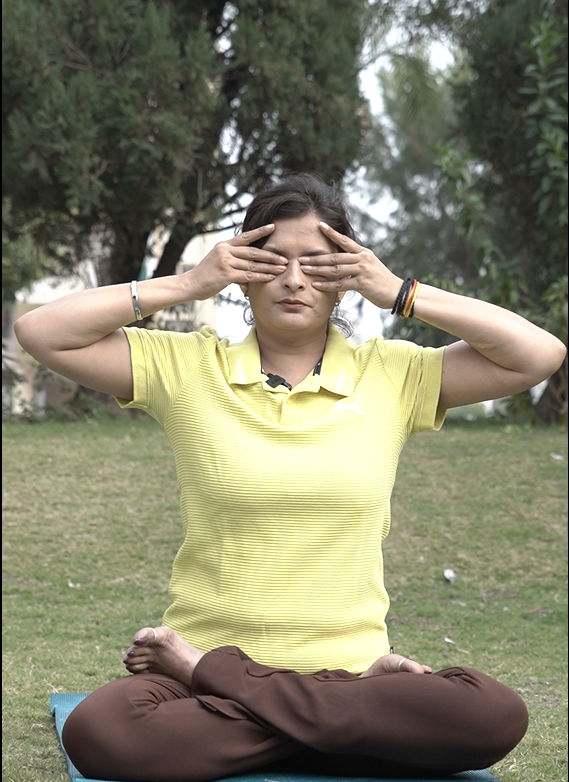
What is Shanmukhi Mudra?
Shanmukhi means six gates or faces. Shanmukhi Mudra involves redirecting awareness inside by closing the six doors of outer perception: the two eyes, the two ears, the nose and the mouth.
This practice promotes a state of Pratyāhāra. The six gates of perception in the head are gently closed with the fingers of both hands.
Stepwise Practice
1 Sit comfortably
Sit in Sukhāsana with the spine erect, face smiling and eyes gently closed.
2 Position the hands
Raise both arms to shoulder level, bend the elbows and close the ears with the thumbs.
3 Place the fingers
Place the index finger gently on the eyelids, middle finger on both nostrils and ring and small finger above and below the lips as shown in the picture.
4 Inhale
Inhale slowly and deeply and fill the lungs completely.
5 Make the humming sound
As you exhale, make a steady, low-pitched humming sound like a bee. This is the Makara sound from Omkāra chanting.
6 Feel the vibration
Feel the vibration of the sound resonate throughout your head and body. Repeat the practice five times.
Benefits of Shanmukhi Mudra
- Calms the mind and nervous system.
- Balances internal and external awareness.
- Enhances focus.
- Helps in managing anxiety.
- Ask the students whether they could feel the resonance during the practice.
- Ask about their state of mind after the practice.
Bhastrikā Prānāyāma

Bhastrikā is a special breathing exercise that gets its name from ‘bellows’, because it is like breathing in and out like a bellows.
It can be practised slowly or quickly, according to what feels comfortable.
During Bhastrikā, the breathing is deep and full. The chest is used like a bellows to breathe in and out strongly.
There are two parts to Bhastrikā. The first part is like a cleansing breath, while the second part is slower and calmer.
Stepwise Practice of Bhastrikā Prānāyāma
1 Comfortable Posture
Sit in a comfortable posture such as Sukhāsana or Vajrāsana. Keep the head and spine straight, close the eyes and relax the whole body.
2 Deep Inhalation
Take a deep breath through both nostrils and fill the lungs with air.
3 Exhalation
After full inhalation, quickly exhale continuously for 5 times. This completes one round of Bhastrikā.
4 Complete Three Rounds
Continue this practice for 3 rounds.
Benefits
- Strengthens the lungs.
- Improves blood circulation.
- Relaxes the body and mind.
- Improves concentration.
Mudras – Introduction to Hand Mudras
Mudras are special hand gestures that help connect our body, mind and energy.
The word mudra means ‘gesture’ or ‘seal’ in Sanskrit.
People have used mudras for a long time as part of practices intended to support physical and mental well-being.
Jnana Mudra

Jnana Mudra is an important and simple mudra which calms the mind.
Stepwise Practice of Jnana Mudra
1 Sit comfortably
Sit in a comfortable posture such as Sukhāsana or Vajrāsana or on a chair with the back straight.
2 Place the hands
Place your hands on the thighs with your palms facing upward.
3 Touch thumb and index finger
Gently touch the tip of the thumb with the tip of the index finger. Do not press hard.
4 Stretch the other fingers
Stretch the other fingers straight and keep the palm facing upward.
5 Focus on the breath
Keep your focus on your breath.
6 Practise regularly
Practise it for 10 minutes every day.
Benefits
- Reduces mental tension, anger and stress.
- Increases memory power.
- Gives energy to the brain and muscles.
Pratyāhāra
Pratyāhāra is the 5th step of Ashtāṅga Yoga. It teaches us how to reduce distractions and turn our attention inward.
Pratyāhāra can help us develop concentration and remain calm.
Activity to Develop Focus by Engaging Your Ear to the Sound of a Bell
Let us listen to the sound of a temple bell. Listen closely as it starts with a strong ‘bong!’ and then continues to ring.
Notice how the ringing changes. It might be loud at first and then become softer and softer until it finally disappears.
Try to feel the vibrations of the sound within you.
Dhārana – Single Point Concentration
Dhārana means single point concentration and involves keeping the mind steady and focused.
Dhārana is like training the mind to pay attention to just one thing. For example, we can focus on our breath or a word and try not to let the mind wander.
Dhārana, along with Dhyāna, helps develop inner peace and is an important part of Yoga.
Jatru Trataka

In the previous grade, we learnt about Jatru Trataka, which improves our focus. In this grade, the practice continues.
Jatru Trataka is yogic gazing that helps to bring one-pointed concentration or focus.
Before starting, it is a good idea to cleanse the eyes with cold water.
Cleansing of Eyes Using the Palms
- Wash your hands thoroughly with soap.
- Make a cup of your right palm and fill it with clean water.
- Immerse your right eyeball in this water.
- Blink the eyes for a few rounds.
- Repeat the same practice with the left eye.
Jatru Trataka – Stepwise Practice
1 Starting Position
Sit in Vajrāsana or Sukhāsana comfortably. Keep your eyes open and hands on the thighs.
2 Stretch the Hands
Stretch both hands in front. Make fists with the thumbs raised upwards.
3 Move the Hands Sideways
Move both hands towards both shoulders parallel to the ground. Keep gazing at the tips of the thumbs.
Stretch the hands sideways as far as possible until the reach of the vision.
4 Return the Hands
Maintain this position for a while. Slowly move the hands back to the original position while gazing at the tips of the thumbs.
Do not move the head. Move only the eyeballs sideways.
Repeat this practice for 3–5 rounds.
5 Palming and Relaxation
After the practice, do simple palming and relax in Vajrāsana or Sukhāsana.
Simple Palming Procedure
- Rub both palms until they become warm.
- Cup your palms and place them gently over the eyes.
- Do not put pressure on the eyeballs.
- Keep your eyes closed.
- Keep the palms on the eyes for 10–15 seconds.
- Gently lift the palms.
Benefits
- Sideways viewing relaxes the muscles around the eyes.
- The textbook states that it prevents and corrects squint.
- The textbook states that it improves eyesight, vision and concentration.
- Ensure that students remove their glasses and wrist watches.
- Encourage students to sit with the head, neck and spine erect.
- Always open the eyes with a few blinks.
- Ensure palming is done after each practice.
- For up-and-down and right-and-left movement of Jatru Trataka, refer to the Khel Yatra Grade 6 textbook.
Dhyāna
Dhyāna means meditation. When the mind becomes calm and still after focused concentration, this is Dhyāna.
Dhyāna helps us feel peaceful inside, even when things around us are noisy or chaotic.
Both Dhārana and Dhyāna can help us focus better in school, stay calm during exams and feel more peaceful in everyday life.
Simple Meditation Exercise
1 Sit comfortably
Sit in Sukhāsana or Vajrāsana with the spine erect and eyes closed.
2 Observe the breath
Slowly move your awareness to your breath. Observe your breathing for a few seconds as you breathe in and breathe out.
3 Return attention gently
If thoughts come into your mind, do not worry. Gently bring your attention back to your breath.
4 Practise
Practise for a few minutes. Focus on your breath and allow your mind to become calm and peaceful.
Panchakosha Meditation

Just like a house has different rooms such as the living room, kitchen and bedroom, our bodies also have different layers.
In this grade, Panchakosha meditation takes us on an inner journey to explore these layers within ourselves.
1. Annamaya Kosha
The physical body.
We become aware of the head, shoulders, chest, waist, back, abdomen, arms and legs.
2. Pranamaya Kosha
The layer connected with the breath and life force.
We observe the air entering and leaving the nostrils and become aware of breathing.
3. Manomaya Kosha
The mental layer.
We observe thoughts and sensations without immediately reacting to them.
4. Vijnanamaya Kosha
The wisdom layer.
We connect with inner wisdom and ask ourselves: “What brings me joy”.
5. Anandamaya Kosha
The bliss layer.
We become deeply relaxed and experience a sense of stillness, silence, happiness and gratitude.
Step-by-Step Practice of Panchakosha Meditation
1 Prepare
Sit comfortably in Sukhāsana with the head, neck and spine in a straight line. Keep the body relaxed.
2 Annamaya Kosha
Gently close your eyes and become aware of your surroundings and sounds.
Scan your body and notice sensations or areas of tension without judgement.
This is your Annamaya Kosha, the physical body. Observe it for a few seconds and relax the physical body.
3 Pranamaya Kosha
Shift your focus to your breath. Bring awareness between your nostrils and observe the air entering and leaving as you breathe.
Observe the breathing become slower, continuous and rhythmic. This is your Pranamaya Kosha.
4 Manomaya Kosha
Observe the thoughts that arise in your mind. Notice how they come and go like clouds in the sky.
Gently bring your attention back to your breath. Notice sensations such as the desire to move or an itching sensation.
This mental chatter is connected with your Manomaya Kosha.
5 Vijnanamaya Kosha
Try not to respond to distractions. Continue observing your breath.
Connect with your inner wisdom and ask yourself: “What brings me joy”.
Gently listen to the inner guidance that arises. This is your Vijnanamaya Kosha.
6 Anandamaya Kosha
Shift your awareness deep inside. Centre your awareness on your heart and relax deeply.
Keep breathing smoothly and evenly. Allow yourself to settle into a state of complete tranquillity.
Enjoy the sense of joy and gratitude within you. This is your Anandamaya Kosha.
7 Return Awareness
Return your awareness to your breath and become aware of your surroundings. Observe that your breathing is slow and continuous.
Take a moment to relax and absorb the experience before getting up.
8 Finish the Practice
Gently rub your palms, place them on your eyes and open your eyes into your palms.
Benefits of Panchakosha Meditation
- Calms the mind and reduces stress.
- Improves focus and self-awareness.
- Brings peace and happiness.
- Encourage students to share their experiences with meditation.
- Let students focus on their breath and observe their thoughts and feelings during the practice.
Samādhi
Samādhi is described in the chapter as the ultimate state of consciousness.
It is described as a state beyond ordinary thought in which one is aware of oneself and connected with one’s true nature of love, joy and strength.
Krīdā Yoga
Yoga is a process for all-round personality development. Krīdā Yoga means Yoga through games.
It is a fun and active way to practise Yoga through different playful activities.
Krīdā Yoga combines Yoga movements with games to develop flexibility, strength and focus while having fun with classmates.
These games can also help students become aware of themselves and develop that awareness.
Yoga of Reflection
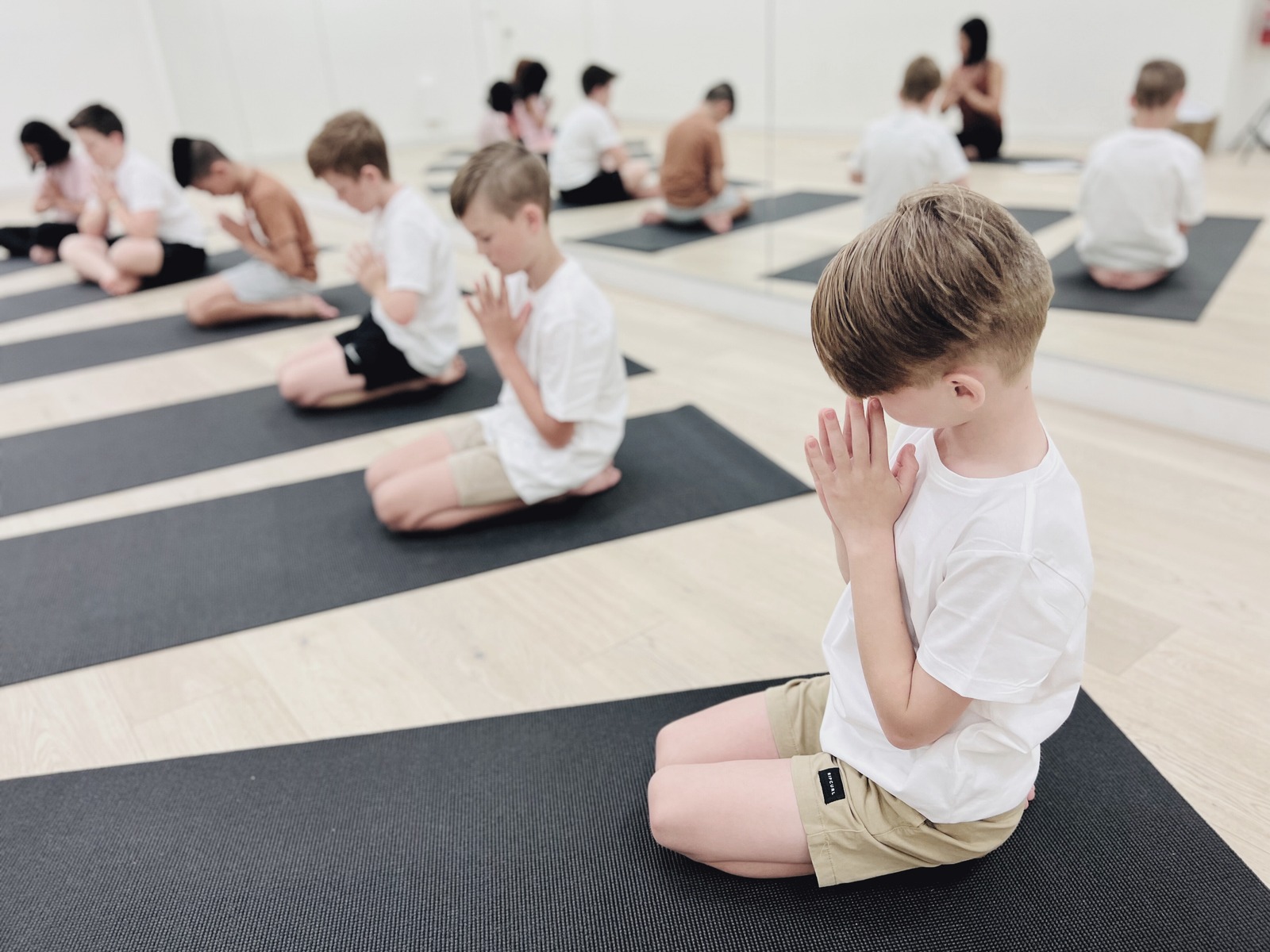
Yoga of Reflection is an indoor game normally played in groups.
This game develops focus and mindfulness by copying the movements of opponents.
It also improves concentration, body awareness and coordination.
How to Play
1 Divide the class
Divide the class into two groups.
2 Pair up
Let the students pair up and face each other.
3 Mirror the movement
One student leads and performs a Yoga pose or movement slowly, while the other student tries to mirror the movement exactly.
4 Change roles
Each student maintains the pose for 1 minute. Then the other student mirrors the pose for 1 minute.
- The game should be played for a maximum of 5 minutes.
- Variations are encouraged to make the game interesting.
- Ensure all students participate.
Learnings from this Game
- Promotes active engagement and focus.
- Promotes physical and mental stability.
- Encourages body awareness.
- Improves communication skills.
- Strengthens trust and cooperation.
- Promotes patience and resilience.
Assessment for Yoga Unit
1. Yoga for Daily Life
Match the Following
| Column A | Column B |
|---|---|
| 1. Annamaya Kosha | (c) Physical Sheath |
| 2. Pranamaya Kosha | (e) Energy Sheath |
| 3. Manomaya Kosha | (a) Mind Sheath |
| 4. Vijnanamaya Kosha | (b) Wisdom Sheath |
| 5. Anandamaya Kosha | (d) Bliss Sheath |
Answer the following
List the practices you were able to do for each kosha
| Kosha | Your Practice |
|---|---|
| 1. Annamaya Kosha | ________________________________ |
| 2. Pranamaya Kosha | ________________________________ |
| 3. Manomaya Kosha | ________________________________ |
| 4. Vijnanamaya Kosha | ________________________________ |
| 5. Anandamaya Kosha | ________________________________ |
2. Yoga Sadhana – Yoga Riddles
1 In this pose, you pretend to sit, with strength in your thighs, you will benefit. Named after a chair but without one in sight, Which yoga pose am I right?
Answer: Utkaṭāsana
2 I stand tall like a tree, With my arms reaching high, My legs are firm and strong, I am a pose; can you tell me why?
Answer: Tree posture / Vrikshāsana.
3 I am a pose that makes you strong, Like a brave warrior, all day long. Kneeling down with legs spread wide, My name is spoken with pride.
Answer: Warrior posture as intended by the riddle.
4 I have two heads but only one face. I give strength and grace to your shoulders. My name comes from a cow’s head; it’s true, But I help you stretch and feel brand new.
Answer: Gomukhasana
5 I stretch your back, Like a bow, you bend without any crack. Your hands hold your feet with a strong grip, What am I? Be careful, you can quickly slip!
Answer: Sarala Dhanurasana
6 I stand on my shoulders with the head resting on the ground, A pose of strength and balance all around. In Sanskrit, my name means “every part,” What am I, young friend? Speak from your heart.
Answer: Sarvāṅgāsana
7 I am a pose that makes you calm and free, Like a fish in water, that’s the key. My name comes from the Sanskrit word for fish, Can you guess what pose I wish?
Answer: Matsyāsana
2. Gomukhasana
3. Sarala Dhanurasana
4. Sarvāṅgāsana
5. Matsyāsana
Prāṇāyāma Riddles
1 I am a breathing practice known to calm the mind. I clear the air passages, leaving worries behind. I balance the energies with each inhale and exhale.
Answer: Nadi Shuddhi Prāṇāyāma
2 I am a breathing exercise known for its buzzing sound. I help calm the mind and bring peace around. My name is derived from a buzzing bee, What am I, can you tell, and set your mind free?
Answer: Bhramari Prāṇāyāma
Evaluation for Āsana
| Criteria | Excellent (4 points) | Good (3 points) | Fair (2 points) | Needs Improvement (1 point) | Points Earned | Teacher’s Comments |
|---|---|---|---|---|---|---|
| Correct identification of asanas | Correctly identifies all asanas. | Correctly identifies 5–6 asanas. | Correctly identifies 3–4 asanas. | Correctly identifies 2 or fewer asanas. | ||
| Understanding of Asana Descriptions | Demonstrates clear comprehension of all riddle clues and connects them to the correct asanas. | Demonstrates good comprehension of most riddle clues and makes accurate connections. | Demonstrates basic comprehension but struggles with some clues. | Demonstrates limited comprehension of the riddle clues. | ||
| Participation and Engagement | Shows strong engagement and enthusiasm in solving the riddles. | Shows good engagement and participates actively. | Shows moderate engagement and participates passively. | Shows limited engagement and minimal participation. |
Evaluation for Prānāyāma
| Criteria | Excellent (4 points) | Good (3 points) | Fair (2 points) | Needs Improvement (1 point) | Points Earned | Teacher’s Comments |
|---|---|---|---|---|---|---|
| Correct identification of Prāṇāyāma | Correctly identifies both Prāṇāyāma practices. | Correctly identifies one Prāṇāyāma practice. | Attempts to answer but both answers are incorrect. | Does not attempt to answer. | ||
| Understanding of Prāṇāyāma Descriptions | Demonstrates clear comprehension of all riddle clues and connects them to the practices. | Demonstrates good comprehension of most riddle clues and makes accurate connections. | Demonstrates basic comprehension but struggles with some clues. | Demonstrates limited comprehension of the riddle clues. | ||
| Participation and Engagement | Shows strong engagement and enthusiasm in solving the riddles. | Shows good engagement and participates actively. | Shows moderate engagement and participates passively. | Shows limited engagement and minimal participation. |
Quick Revision
| Topic | Remember |
|---|---|
| Prānāyāma | Fourth aspect of Ashtāṅga Yoga; conscious control and direction of breath. |
| Sectional Breathing | Preparatory breathing practice. |
| Nādīśuddhi | Balances the flow of Prānā. |
| Bhrāmarī | Breathing practice with a humming sound. |
| Shanmukhi Mudra | Six-gate hand position used with Bhrāmarī in this chapter. |
| Bhastrikā | Bellows-like breathing practice; one round includes 5 continuous exhalations in the supplied textbook steps. |
| Jnana Mudra | Thumb and index finger gently touch. |
| Pratyāhāra | Fifth step of Ashtāṅga Yoga. |
| Dhārana | Single-point concentration. |
| Jatru Trataka | Yogic gazing practice for focus. |
| Dhyāna | Meditation and calmness of mind. |
| Panchakosha | Five layers explored through meditation. |
| Samādhi | Described as the ultimate state of consciousness. |
| Krīdā Yoga | Yoga through games. |
Important Practice Guidelines
- Practise under proper teacher guidance.
- Follow the textbook steps carefully.
- Do not use jerky movements during Bhastrikā.
- Students with low stamina should avoid Bhastrikā according to the textbook.
- Do not put pressure on the eyeballs during palming.
- Students with severe headaches should avoid Jatru Trataka according to the textbook.
- Relax after meditation and breathing practices.
Chapter Summary
Prānāyāma is the fourth aspect of Ashtāṅga Yoga and focuses on conscious control and direction of breath.
The chapter introduces Sectional Breathing, Nādīśuddhi Prānāyāma, Bhrāmarī Prānāyāma and Bhastrikā Prānāyāma.
Students also learn about Shanmukhi Mudra and Jnana Mudra, followed by Pratyāhāra, Dhārana, Jatru Trataka, Dhyāna, Panchakosha Meditation and Samādhi.
The chapter ends with Krīdā Yoga and the Yoga of Reflection, which combines Yoga movements with a fun group activity.
Practice important questions and revision exercises with this easy Class 7 Khel Yatra worksheet for unit 6 chapter 4 . It is useful for chapter revision, practice and exam preparation
Class 7 Khel Yatra Unit 6 Chapter 4, Class 7 Khel Yatra Pranayama Notes, Prāṇāyāma Class 7, Class 7 Yoga Pranayama, Class 7 Khel Yatra Unit 6 Notes, Class 7 Khel Yatra Chapter 4 Solutions, Pranayama Questions and Answers Class 7, Class 7 Khel Yatra Worksheet, Pranayama Worksheet Class 7, Class 7 Khel Yatra Notes, Class 7 Yoga Notes, Class 7 Khel Yatra Study Material