Class 7 Khel Yatra Unit 6 Chapter 3 – Āsana with easy NCERT and CBSE Notes, Solutions, Questions & Answers and Worksheet. Learn important yoga concepts and practices related to Āsana with simple Class 7 study material for revision and exam preparation.
Class 7 Khel Yatra
Chapter 3 – Āsana
Notes, Practice Steps, Benefits and Easy Solutions
Reprint 2026–27 | Pages 179–195
Āsana
Āsana is the third limb of Ashtāṅga Yoga. The word Āsana means a comfortable posture.
In Yoga, Āsanas are specific body postures designed to improve strength, flexibility and balance. They are not just exercises but are a part of a holistic lifestyle.
Regular practice of Yoga postures can have a positive impact on physical and mental well-being.
Yoga believes that there are countless Yoga poses, as many as there are living beings in the world. Many poses resemble animals such as snakes, birds and fish, or plants such as trees and lotuses.
Types of Āsanas in This Grade
Hatha Yoga is a popular type of Yoga that focuses on physical postures. It highlights 32 special poses that are believed to improve balance, help the body’s energy flow smoothly and keep us healthy.
Standing
Utkaṭāsana
Chair Posture
Sitting
Gomukhāsana
Cow’s Face Posture
Prone
Dhanurāsana
Bow Posture
Supine
Sarvāṅgāsana
Shoulder Stand Posture
Supine
Matsyāsana
Fish Posture
Utkaṭāsana – Chair Posture
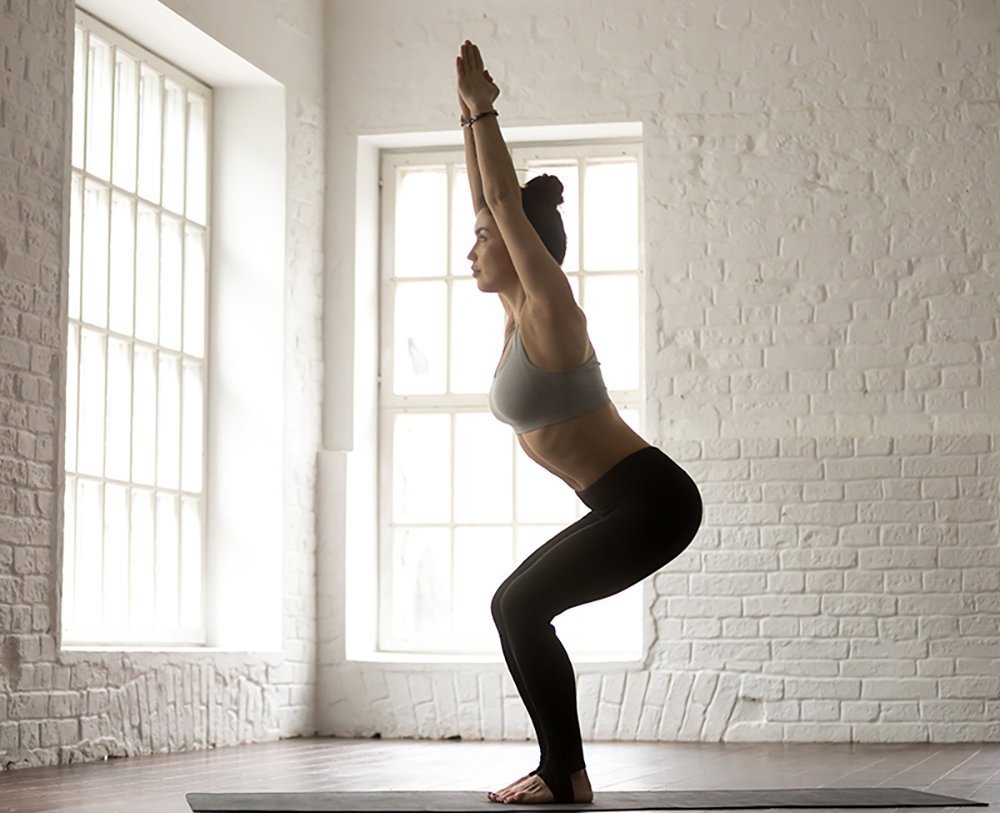
Do you want to sit on an imaginary chair? Then let us learn about Utkaṭāsana.
Utkaṭāsana gives extra strength to the legs. It belongs to the balancing group of Āsanas and strengthens the lower body.
Sthiti: Tāḍāsana
1Raise the Hands
While inhaling, raise both hands so that the biceps touch the ears. Keep both hands parallel to each other.
2Form the Chair Position
While exhaling, bend the knees and lower the hips until the body resembles the shape of a chair.
Stay in this posture for a count of 10, breathing normally.
3Return to Standing
While inhaling, straighten the knees and return to a standing position.
4Lower the Hands
While exhaling, lower the hands to your sides.
Viśrānti: Śithila Tāḍāsana
Benefits
- Strengthens and stabilises the ankles, thighs, calf muscles and spine.
- Stretches the shoulders and chest.
- Helps ease respiration.
- Improves concentration.
Limitations
Students with knee pain, sprained ankles or injured ligaments should avoid this posture.
Gomukhāsana – Cow’s Face Posture
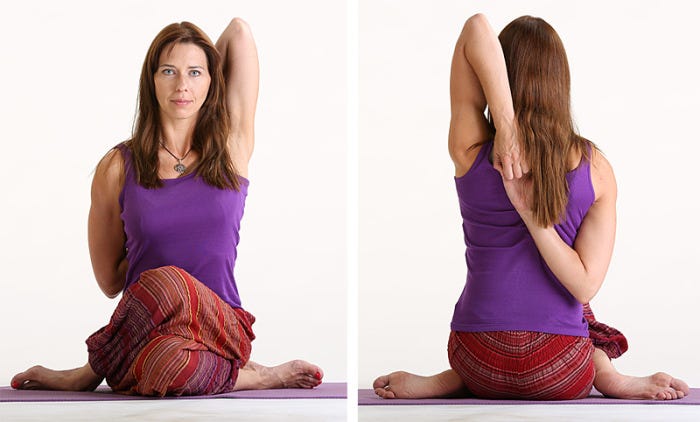
This Āsana resembles the face of a cow. Let us learn step by step how to achieve this posture.
1Position the Legs
Inhale and fold the right leg, placing the right heel by the side of the left buttock.
Inhale again and fold the left leg, placing the left heel by the side of the right hip, with both knees stacked in line and the left knee on top.
2Position the Arms
Raise both the hands sideways and take the left arm above the head and bend the elbow.
Simultaneously, bring the right arm behind the back and interlock the fingers of both hands.
Keep the spine erect, head slightly back and eyes closed. Stay in this posture with normal breathing for 10 counts.
3Release the Hands
Inhale and exhale, gently release the hands.
4Release the Legs
Exhale and release your left leg. Further exhalation releases the other leg and relax.
Viśrānti
Repeat the same Āsana on the left side.
Benefits
- Improves posture.
- Removes stiffness in the shoulders, neck and legs.
- Strengthens the ankles, hips, thighs, shoulders, back and chest.
- Helps improve respiration.
- Helps reduce anxiety, stress and tiredness.
Limitations
Those with acute knee and ankle problems can initially avoid this practice.
Dhanurāsana – Bow Posture
Did you know that ‘Dhanur’ means a bow? This posture resembles a bow, with the bending of the back resembling the bowstring. That is why it is called the Bow Pose.
Sthiti: Prone posture
1Hold the Ankles
While inhaling, fold both the legs at the knees and catch the ankles with both hands, keeping the arms straight.
Bring the heels close to the buttocks.
2Raise the Head and Chest
Inhale and raise the head and chest as high as possible from the floor. Slightly tilt the head back so that the posture resembles a bow.
Keep the eyes closed and face relaxed. Hold this position with normal breathing for 10 counts.
3Lower the Body
While exhaling, slowly lower the thighs and head to the ground.
4Relax
Release the hands and legs. Then take both hands above the head with palms facing down. Rest the forehead on the ground.
Viśrānti: Makarāsana
Benefits
- Improves spinal flexibility.
- Strengthens the muscles of the back.
- Opens the chest and shoulders.
- Helps ease respiration.
- Enhances the digestive process.
Limitations
Avoid the practice if there is any injury related to the ankle, wrist or spine.
Sarvāṅgāsana – Shoulder Stand Posture
‘Sarv’ means all, ‘anga’ means part of the body, and ‘āsana’ means posture.
As the name suggests, Sarvāṅgāsana influences the functioning of all parts of the body, which is why it is called the Queen of Āsanas.
Sthiti: Supine posture
1Raise the Legs to 45°
While inhaling, raise both legs to a 45° angle without folding the knees.
2Raise the Legs to 90°
Continue inhaling and raise both legs to a 90° angle.
3Move the Legs Back
While exhaling, move both legs backward until they are parallel to the ground. Bring the hands forward and place them on the ground.
4Raise the Body
While inhaling, slowly raise the body vertically upward, ensuring the chin touches the chest.
The final position should resemble the shape of the letter ‘L’. Hold this position for 10 counts with normal breathing.
5Move the Legs Back
While exhaling, slowly bring both legs backward until they are parallel to the ground.
6Return to 90°
While inhaling, bring both legs back to a 90° angle.
7Lower to 45°
While exhaling, lower both legs to a 45° angle.
8Lower the Legs
Continue exhaling and gently place both legs on the ground.
Viśrānti: Śavāsana
Benefits
- Improves flexibility of the neck.
- Enhances circulation to the brain, eyes, ears and nose.
- Strengthens the legs, arms and shoulders.
- Helps keep the spine flexible.
- Stimulates the thyroid and parathyroid glands.
- Improves focus and attention.
- Supports clear thinking and mood.
Limitations
Avoid this practice if there are respiratory disorders, neck injuries, spinal injuries or serious eye disorders such as high myopia.
- Keep the neck relaxed.
- Avoid jerky movements.
- Avoid the posture if dizziness or difficulty in breathing occurs.
Matsyāsana – Fish Posture
The name comes from the Sanskrit word Matsya, which means fish.
Did you know how this posture got the name Matsyāsana? The way of folding the legs in this Āsana resembles the tail of a fish.
Sthiti: Supine posture
1Fold the Right Leg
Inhale and exhale, fold the right leg and place it on the left thigh.
2Fold the Left Leg
Inhale and exhale, fold the left leg and place it on the right thigh.
3Position the Palms
While inhaling, position both palms by the sides of the neck. Place the palms on the ground with the fingers pointing toward the legs.
4Raise the Head
While inhaling, slowly raise the head and rest the crown of the head on the ground.
Hold the toes with the hands, forming the shape of a bridge. Breathe normally and maintain the posture for 10 counts. Keep the eyes closed and face relaxed.
5Return the Hands
While inhaling, place both hands back by the sides of the neck.
6Lower the Head
While exhaling, lift the head slowly and rest it on the ground.
7Release the Right Leg
Inhale and exhale, release the right leg.
8Release the Left Leg
Inhale and exhale, release the left leg.
Viśrānti: Śavāsana
Benefits
- Stimulates the thyroid glands.
- Helps keep the spine flexible and healthy.
- Relieves tension in the neck and shoulder region.
- Strengthens the knees, calf muscles and thighs.
- Helps improve lung capacity.
- The textbook notes benefits for asthma and bronchitis.
Limitations
This Āsana must not be attempted if there is abdominal or thoracic surgery, neck injury, hernia, peptic ulcers or similar conditions specified by the textbook.
This Āsana must be performed with care because it is easy to injure the spine.
If students find Padmasana challenging, they can perform the Āsana with their legs stretched out.
Relaxation
Relaxation is essential after the practice session to regain and rejuvenate the body and mind.
Relaxation techniques remove tightness in the muscles, relax the spine and calm the mind.
How to Relax
- Lie down in Śavāsana.
- Keep the feet apart.
- Keep the hands apart.
- Keep the palms facing upward.
- Let go and relax the whole body.
The textbook refers students to the Grade 6 Khel Yatra textbook for the detailed step-by-step practice of relaxation.
The maximum benefit of relaxation can be achieved after a dynamic activity such as Sūrya Namaskāra, Śithalīkarana Vyāyāma or the practice of Āsanas.
Prāṇāyāma should be practised after relaxation.
Breathing Practices
Before practising Prāṇāyāma, it is essential to normalise breathing patterns.
To make breathing uniform, continuous and rhythmic, full utilisation of the lungs is necessary.
Breathing practices develop awareness of breathing while practising Yoga.
In this grade, students learn about Marjariāsana and Vyagrāsana with breathing techniques. These Āsanas are named because they imitate spinal stretching movements made by cats and tigers.
Marjariāsana with Breathing – Cat Stretch Pose

Sthiti: Dāndāsana
1Come to Vajrāsana
Sit in Vajrāsana by folding both the right leg and the left leg.
2Place the Hands
Lean forward and place your hands flat on the floor, in line with your shoulders, with fingers pointing forward.
Ensure that your arms, thighs and heels are about one shoulder-width apart, and that your arms and thighs are perpendicular to the floor.
3Inhale and Raise the Head
While inhaling, raise your head and look at the ceiling or roof. Simultaneously, depress your spine so that your back becomes concave.
4Exhale and Arch the Spine
While exhaling, arch your spine upwards and bend your head downward, bringing your chin toward your chest.
This constitutes one round of breathing. Repeat for 5 rounds.
5Return to the Initial Posture
Return to the initial posture after completing the practice.
6Relax
Slowly return to Vajrāsana, then stretch your legs forward.
Relax in Śithila Dāndāsana.
Benefit
Marjariāsana with breathing improves the flexibility of the neck, shoulders and spine.
Vyagrāsana Breathing – Tiger Stretch Pose

Now let us stretch like a tiger.
Sthiti: Dāndāsana
1Come to Vajrāsana
Sit in Vajrāsana by folding the right leg and the left leg.
2Place the Hands
Lean forward and place the hands flat on the floor in line with the shoulders with fingers pointing forward and look forward.
Arms, thighs and heels should be about one shoulder width apart. The arms and thighs are perpendicular to the floor.
3Raise the Right Leg
While inhaling, raise the head up and simultaneously raise the right leg, stretching it up and slightly bending the right knee.
4Bring the Knee Towards the Nose
While exhaling, bend the knee and swing the leg under the hips. Simultaneously, arch the back and bend the head down, bringing the knee towards the nose.
This constitutes one round of breathing. Repeat for 3–5 rounds. Repeat the same practice on the left side.
5Return
Come to the initial posture after the practice.
6Relax
Slowly come to Vajrāsana, stretch your leg forward and relax in Śithila Dāndāsana.
Benefits
- Loosens the legs and hip joint.
- Stretches the abdominal muscles.
- Promotes digestion.
- Stimulates blood circulation.
- Tones the hips and thighs.
- Ensure that students are comfortable standing on both palms and knees.
- After completing the practice, students can relax in Śaśāṅkāsana or child pose for a few seconds.
Āsanas at a Glance
| Āsana | Meaning / Type | Main Points |
|---|---|---|
| Utkaṭāsana | Chair Posture – Standing | Strengthens the lower body and improves concentration. |
| Gomukhāsana | Cow’s Face Posture – Sitting | Improves posture and shoulder, neck and leg flexibility. |
| Dhanurāsana | Bow Posture – Prone | Improves spinal flexibility and strengthens the back. |
| Sarvāṅgāsana | Shoulder Stand – Supine | Works with balance and body alignment; requires careful practice. |
| Matsyāsana | Fish Posture – Supine | Helps maintain spinal flexibility and releases neck and shoulder tension. |
| Marjariāsana | Cat Stretch – Breathing Practice | Improves flexibility of the neck, shoulders and spine. |
| Vyagrāsana | Tiger Stretch – Breathing Practice | Loosens legs and hip joints and stretches the abdomen. |
Important Safety Points
- Perform Āsanas under the guidance of the teacher.
- Follow the steps carefully.
- Do not force the body into a posture.
- Move slowly and avoid jerky movements.
- Stop if you feel dizzy, uncomfortable or have difficulty breathing.
- Pay attention to the limitations given for each Āsana.
- Students with injuries or medical concerns should follow appropriate professional guidance.
- Relax after completing the practice.
Important Terms
Āsana
A comfortable Yoga posture.
Sthiti
Starting position.
Viśrānti
Relaxation position.
Supine
Lying on the back.
Prone
Lying on the front.
In-text Questions – Easy Solutions
Chapter Summary
Āsana is the third limb of Ashtāṅga Yoga. Āsanas are comfortable body postures that can help develop strength, flexibility and balance.
In this chapter, we learn five main Āsanas: Utkaṭāsana, Gomukhāsana, Dhanurāsana, Sarvāṅgāsana and Matsyāsana.
The chapter also introduces breathing practices through Marjariāsana and Vyagrāsana.
The most important rule is to practise carefully, gradually and under the guidance of the teacher.
Practice important questions and revision exercises with this easy Class 7 Khel Yatra worksheet for unit 6 chapter 3. It is useful for chapter revision, practice and exam preparation
Class 7 Khel Yatra Unit 6 Chapter 3 Notes, Class 7 Khel Yatra Asana Notes, Āsana Class 7, Class 7 Yoga Asana Notes, NCERT Class 7 Khel Yatra Notes, CBSE Class 7 Khel Yatra Notes, Class 7 Khel Yatra Unit 6 Solutions, Asana Questions and Answers Class 7, Class 7 Khel Yatra Worksheet, NCERT Class 7 Yoga Notes, CBSE Class 7 Yoga Notes, Class 7 Khel Yatra Study Material