Class 7 Khel Yatra Unit 5 – Fundamental Skills of Sports: Kabaddi with easy Notes, Solutions, Questions & Answers and Worksheet. Learn important Kabaddi skills such as raiding footwork, hand touch, toe touch, kicks and different holds with simple Class 7 study material.
Fundamental Skills of Sports – Kabaddi
Class 7 Khel Yatra | Reprint 2026–27
Easy Notes • Activities • Circle Time Questions • Solutions
Introduction to Kabaddi
Kabaddi is played between two teams, and the goal is to tag players. Players must touch opponents and return to their side of the court without getting caught. Kabaddi helps build strength, speed, and improves teamwork. It is a popular game in many countries and is also played in the Asian Games.
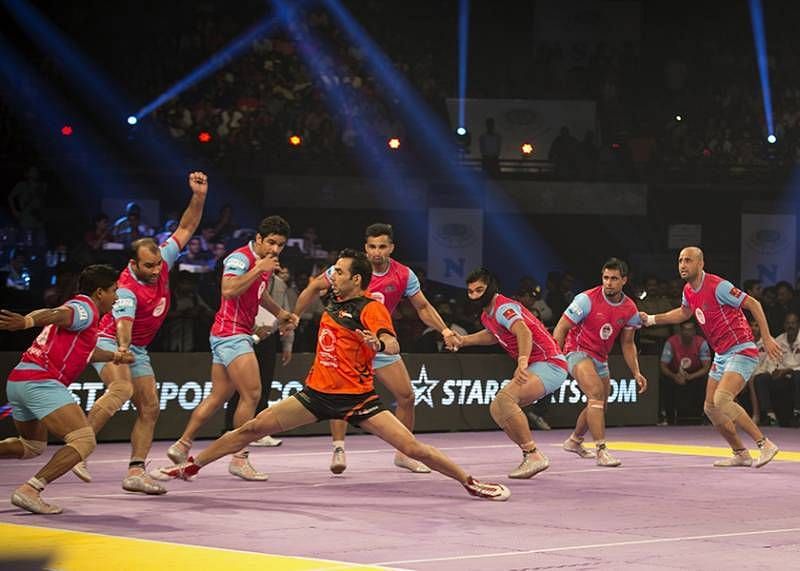 Example of a kabaddi raiding movement.
FSB – 1: Raiding Foot Work
Pages 118–121Raiders perform offensive skills in the opponent’s half to touch the defenders and score points for their team.
Steps to Learn
1. Stance
2. Execution
3. Follow Through
Mark two parallel lines of 30 feet each (9.15 m). Set up two blocks 30 feet apart, opposite each line. Keep two blocks on the other side of the starting line.
The player will run towards the blocks as fast as possible, pick up a block, return and place it behind the starting line. Then the player runs to pick up the second block and returns backwards across the line.
The player who takes the minimum time to finish the activity will be the winner.
Pop Up – Types of Raid
- Leading Leg Raid
- Shuffling Leg Raid
- Natural Run Raid
FSB – 2: Hand Touch
Pages 122–124The primary aim of the hand touch technique is to touch a defender and return back to the own half of the court after a successful raid.
Steps to Learn
1. Stance
2. Execution
- Vertical or Diagonal on covers and corners.
- Sideward swing on wings and supporter.
- Sideward to forward on the chain in front.
- Sideward to reverse on the defence who is covering the rear.
3. Follow Through
Make two teams, Team A and Team B. Keep a small ball in the centre. Each player is given a chest number. When a number is called, one player from both sides runs in and tries to take the ball to their side using hands only.
The team that succeeds scores a point.
FSB – 3: Toe Touch
Pages 125–127The primary aim of the Toe Touch technique is to touch a defender and return to their half of the court after a raid.
Types of Toe Touch
- Toe touch on same stance.
- Taking one step back and toe touch.
- Running toe touch.
- Dragging back and toe touch.
- Feinting and toe touch.
Steps to Learn
1. Approach
2. Execution
3. Follow Through
Draw four different shapes such as triangle, square and circle in the court. When a player’s number is called, the player runs to the baulk line. Just before reaching it, the teacher calls a shape. The player quickly runs to toe touch the shape and returns to the centre line.
FSB – 4: Kick
Pages 128–130Kick is one of the major offensive skills in Kabaddi used by the raider. The primary aim of the kick technique is to touch a defender with a leg and return back to their own half of the court after a raid.
Steps to Learn
1. Approach
2. Stance
- Stance should be diagonal or parallel.
- Maintain stability on rear leg.
- Shoulder line towards the mid line.
- Upper body should be in crouch position.
- Arms should be flexed and relaxed to balance the body.
3. Execution
4. Follow Through
5. Variation
- Back kick
- Side kick
- Roll or Curve kick
Two teams stand with their arms extended at the corners behind the bonus line. The first player starts at the whistle and goes to the opposite court, kicks the extended arm and returns. The team that finishes first wins.
Defensive Skills and Positions
Page 131Defensive Positions
- Corners: Players stand at the extreme right and left corners. Their responsibility is to initiate tackles.
- Centre: The centre player plays in the centre position.
- Ins: Ins are positioned between corners and covers. They help protect the corner defender and can also help in defence.
- Covers: Covers are positioned between the ins and centre. Teams generally position all-rounders here.
FSB – 5: Ankle-hold
Pages 132–135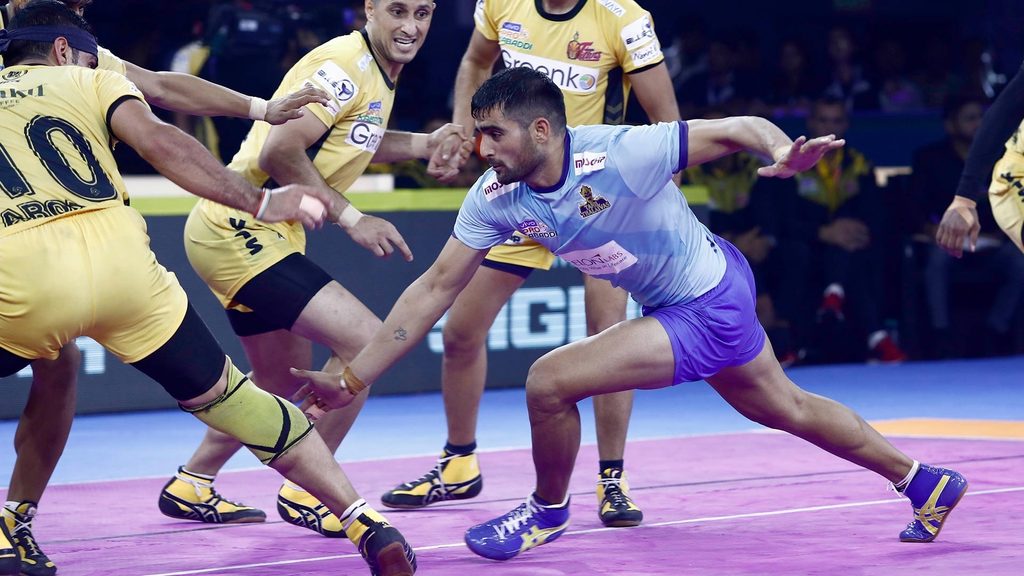 An example of an ankle-hold defensive action.
The primary aim of the defensive ankle hold technique is to catch the attacker in such a way that the raider cannot safely return during the raid.
Steps to Learn
1. Body Position
- Wider stance.
- Upper body slightly inclined towards the raider.
- More body weight on the leading leg.
- Knees slightly flexed to balance.
- Hands should be free.
- Eyes on the target.
2. Approach
3. Execution
4. Follow Through
Draw four different shapes in the court and place four defenders just behind the shapes. When a number is called, the player runs to the baulk line. The teacher calls a shape, and the player moves towards it while the defender attempts the ankle hold.
FSB – 6: Thigh-hold
Pages 136–138 Illustration of a thigh-hold technique.
The primary aim of the defensive thigh-hold technique is to catch a raider and prevent the raider from escaping during a raid.
Steps to Learn
1. Body Position
- Optimum diagonal stance.
- Leading leg toe should be towards the front lobby.
- Rear leg toe should be towards the end line.
- Both knees should be slightly bent.
- Eyes should be on the target.
- Upper body slightly inclined towards the raider.
2. Approach
3. Execution
4. Follow Through
FSB – 7: Knee-hold
Pages 139–141The primary aim of the defensive knee hold technique is to prevent the raider from escaping or returning to their own half of the court after a raid.
Steps to Learn
1. Body Position
- Optimum diagonal stance.
- Leading leg toe should be towards the lobby.
- Rear leg toe should be parallel to the end line.
- Both knees should be slightly bent.
- Eyes should be on the target.
- Upper body should be slightly inclined towards the raider.
2. Approach
3. Execution
4. Follow Through
- The raider can only use the hand touch technique to tag the defender.
- The defenders can only do knee-hold to restrict the raider from scoring a point.
- Ensure each defender will get ample opportunity to do knee-hold.
FSB – 8: Wrist-hold
Pages 142–144The primary aim of the wrist hold technique is to prevent the raider from escaping or returning to their half of the court after a raid so that the defending team can gain points.
Types of Wrist-hold
- Holding the wrist from above
- Holding the wrist from below
Approach
- Observe, focus and judge the raider’s hand movements.
- Remain free and relaxed without holding the chain.
- Keep the palm in a cup shape with the thumb apart.
- Lean slightly forward.
Execution of Wrist-hold
The players hold the wrists of one another and pull in opposite directions. This can be done from the midline to the baulk lane as a competitive drill.
1. Hand Touch
2. Toe Touch
3. Kick
- Hand Touch: Defenders should watch the raider’s hand movement and be ready to stop the raid.
- Toe Touch: Defenders should watch the raider’s feet and maintain safe positioning.
- Kick: Defenders should keep distance, watch the kicking leg and react safely.
FSB – 9: Waist-hold
Pages 145–147Steps to Learn
1. Body Position
- Optimum diagonal stance.
- Cover the raider’s outer shoulder from behind.
- Knees bent.
- Chin up and eyes on the target.
2. Approach
3. Holding and Execution
4. Follow Through Action
- Raider should be dragged towards the end line.
- Raider may be lifted towards the end line.
- Defender can change the direction of the hold from back to front.
- Defender can fall back or roll back while holding the raider.
Players hold the trunk of the player in front and form a train. One player in front is the opponent and tries to touch the last player. The players protect the last player without breaking the waist hold.
FSB – 10: Chain-hold
Pages 148–150The primary aim of the chain hold technique is to prevent the raider from escaping or returning to their own half of the court.
1. How to form the chain?
2. Approach
- Form the chain with supporting students.
- Cover the path and outer shoulder of the raider.
- Observe the raider carefully and anticipate movement.
- Maintain the grip while approaching.
3. Stance
- Stance must be wide.
- Shoulders should be parallel and close to each other.
- Grip should be firm.
- Head should face the line of attack.
4. Execution
5. Follow Through
- Lifting the raider at the same spot with a wider stance.
- Changing the direction of the raider by pushing away from the midline with the chain.
Form two teams facing each other at a distance of approximately six metres. One player from each team comes to the centre and locks elbows. After a short movement, each tries to pull the other towards their own side. The successful player earns one point.
Complete the Following Task
Page 151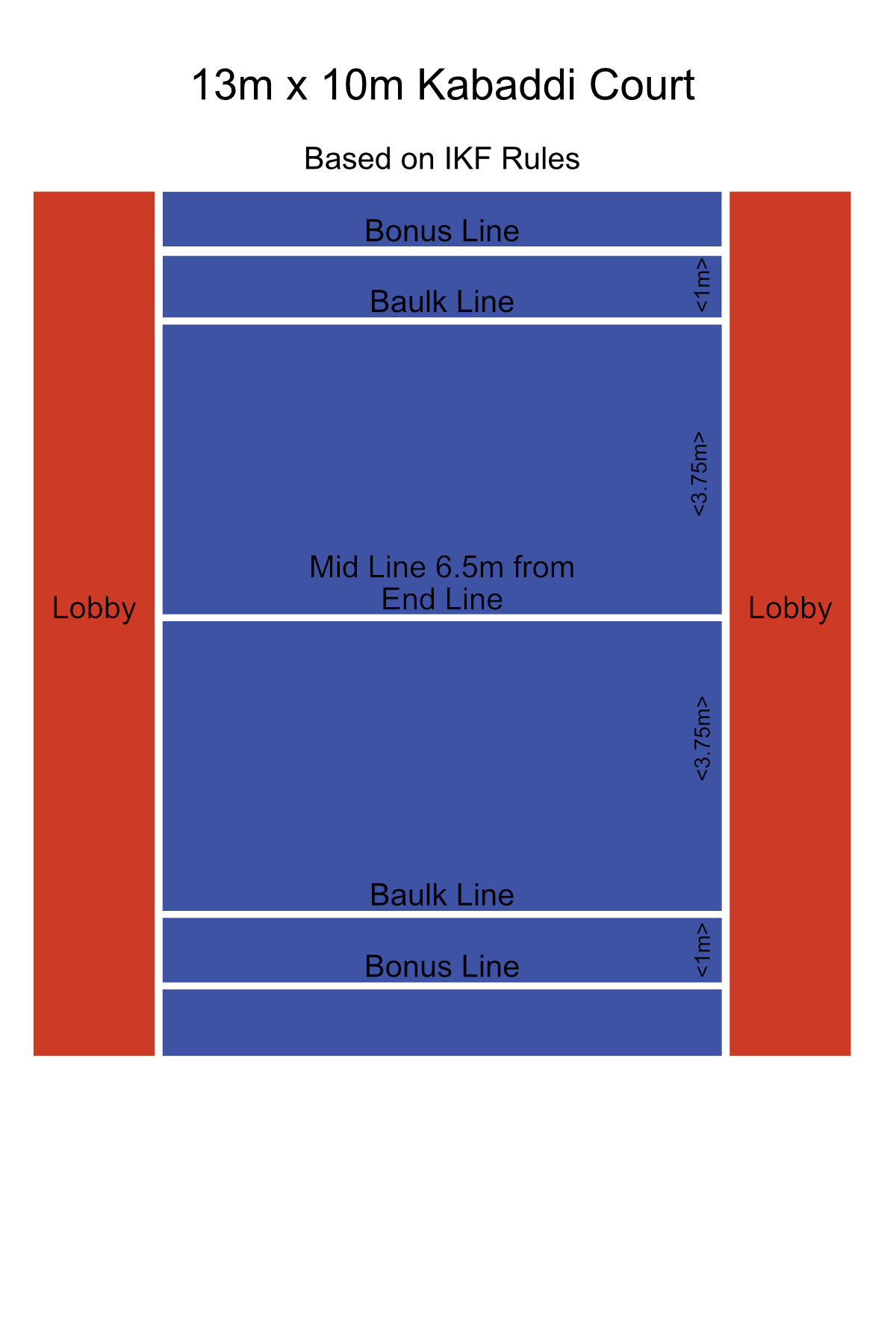 Kabaddi court layout reference.
Teacher-Assessment
Pages 151 onwardTouch (Hand Touch and Toe Touch)
| Level | Performance Description |
|---|---|
| 1 | Student is learning how to balance while attempting to touch with hands and toes. |
| 2 | Student can do simple hand and toe touches but have trouble with speed and precision. |
| 3 | Occasionally avoids defenders and perform hand and toe touches with respectable control. |
| 4 | Student is agile and aware on how to make rapid, calculated touches. |
| 5 | Confidently makes accurate hand and toe movements, avoiding opponents with agility and planning. |
Hold (Ankle Hold, Knee Hold and Thigh Hold)
| Level | Performance Description |
|---|---|
| 1 | Student is getting better at controlling grip on the raider’s leg, knee, or ankle. |
| 2 | Tries holds, but occasionally have trouble with timing and grip strength. |
| 3 | Using holds with respectable strength and skill the student slowdowns the raider. |
| 4 | Successfully halts the raider with powerful, well-timed holds. |
| 5 | Uses strategy and control to secure the raider with strong, accurate holds executed with assurance. |
Hold (Wrist Hold and Waist Hold)
| Level | Performance Description |
|---|---|
| 1 | Student is becoming better at controlling grip on the raider’s waist or wrist. |
| 2 | Tries waist and wrist holds, but needs to improve timing and grip strength. |
| 3 | Using holds with respectable strength and skill the student makes it difficult for the raider to get away. |
| 4 | Successfully halts the raider’s movement with firm, well-timed holds. |
| 5 | Executes solid, well-planned holds with assurance, keeping the raider from getting away. |
Understanding Self-Distress
| Level | Performance Description |
|---|---|
| 1 | Student has trouble identifying feelings and hardly ever acknowledge their problem. |
| 2 | Occasionally becomes aware of the distress, but finds it hard to pinpoint the reason. |
| 3 | Although having trouble controlling themself, student is aware of the distress and its causes. |
| 4 | Has a good understanding of their distress and can control emotions to some extent. |
| 5 | Successfully controls emotions and completely understand the reasons behind distress. |
Quick Revision – Kabaddi Skills
Remember
- Raiders need speed, balance and anticipation.
- Hand touch uses the hand to tag a defender.
- Toe touch uses the foot to touch a defender.
- Kicks are offensive skills used by raiders.
- Ankle, thigh, knee, wrist and waist holds are defensive skills.
- Good footwork helps players change direction quickly.
- Balance and safe movement are important in every skill.
- Teamwork and communication help defenders work together.
- Players should always follow safety instructions during practice.
Practice important questions and revision exercises with this easy Class 7 Khel Yatra worksheet for unit 3. It is useful for chapter revision, practice and exam preparation
Class 7 Khel Yatra Unit 5, Class 7 Khel Yatra Unit 5 Notes, Fundamental Skills of Kabaddi Class 7, Class 7 Kabaddi Notes, Class 7 Khel Yatra Kabaddi, Class 7 Khel Yatra Unit 5 Solutions, Kabaddi Questions and Answers Class 7, Class 7 Khel Yatra Unit 5 Worksheet, Kabaddi Worksheet Class 7, Class 7 Khel Yatra Notes, Class 7 Physical Education Notes, Class 7 Khel Yatra Study Material