Class 6 Maths Chapter 8 Playing with Constructions – easy notes, concepts, NCERT book solutions, important questions, worksheet and answers. Learn about geometric constructions, drawing shapes, measuring lengths and angles, and constructing different figures using simple steps.
📐 Class 6 Mathematics
Ganita Prakash – Chapter 8: Playing with Constructions
Complete Concept Notes • Book Questions • Easy Solutions
🌟 Chapter Overview
Playing with Constructions teaches us how mathematical figures can be made accurately using a ruler and a compass.
In this chapter we learn:
- How to use a compass.
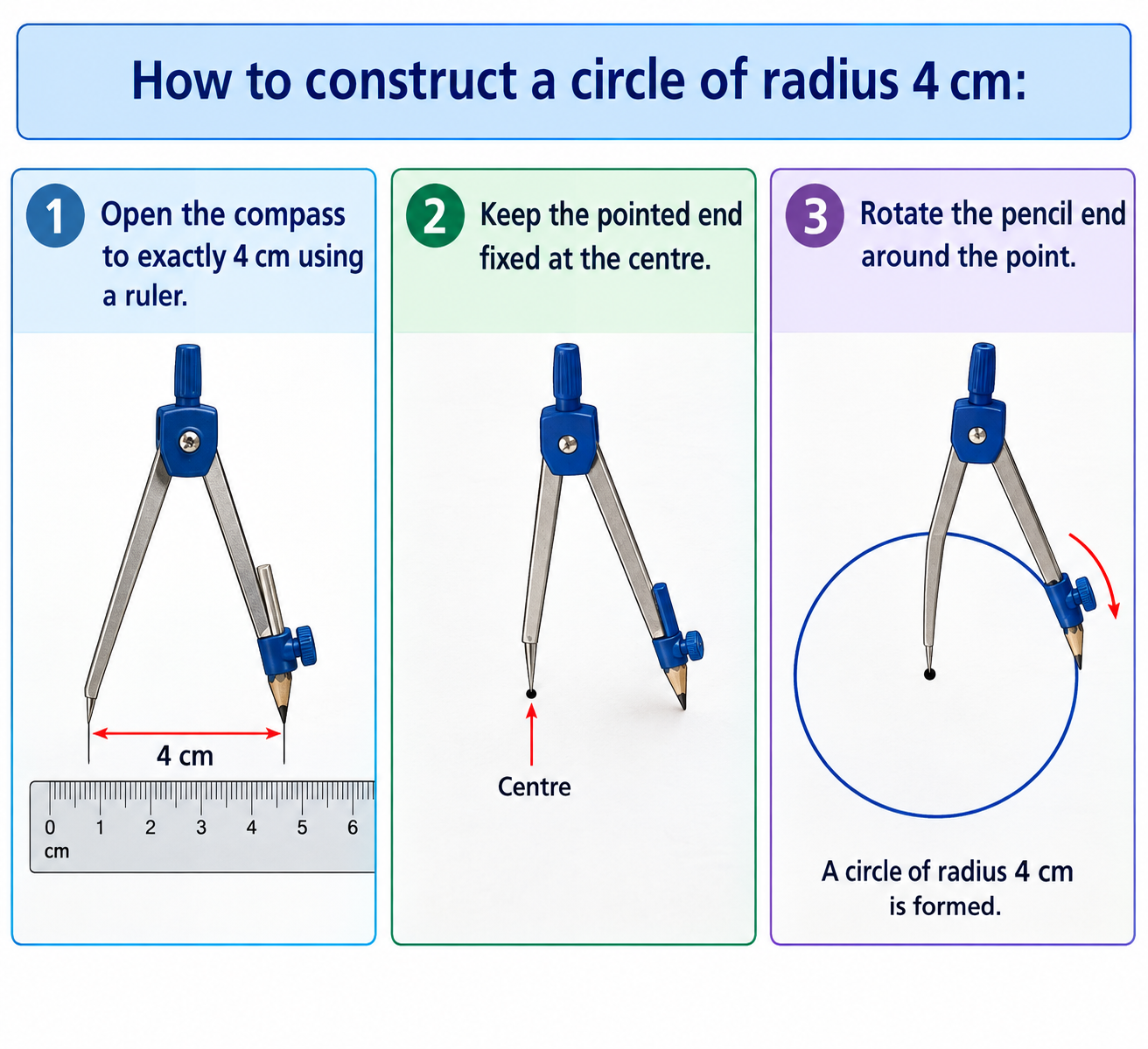
- How to construct circles and arcs.
- Centre and radius of a circle.
- Properties of squares and rectangles.
- How to construct squares and rectangles.
- How to use a rough diagram before construction.
- How to construct rectangles when a side and diagonal are given.
- How to find points that are equidistant from two given points.
- How diagonals behave in rectangles and squares.
🧠 Important Concepts
Circle: A circle is a curve in which every point is at the same distance from its centre.
Centre: The fixed point from which all points on a circle are at the same distance.
Radius: The distance between the centre of a circle and any point on the circle.
Compass: A mathematical instrument used to draw circles and arcs and to transfer lengths.
Rectangle: A four-sided figure in which opposite sides are equal and all angles are 90°.
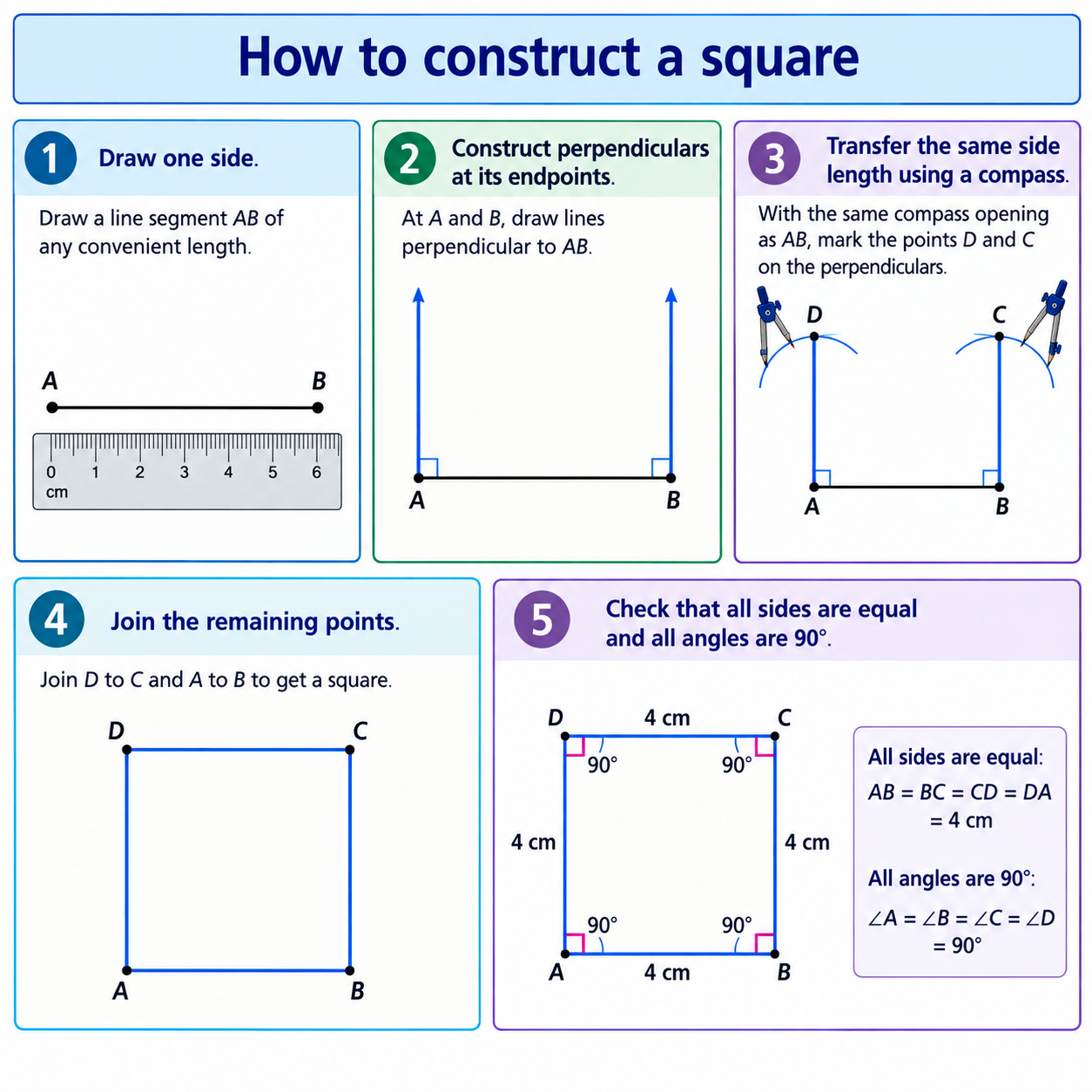
Square: A four-sided figure in which all sides are equal and all angles are 90°.
Diagonal: A line segment joining two opposite vertices of a rectangle or square.
Equidistant: Two or more points are equidistant from another point when their distances from that point are equal.
⭐ Remember:
A compass is useful not only for drawing circles. It can also be used to transfer a length accurately from one place to another.
A compass is useful not only for drawing circles. It can also be used to transfer a length accurately from one place to another.
8.1 Artwork
Page 188
Q. Think: Imagine marking all the points of 4 cm distance from the point P. How would they look?
Solution:
If we mark many points that are exactly 4 cm away from P and join them, they form a circle.
The point P is the centre and 4 cm is the radius.
If we mark many points that are exactly 4 cm away from P and join them, they form a circle.
The point P is the centre and 4 cm is the radius.
Page 191
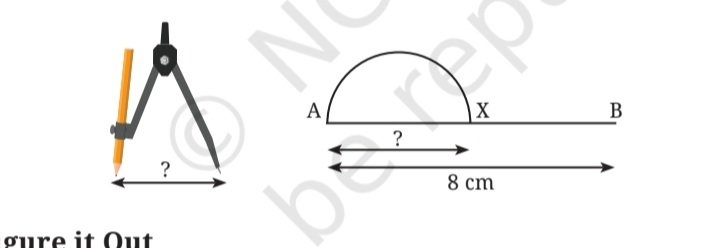
Q1. What radius should be taken in the compass to get this half circle? What should be the length of AX?
Solution:
Radius = 2 cm.
Length of AX = 4 cm.
Radius = 2 cm.
Length of AX = 4 cm.
Q2. Take a central line of a different length and try to draw the wave on it.
Solution:

The important point is that all the waves should have the same size and should join properly.
Q3. Try to recreate the figure where the waves are smaller than a half circle (as appearing in the neck of the figure ‘A Person’). The challenge here is to get both the waves to be identical. This may be tricky!
Solution:

8.2 Squares and Rectangles
Rectangle Properties
- Opposite sides are equal.
- All four angles are 90°.
Square Properties
- All four sides are equal.
- All four angles are 90°.
Page 193
Q. Which of the following is not a name for this square?
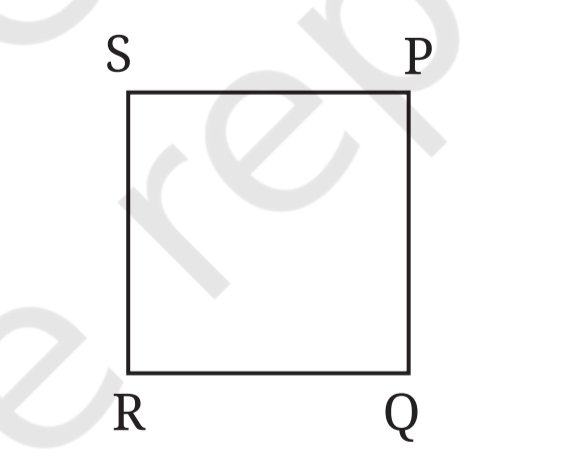
1. PQSR
2. SPQR
3. RSPQ
4. QRSP
Solution:
The correct answer is PQSR.
A square must be named by moving around its boundary in order. In PQSR, the letters do not follow the boundary order.
The correct answer is PQSR.
A square must be named by moving around its boundary in order. In PQSR, the letters do not follow the boundary order.
Page 194
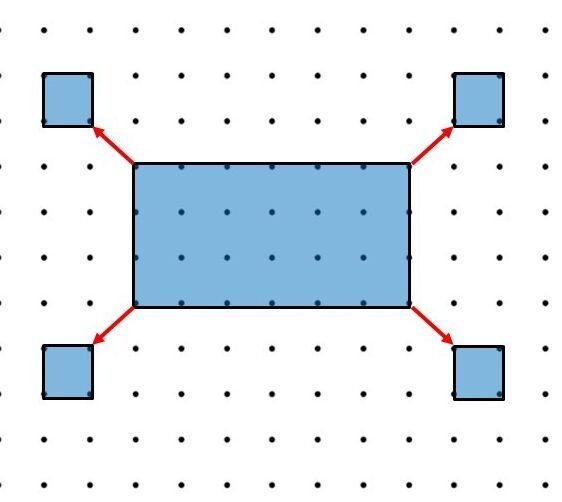
Q1. Draw the rectangle and four squares configuration (shown in Fig. 8.3) on a dot paper. What did you do to recreate this figure so that the four squares are placed symmetrically around the rectangle? Discuss with your classmates.
Solution:
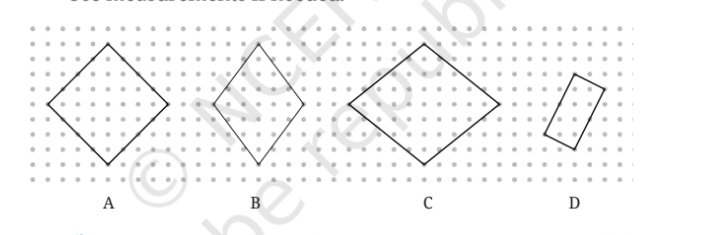
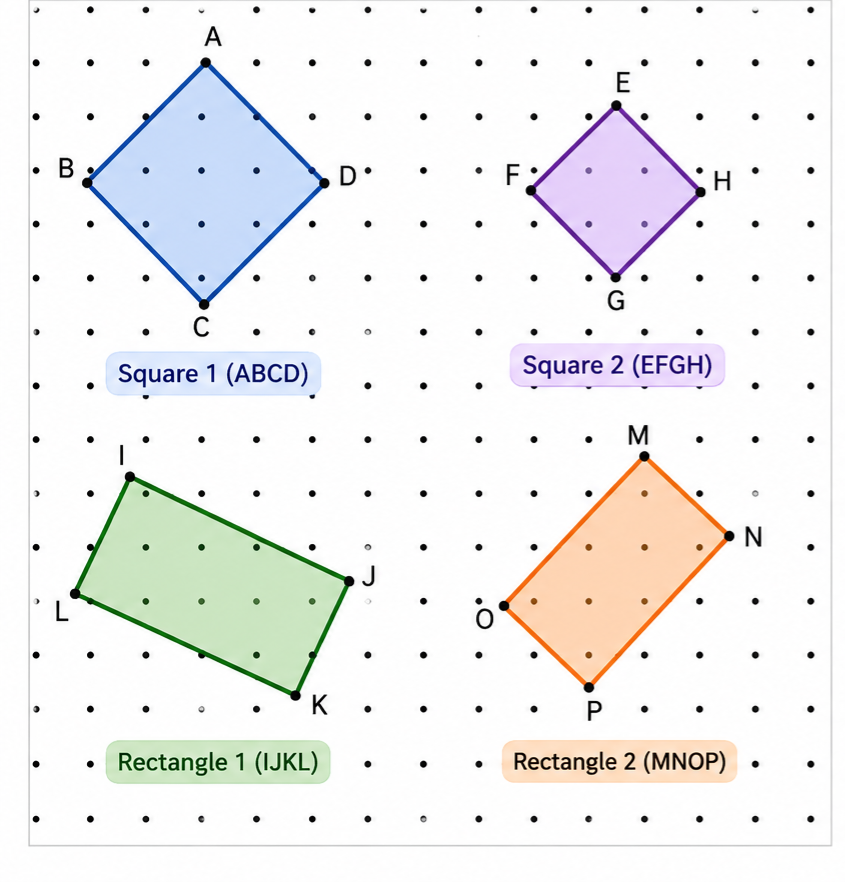
Q2. Identify if there are any squares in this collection. Use measurements if needed.
Solution:
The square is A.
It has equal sides and right angles.
The square is A.
It has equal sides and right angles.
Think: Is it possible to reason out if the sides are equal or not, and if the angles are right or not without using any measuring instruments in the above figure? Can we do this by only looking at the position of corners in the dot grid?
Solution:
Yes. The positions of the points on the dot grid can help us reason about equal lengths and right angles.
However, careful observation of the grid is needed.
Yes. The positions of the points on the dot grid can help us reason about equal lengths and right angles.
However, careful observation of the grid is needed.
Q3. Draw at least 3 rotated squares and rectangles on a dot grid. Draw them such that their corners are on the dots. Verify if the squares and rectangles that you have drawn satisfy their respective properties.
Solution:
For every square, check:
For every square, check:
- All four sides are equal.
- All four angles are 90°.
- Opposite sides are equal.
- All four angles are 90°.
8.3 Constructing Squares and Rectangles
Page 197
Q1. Draw a rectangle with sides of length 4 cm and 6 cm. After drawing, check if it satisfies both the rectangle properties.
Solution:
∠A = ∠B = ∠C = ∠D = 90°
AB = CD = 6 cm
AD = BC = 4 cm.
Hence the figure satisfies both properties of a rectangle.
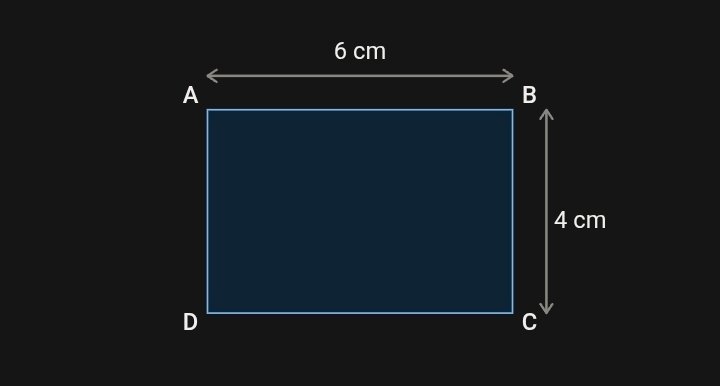
Step 1: Draw a line segment of 6 cm.
Step 2: Draw perpendiculars at both ends.
Step 3: Mark 4 cm on both perpendiculars.
Step 4: Join the two marked points.
Therefore:
∠A = ∠B = ∠C = ∠D = 90°
AB = CD = 6 cm
AD = BC = 4 cm.
Hence the figure satisfies both properties of a rectangle.
Q2. Draw a rectangle of sides 2 cm and 10 cm. After drawing, check if it satisfies both the rectangle properties.
Solution:
Therefore, it is a rectangle.

Therefore, it is a rectangle.
Q3. Is it possible to construct a 4-sided figure in which—
• all the angles are equal to 90º but
• opposite sides are not equal?
Solution:
No.
A quadrilateral with all four angles equal to 90° is a rectangle, and in a rectangle opposite sides are equal.
No.
A quadrilateral with all four angles equal to 90° is a rectangle, and in a rectangle opposite sides are equal.
8.4 An Exploration in Rectangles
Page 198

Q. Is there a shorthand way of writing it down? In all the sentences, only the position of X, Y and the length XY changes. So we could write this as:
Distance of X from A Distance of Y from B Length of XY
Solution:
A convenient table can be used:
A convenient table can be used:
| Distance of X from A | Distance of Y from B | Length of XY |
|---|---|---|
| 5 mm | 3 cm | 7.4 cm |
| 1 cm | 1 cm | 7 cm |
| 2 cm | 4 cm | 7.3 cm |
Page 199
Q. Have you checked what happens to the length XY when X and Y are placed at the same distance away from A and B, respectively?
Solution:
When X and Y are placed at the same distance from A and B respectively, the length XY becomes equal to AB.
For example, if both are 5 mm away, then XY = AB. The same pattern occurs for 1 cm, 1.5 cm and so on.
When X and Y are placed at the same distance from A and B respectively, the length XY becomes equal to AB.
For example, if both are 5 mm away, then XY = AB. The same pattern occurs for 1 cm, 1.5 cm and so on.
Q. In each of these cases, observe (i) how the length XY compares to that of AB and (ii) the shape of the 4-sided figure ABYX.
Solution:
(i) XY = AB.
(ii) ABYX forms a rectangle.
(i) XY = AB.
(ii) ABYX forms a rectangle.
Q. How does the farthest distance between X and Y compare with the length of AC? BD?
Solution:
The farthest distance between X and Y is equal to the length of the diagonal.
Therefore, it is equal to AC or BD.
The farthest distance between X and Y is equal to the length of the diagonal.
Therefore, it is equal to AC or BD.
Construct a rectangle that can be divided into 3 identical squares as shown in the figure.
Solution:

Page 201
Give the lengths of the sides of a rectangle that cannot be divided into—
• two identical squares;
• three identical squares.
Solution:
For two identical squares, the length should be twice the breadth. Therefore, a rectangle such as:
4 cm × 2.5 cm
cannot be divided into two identical squares.
For three identical squares, the length should be three times the breadth. Therefore:
7 cm × 2 cm
cannot be divided into three identical squares.
Construct 1. A Square within a Rectangle: Construct a rectangle of sides 8 cm and 4 cm. How will you construct a square inside, as shown in the figure, such that the centre of the square is the same as the centre of the rectangle?

Solution:
Thus the required square is centrally placed inside the rectangle.
Step 1: Construct the 8 cm × 4 cm rectangle.
Step 2: Find the centre of the rectangle by drawing its diagonals.
Step 3: The largest centred square has side 4 cm.
Step 4: Position the square so that its centre coincides with the rectangle’s centre.
Thus the required square is centrally placed inside the rectangle.
8.5 Exploring Diagonals of Rectangles and Squares
Important Idea: A rectangle has two diagonals joining opposite corners.
Page 204
Q. How should the rectangle be constructed so that the diagonal divides the opposite angles into equal parts?
Solution:
The rectangle should be constructed so that its adjacent sides are equal.
In other words, the rectangle becomes a square.
In a square, the diagonals divide the opposite angles into equal parts.
The rectangle should be constructed so that its adjacent sides are equal.
In other words, the rectangle becomes a square.
In a square, the diagonals divide the opposite angles into equal parts.
Page 211
Q1. Construct a rectangle in which one of the diagonals divides the opposite angles into 50° and 40°.
Solution:

Step 1: Draw a base line AB of convenient length.
Step 2: At B, construct an angle of 50° and draw the diagonal line.
Step 3: At A, draw a perpendicular to AB.
Step 4: Use the properties of a rectangle to locate the remaining vertex.
Step 5: Complete the rectangle using perpendiculars and equal opposite sides.
The diagonal divides the right angle into 50° and 40°.
Q2. Construct a rectangle in which one of the diagonals divides the opposite angles into 45° and 45°. What do you observe about the sides?
Solution:
When the diagonal divides a right angle into 45° and 45°, the two adjacent sides are equal.
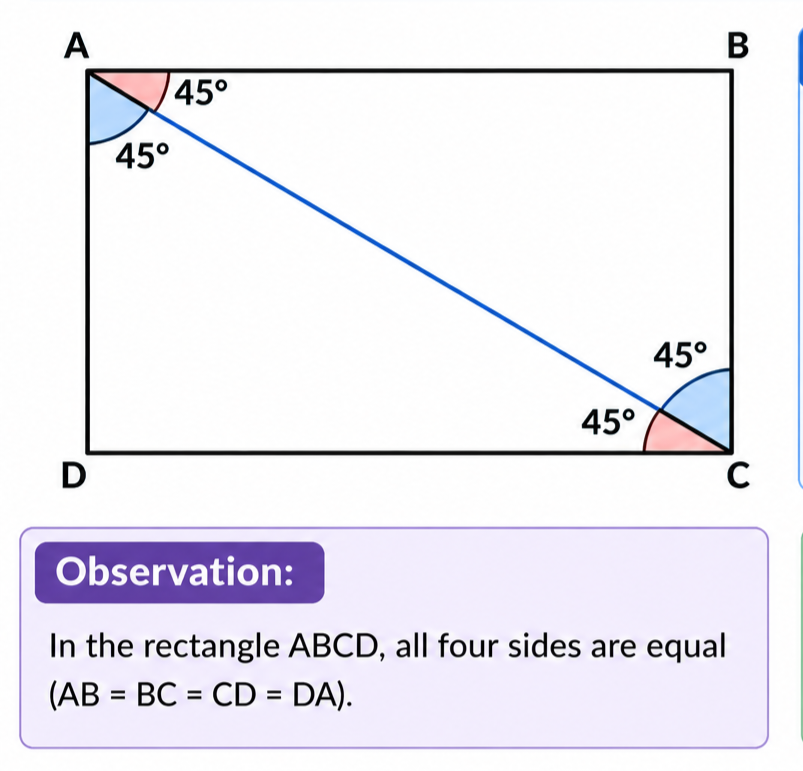
Therefore, the rectangle becomes a square.
Q3. Construct a rectangle one of whose sides is 4 cm and the diagonal is of length 8 cm.
Solution:

Step 1: Draw a line segment CD = 4 cm.
Step 2: At C, draw a perpendicular to CD.
Step 3: With D as centre and radius 8 cm, draw an arc cutting the perpendicular.
Step 4: The intersection gives the required vertex B.
Step 5: Complete the rectangle using perpendicular lines.
The diagonal is 8 cm and one side is 4 cm.
Q4. Construct a rectangle one of whose sides is 3 cm and the diagonal is of length 7 cm.

Solution:
Thus the rectangle has one side 3 cm and diagonal 7 cm.
Step 1: Draw CD = 3 cm.
Step 2: Draw a perpendicular at C.
Step 3: With D as centre and radius 7 cm, draw an arc.
Step 4: The point where the arc meets the perpendicular gives B.
Step 5: Complete the rectangle using perpendiculars.
Thus the rectangle has one side 3 cm and diagonal 7 cm.
8.6 Points Equidistant from Two Given Points
Main Idea:
If a point is required to be at the same distance from two points B and C, we can use a compass.
If a point is required to be at the same distance from two points B and C, we can use a compass.
Draw circles or arcs of the same radius from B and C. Their intersection gives a point that is equally distant from B and C.
Page 211
Construct: Recreate this figure. Note that all the lines forming the border of the house are of length 5 cm.

Solution:
The house is completed.
Step 1: Draw the required 5 cm sides forming the lower part of the house.
Step 2: To locate the top point A, notice that A must be 5 cm from both B and C.
Step 3: With B as centre and radius 5 cm, draw an arc.
Step 4: With C as centre and the same radius 5 cm, draw another arc.
Step 5: Their intersection gives point A.
Step 6: Join A to B and A to C.
Step 7: With A as centre and radius 5 cm, draw the required curved part.
The house is completed.
Page 215
Q1. Construct a bigger house in which all the sides are of length 7 cm.
Solution:
The larger house is obtained with every required side measuring 7 cm.

Step 1: Draw the required base and side segments of 7 cm.
Step 2: Use the compass with radius 7 cm to locate the points that must be 7 cm from two given points.
Step 3: Join the required points.
Step 4: Draw the curved roof using the same 7 cm radius.
The larger house is obtained with every required side measuring 7 cm.
Q2. Try to recreate ‘A Person’, ‘Wavy Wave’ and ‘Eyes’ from the section ‘Artwork’, using ideas involved in the ‘House’ construction.
Solution:

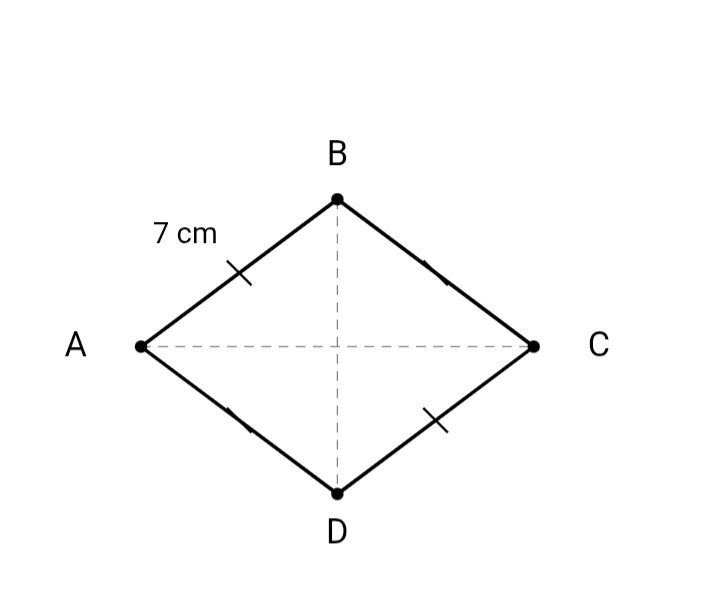
Q3. Is there a 4-sided figure in which all the sides are equal in length but is not a square? If such a figure exists, can you construct it?
Solution:
A rhombus can have all four sides equal but need not have four right angles. Therefore, it need not be a square.
To construct one, choose four equal side lengths and make angles that are not 90°.
A rhombus can have all four sides equal but need not have four right angles. Therefore, it need not be a square.
To construct one, choose four equal side lengths and make angles that are not 90°.
📐 Important Construction Methods – Quick Revision
How to construct a circle of radius 4 cm:
How to construct a square:
How to construct a rectangle:

