Class 6 Maths Chapter 6 – Perimeter and Area | Notes, Solutions & Worksheet
Class 6 Maths Chapter 6 Perimeter and Area – easy notes, concepts, NCERT book solutions, important questions, worksheet and answers. Learn how to find the perimeter and area of different shapes using simple methods, formulas and step-by-step examples.
Class 6 Maths Chapter 6 Perimeter and Area Notes & Solutions
Perimeter is the distance covered along the boundary of a closed plane figure when we go around it once.
Perimeter of a polygon = Sum of the lengths of all its sides.
Rectangle: Perimeter = 2 × (Length + Breadth)
Square: Perimeter = 4 × Side
Triangle: Perimeter = Sum of the three sides
Regular polygon: Perimeter = Number of sides × Length of one side
Area is the amount of region enclosed by a closed figure.
Area of rectangle = Length × Breadth
Area of square = Side × Side
Area of triangle = ½ × Base × Height
Remember:
Perimeter is measured in units such as cm, m and ft.
Area is measured in square units such as cm², m² and sq ft.
📖 Page No. 132 — Section 6.1: Perimeter
Q.1. Find the missing terms:
a. Perimeter of a rectangle = 14 cm; breadth = 2 cm; length = ?.
b. Perimeter of a square = 20 cm; side of a length = ?.
c. Perimeter of a rectangle = 12 m; length = 3 m; breadth = ?.
Solution: a. 14 = 2 × (length + 2)
7 = length + 2 Length = 5 cm.
b. 20 = 4 × side Side = 5 cm.
c. 12 = 2 × (3 + breadth)
6 = 3 + breadth Breadth = 3 m.
Q.2. A rectangle having sidelengths 5 cm and 3 cm is made using a piece of wire. If the wire is straightened and then bent to form a square, what will be the length of a side of the square?
Perimeter of rectangle:2 × (5 + 3) = 16 cmThe same wire forms the square.4 × side = 16Side = 4 cm.
Q.3. Find the length of the third side of a triangle having a perimeter of 55 cm and having two sides of length 20 cm and 14 cm, respectively.
Third side = 55 − 20 − 14= 21 cmLength of the third side = 21 cm.
Q.4. What would be the cost of fencing a rectangular park whose length is 150 m and breadth is 120 m, if the fence costs `40 per metre?
Q.5. A piece of string is 36 cm long. What will be the length of each side, if it is used to form:
a. A square,
b. A triangle with all sides of equal length, and
c. A hexagon (a six sided closed figure) with sides of equal length?
a. Square:36 ÷ 4 = 9 cm
b. Triangle:36 ÷ 3 = 12 cm
c. Hexagon:36 ÷ 6 = 6 cm
Q.6. A farmer has a rectangular field having length 230 m and breadth 160 m. He wants to fence it with 3 rounds of rope as shown. What is the total length of rope needed?
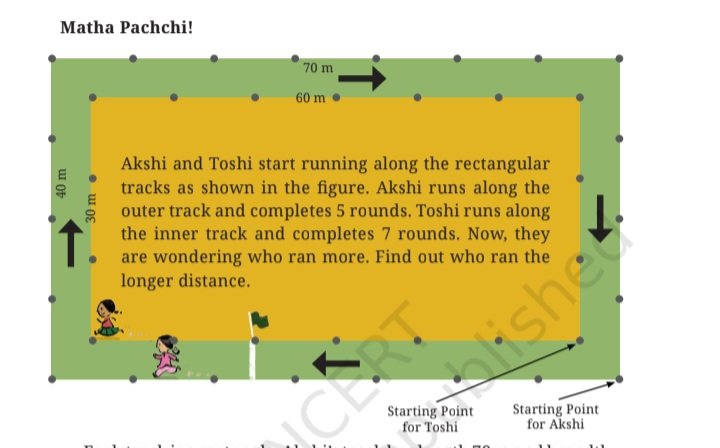
Q.1. Find out the total distance Akshi has covered in 5 rounds.
Perimeter of outer track:2 × (70 + 40) = 220 mDistance in 5 rounds:5 × 220 =1100 m.
Q.2. Find out the total distance Toshi has covered in 7 rounds. Who ran a longer distance?
Perimeter of inner track:2 × (60 + 30) = 180 mDistance in 7 rounds:7 × 180 =1260 m.Therefore, Toshi ran a longer distance.
Q.3. Think and mark the positions as directed—
a. Mark ‘A’ at the point where Akshi will be after she ran 250 m.
b. Mark ‘B’ at the point where Akshi will be after she ran 500 m.
c. Now, Akshi ran 1000 m. How many full rounds has she finished running around her track? Mark her position as ‘C’.
d. Mark ‘X’ at the point where Toshi will be after she ran 250 m.
e. Mark ‘Y’ at the point where Toshi will be after she ran 500 m.
f. Now, Toshi ran 1000 m. How many full rounds has she finished running around her track? Mark her position as ‘Z’.
Use the perimeter of each track and find the remaining distance after complete rounds.
Akshi:250 m = 220 m + 30 m500 m = 440 m + 60 m1000 m = 880 m + 120 mSo, Akshi completes 4 full rounds in 1000 m.
Toshi:250 m = 180 m + 70 m500 m = 360 m + 140 m1000 m = 900 m + 100 mSo, Toshi completes 5 full rounds in 1000 m.
📖 Page No. 134 — Deep Dive / Estimate and Verify
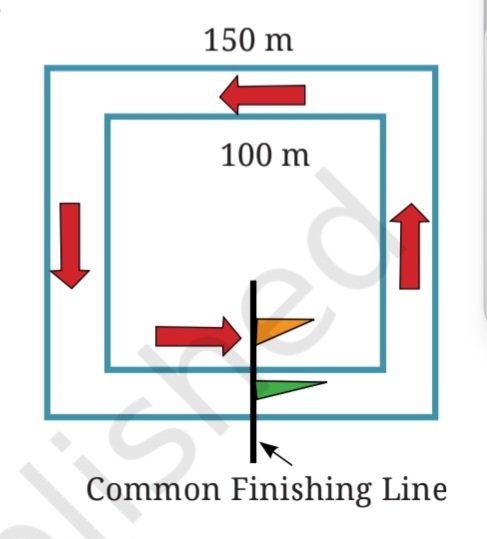
Deep Dive: In races, usually there is a common finish line for all the runners. Here are two square running tracks with the inner track of 100 m each side and outer track of 150 m each side. The common finishing line for both runners is shown by the flags in the figure which are in the center of one of the sides of the tracks.If the total race is of 350 m, then we have to find out where the starting positions of the two runners should be on these two tracks so that they both have a common finishing line after they run for 350 m. Mark the starting points of the runner on the inner track as ‘A’ and the runner on the outer track as ‘B’.
Inner track:100 + 100 + 100 + 50 =350 mOuter track:125 + 150 + 75 =350 mTherefore, mark A and B at the corresponding positions shown in the figure.
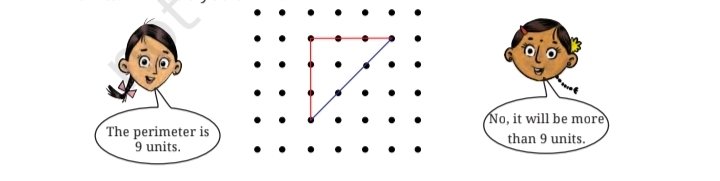
Q. Akshi says that the perimeter of this triangle shape is 9 units. Toshi says it can’t be 9 units and the perimeter will be more than 9 units. What do you think?
The perimeter will be more than 9 units because the diagonal of a square is longer than its side.Toshi’s statement is correct.
📖 Page No. 135 — Straight and Diagonal Units
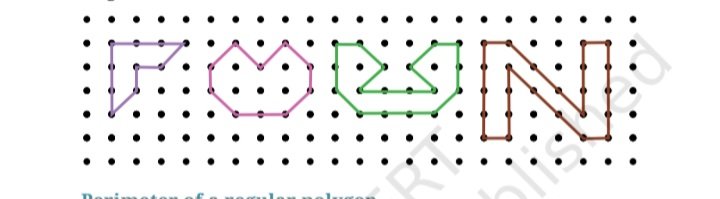
Q. Write the perimeters of the figures below in terms of straight and diagonal units.
Q. Find various objects from your surroundings that have regular shapes and find their perimeters. Also, generalise your understanding for the perimeter of other regular polygons.
Examples: square tiles, equilateral triangular shapes, regular pentagons and regular hexagons.For a regular polygon:
Perimeter = Number of sides × Length of one side.
Q. What is a similarity between a square and an equilateral triangle?
Both are regular polygons. Their sides are equal and their angles are equal.
📖 Page No. 136 — Split and Rejoin
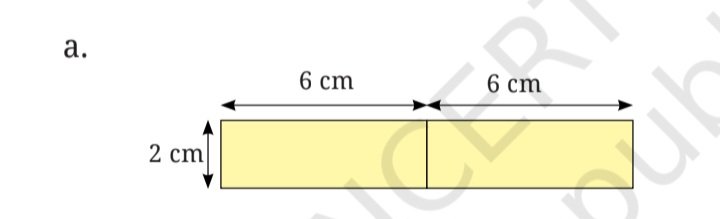
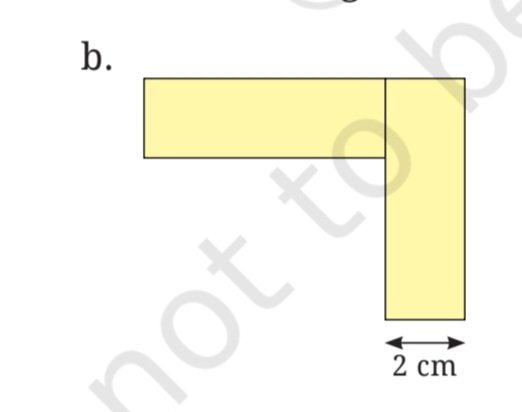
Q. Find out the length of the boundary (i.e., the perimeter) of each of the other arrangements below.
a) Length of the boundary = 6 + 2 + 6 + 2 + 4 + 6 + 2 = 28 cm.
Length of the boundary = 2 + 6 + 2 + 2 + 6 + 2 + 6 + 2 = 28 cm. Length of the boundary = 6 + 2 + 3 + 2 + 6 + 2 + 3 + 2 = 26 cm.
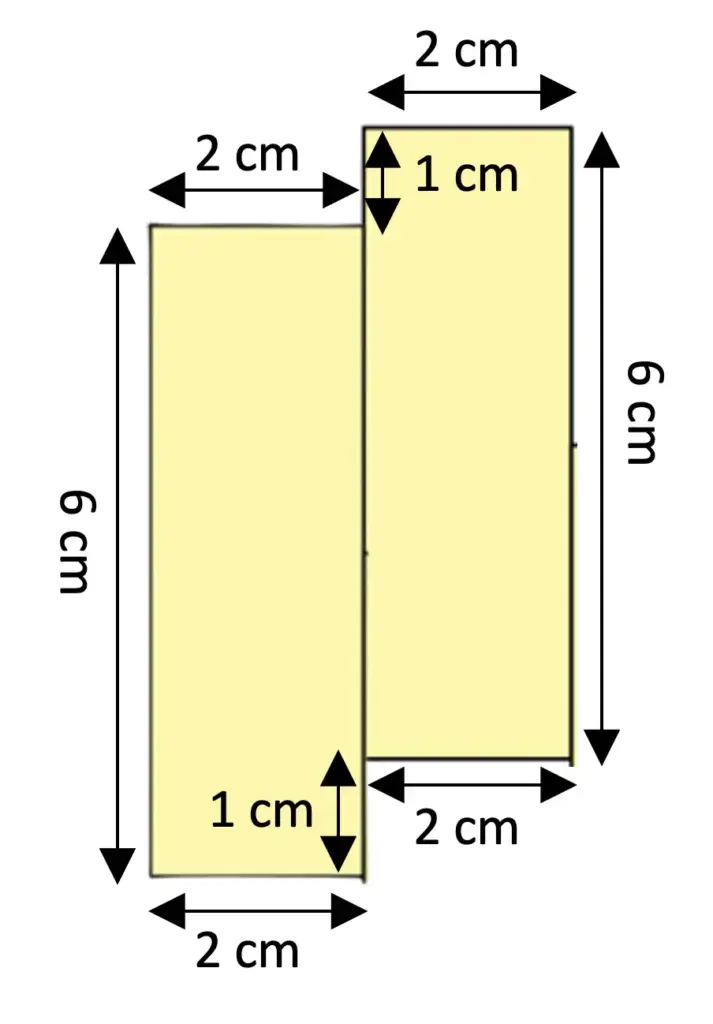
Q. Arrange the two pieces to form a figure with a perimeter of 22 cm.
Perimeter of the figure = 6 + 2 + 1 + 2 + 6 + 2 + 1 + 2 = 22 cm
📖 Page No. 137 — Section 6.2: Area
The amount of region enclosed by a closed figure is called its area.
Area of a square = Side × Side
Area of a rectangle = Length × Width
Q. Area of a square = ________ Area of a rectangle = _______
Area of a square = side × side.
Area of a rectangle = length × width.
📖 Page No. 138 — Figure it Out
Q.1. The area of a rectangular garden 25 m long is 300 sq m. What is the width of the garden?
Width = Area ÷ Length= 300 ÷ 25= 12 m.
Q.2. What is the cost of tiling a rectangular plot of land 500 m long and 200 m wide at the rate of ` 8 per hundred sq m?
Q.3. A rectangular coconut grove is 100 m long and 50 m wide. If each coconut tree requires 25 sq m, what is the maximum number of trees that can be planted in this grove?
Area of grove = 100 × 50= 5000 sq mNumber of trees = 5000 ÷ 25= 200 trees.
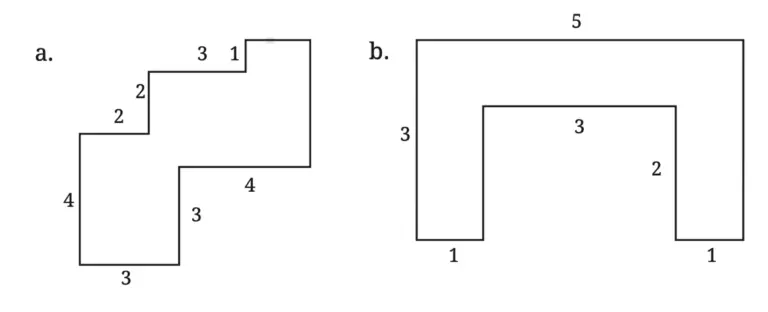
Q.4. By splitting the following figures into rectangles, find their areas (all measures are given in metres).
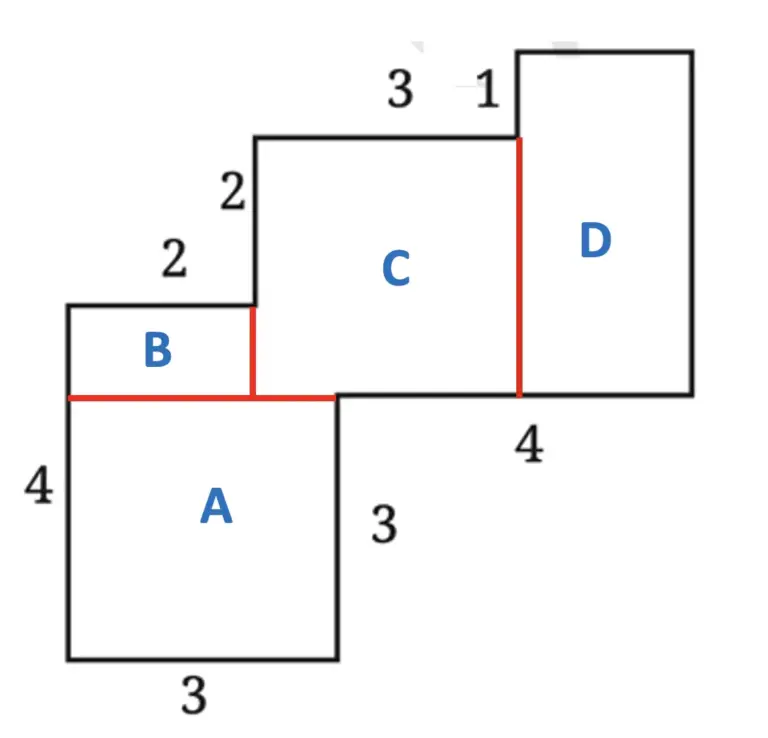
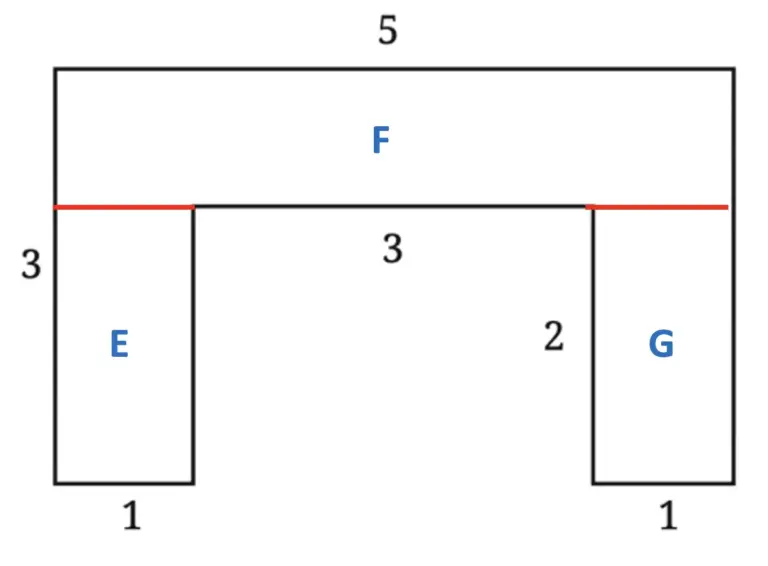
Split each figure into rectangles and add their areas.
Area of the figure(a) = Area of square A + Area of rectangle B + Area of square C + Area of rectangle D
= (3 × 3) + (1 × 2) + (3 × 3) + (4 × 2)
= 9 + 2 + 9 + 8
= 28 m2 < Br>
Area of the figure = Area of rectangle E + Area of rectangle F + Area of rectangle G
= (1 × 2) + (1 × 5) + (1 × 2)
= 2 + 5 + 2
= 9 m2
(a) 28 sq. m.
(b) 9 sq. m.
📖 Page No. 139 — Figure it Out
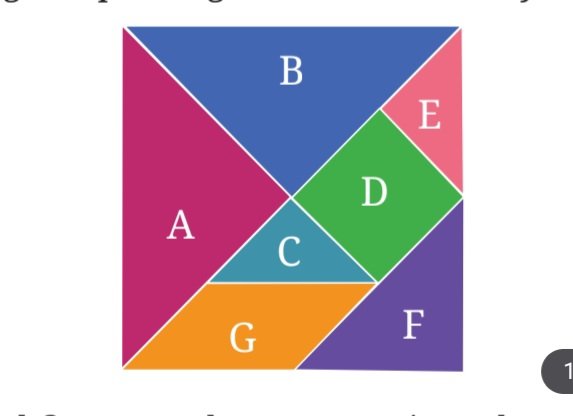
Q.1. Explore and figure out how many pieces have the same area.
The pieces having the same area are:
Shape A and Shape B have the same area.
Shape C and Shape E have the same area.
Shape D, Shape F and Shape G have the same area.
Q.2. How many times bigger is Shape D as compared to Shape C? What is the relationship between Shapes C, D and E?
Shape D can be exactly covered by Shapes C and E.Since Shapes C and E have equal areas:
Area of D = Area of C + Area of E
Therefore, Shape D is 2 times the area of Shape C.
The relationship is: C = E D = C + E = 2C
Q.3. Which shape has more area: Shape D or F? Give reasons for your answer.
Both Shape D and Shape F have the same area.
Reason: Shape D has twice the area of Shape C, and Shape F also has the same area as Shape D.
Therefore: Area of D = Area of F
Q.4. Which shape has more area: Shape F or G? Give reasons for your answer.
Shape F and Shape G have the same area.
Both pieces occupy the same amount of area in the tangram.
Therefore: Area of F = Area of G
Q.5. What is the area of Shape A as compared to Shape G? Is it twice as big? Four times as big?
Shape A has the same area as Shape B.
Shape D, F and G each have twice the area of Shape C. Shape A has twice the area of Shape D.
Therefore: Area of A = 2 × Area of G
So, Shape A is twice as big as Shape G, not four times as big.
Q.6. Can you now figure out the area of the big square formed with all seven pieces in terms of the area of Shape C?
Let the area of Shape C be 1 unit.
Shape C = 1 unit
Shape E = 1 unit
Shape D = 2 units
Shape F = 2 units
Shape G = 2 units
Shape A = 4 units
Shape B = 4 units
Therefore, the area of the big square is:
1 + 1 + 2 + 2 + 2 + 4 + 4 = 16 units
Hence, the area of the big square is: 16 times the area of Shape C.
Q.7. Arrange these 7 pieces to form a rectangle. What will be the area of this rectangle in terms of the area of Shape C now? Give reasons for your answer.
When the seven pieces are rearranged to form a rectangle, no piece is added or removed. Therefore, the total area remains unchanged.
From Question 6, the total area of all seven pieces is 16 times the area of Shape C.
Therefore: Area of the rectangle = 16 × Area of Shape C
The area remains the same because rearranging the pieces changes their positions but does not change their individual areas.
Q.8. Are the perimeters of the square and the rectangle formed from these 7 pieces different or the same? Give an explanation for your answer.
The perimeters of the square and the rectangle are different.
Although both shapes are made from the same seven pieces and therefore have the same area, their outer boundaries are arranged differently.
A square and a rectangle of the same area generally have different side lengths and therefore different perimeters.
Thus: Area of square = Area of rectangle
but Perimeter of square ≠ Perimeter of rectangle.
📖 Page No. 140 — Estimating Area
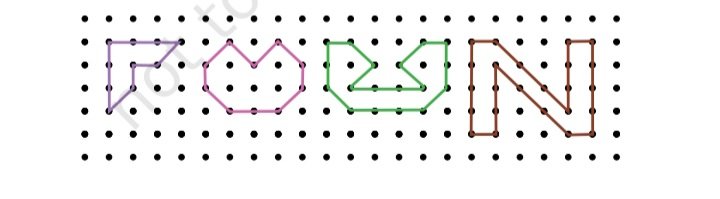
Q. Find the area of the following figures.
Using the square-grid estimation method:
4 sq. units, 9 sq. units, 10 sq. units, 11 sq. units.
📖 Page No. 142 — Area and Triangle
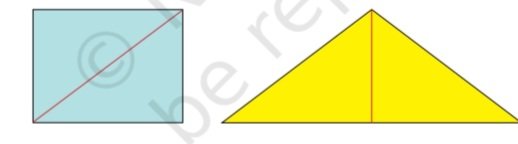
Draw a rectangle on a piece of paper and draw one of its diagonals. Cut the rectangle along that diagonal and get two triangles. Check! whether the two triangles overlap each other exactly. Do they have the same area?
Yes. The diagonal divides the rectangle into two triangles of equal area.Each triangle has half the area of the rectangle.
Can you draw any inferences from this exercise? Please write it here.
A diagonal of a rectangle divides it into two triangles having equal areas.
📖 Page No. 143 — Area of Triangle
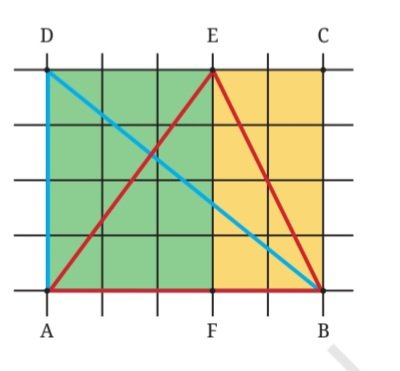
1. Find the area of blue triangle BAD.
Triangle BAD is half of rectangle ABCD.
Area of triangle BAD = ½ × Area of rectangle ABCD.
2. Find the area of red triangle ABE.
Triangle ABE is formed from two triangular halves of rectangles AFED and BFEC.Therefore:
Area of triangle ABE = ½ × Area of rectangle ABCD.
Conclusion
The area of a triangle is half the area of a rectangle having the same base and height.
Area of triangle = ½ × base × height.
📖 Page No. 144 — Figure it Out
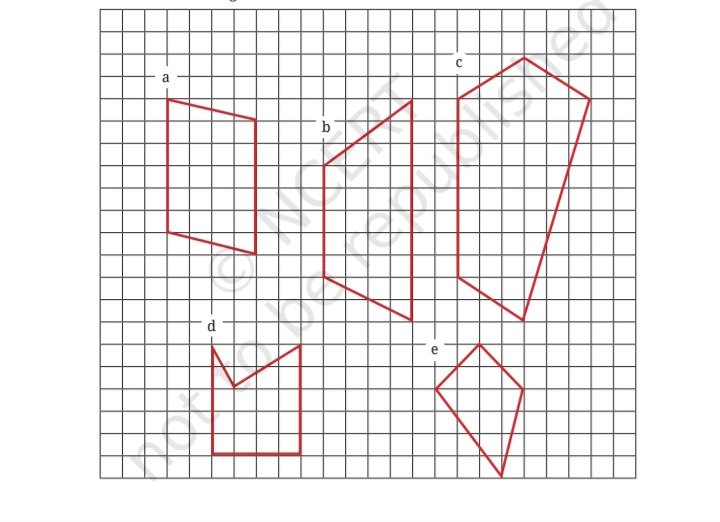
Q.1. Find the areas of the figures below by dividing them into rectangles and triangles.
Answers:a. 24 sq. units
b. 30 sq. units
c. 48 sq. units
d. 16 sq. units
e. 12 sq. units
📖 Page No. 145 — Making it ‘More’ or ‘Less’
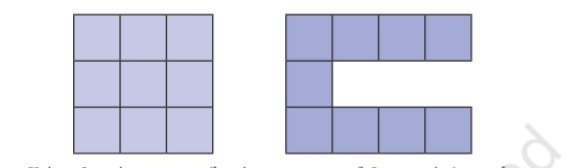
Using 9 unit squares, solve the following.
1. What is the smallest perimeter possible?
2. What is the largest perimeter possible?
3. Make a figure with a perimeter of 18 units.
4. Can you make other shaped figures for each of the above three perimeters, or is there only one shape with that perimeter? What is your reasoning?
1. Smallest possible perimeter = 12 units.
2. Largest possible perimeter = 20 units.
3. A suitable connected arrangement can be made with perimeter 18 units.
4. Different arrangements can have the same perimeter, except the smallest perimeter in this activity.
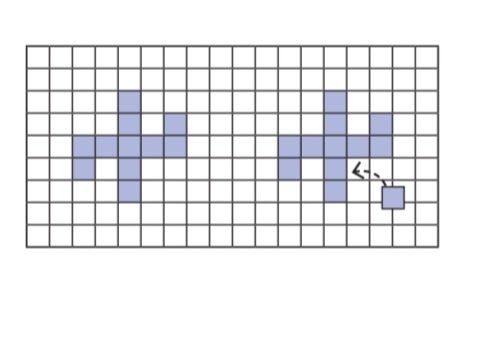
Let’s do something tricky now! We have a figure below having perimeter 24 units. Without calculating all over again, observe, think and find out what will be the change in the perimeter if a new square is attached as shown on the right.
When a square is attached along one complete side, one old boundary side disappears and three new sides are added.Therefore:
Perimeter increases by 2 units.
Experiment placing this new square at different places and think what the change in perimeter will be. Can you place the square so that the perimeter: a) increases; b) decreases; c) stays the same?
a. If the square shares one side, the perimeter increases by 2 units. b. If the square shares three sides, the perimeter decreases by 2 units. c. If the square shares two sides, the perimeter stays the same.
📖 Page No. 146 — Charan’s House Plan
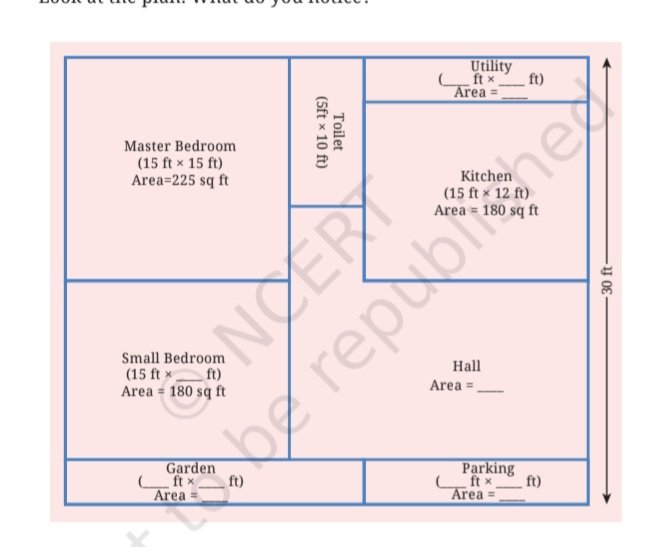
Below is the house plan of Charan. It is in a rectangular plot. Look at the plan. What do you notice?
The house plan is divided into different rectangular regions. The missing dimensions can be found using the given dimensions and the total dimensions.
a. Find the missing measurements.
Small Bedroom = 15 ft × 12 ft = 180 sq ft
Utility = 15 ft × 3 ft = 45 sq ft
Hall = 20 ft × 12 ft = 240 sq ft
Parking = 15 ft × 3 ft = 45 sq ft
Garden = 20 ft × 3 ft = 60 sq ft
b. Find out the area of his house.
Area = 35 ft × 30 ft
= 1050 sq ft.
📖 Page No. 147 — Sharan’s Home
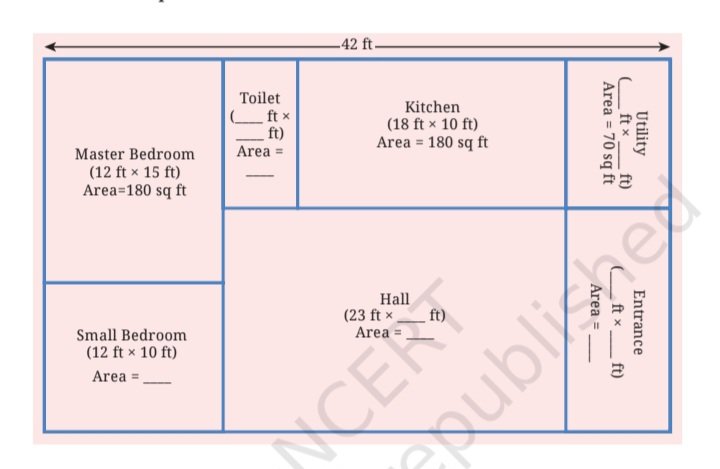
Now, find out the missing dimensions and area of Sharan’s home. Below is the plan:
Utility = 7 ft × 10 ft = 70 sq ft
Hall = 23 ft × 15 ft = 345 sq ft
Entrance = 7 ft × 15 ft = 105 sq ft
Small Bedroom = 12 ft × 10 ft = 120 sq ft
Toilet = 5 ft × 10 ft = 50 sq ft
a. Find the missing measurements.
b. Find out the area of his house.
What are the dimensions of all the different rooms in Sharan’s house? Compare the areas and perimeters of Sharan’s house and Charan’s house.
Sharan’s house:42 ft × 25 ftArea = 1050 sq ft.
Charan’s house:35 ft × 30 ftArea = 1050 sq ft.
Thus, the areas of both houses are equal.
Perimeter of Charan’s house = 130 ft Perimeter of Sharan’s house = 134 ft
📖 Page No. 148 — Area Maze Puzzles
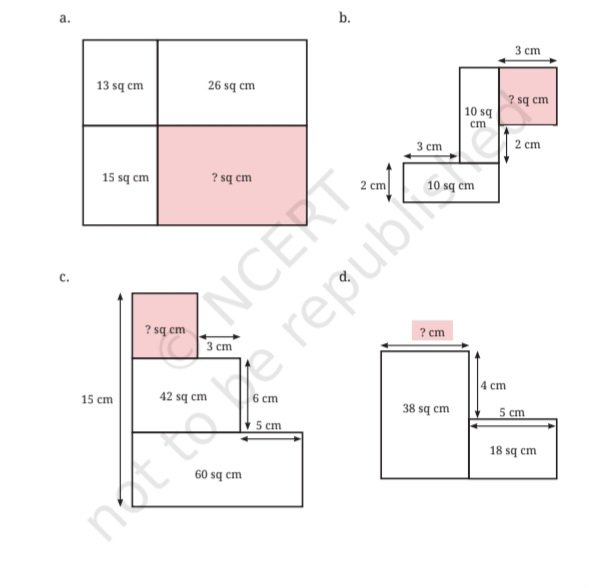
In each figure, find the missing value of either the length of a side or the area of a region.
a. 30 sq cm
b. 9 sq cm
c. 16 sq cm
d. 5 cm
📖 Page No. 149 — Figure it Out
Q.1. Give the dimensions of a rectangle whose area is the sum of the areas of these two rectangles having measurements: 5 m × 10 m and 2 m × 7 m.
Area of first rectangle = 5 × 10 = 50 sq m Area of second rectangle = 2 × 7 = 14 sq m Total area = 64 sq m
Possible dimensions:
16 m × 4 m
32 m × 2 m
8 m × 8 m
Q.2. The area of a rectangular garden that is 50 m long is 1000 sq m. Find the width of the garden?
Width = Area ÷ Length= 1000 ÷ 50= 20 m.
Q.3. The floor of a room is 5 m long and 4 m wide. A square carpet whose sides are 3 m in length is laid on the floor. Find the area that is not carpeted.
Floor area = 5 × 4 = 20 sq m Carpet area = 3 × 3 = 9 sq m Uncarpeted area = 20 − 9= 11 sq m.
Q.4. Four flower beds having sides 2 m long and 1 m wide are dug at the four corners of a garden that is 15 m long and 12 m wide. How much area is now available for laying down a lawn?
Garden area = 15 × 12 = 180 sq m Area of four flower beds:4 × 2 × 1 = 8 sq m Lawn area = 180 − 8= 172 sq m.
Q.5. Shape A has an area of 18 square units and Shape B has an area of 20 square units. Shape A has a longer perimeter than Shape B. Draw two such shapes satisfying the given conditions.
One possible choice:Shape A = 2 × 9Area = 18 sq unitsPerimeter = 22 units
Shape B = 5 × 4Area = 20 sq unitsPerimeter = 18 units Thus, Shape A has a longer perimeter.
Q.6. On a page in your book, draw a rectangular border that is 1 cm from the top and bottom and 1.5 cm from the left and right sides. What is the perimeter of the border?
The numerical answer depends on the dimensions of the book page.Use:
Perimeter = 2 × (length + breadth)
after finding the dimensions of the rectangular border.
Q.7. Draw a rectangle of size 12 units × 8 units. Draw another rectangle inside it, without touching the outer rectangle that occupies exactly half the area.
Area of outer rectangle:12 × 8 = 96 sq units Half area:96 ÷ 2 = 48 sq units A possible inner rectangle is:8 × 6 = 48 sq units.
Q.8. A square piece of paper is folded in half. The square is then cut into two rectangles along the fold. Regardless of the size of the square, one of the following statements is always true. Which statement is true here?
a. The area of each rectangle is larger than the area of the square. b. The perimeter of the square is greater than the perimeters of both the rectangles added together. c. The perimeters of both the rectangles added together is always 11/2 times the perimeter of the square. d. The area of the square is always three times as large as the areas of both rectangles added together.
Let the side of the square be s.Each rectangle has dimensions:s × s/2Perimeter of each rectangle:2(s + s/2) = 3sPerimeters of both rectangles:3s + 3s = 6sPerimeter of square:4sTherefore:6s ÷ 4s = 3/2So the correct statement is:
c. The perimeters of both the rectangles added together is always 11/2 times the perimeter of the square.
⭐ Quick Revision
Perimeter = Boundary length of a closed figure.
Rectangle: P = 2(l + b)
Square: P = 4s
Triangle: P = Sum of three sides
Regular polygon: P = Number of sides × Side
Rectangle area: A = l × b
Square area: A = s × s
Triangle area: A = ½ × base × height
Two figures can have the same area but different perimeters.
Two figures can have the same perimeter but different areas.
Practice Class 6 Maths Chapter 6 with this easy and engaging worksheet. This worksheet is useful for practice, revision and exam preparation.
Class 6 Maths Chapter 6, Perimeter and Area, Class 6 Maths notes, Class 6 Maths solutions, NCERT Class 6 Maths Chapter 6, Class 6 Maths worksheet, perimeter, area, rectangles, squares, shapes, Class 6 Maths questions and answers.


 Perimeter of the figure = 6 + 2 + 1 + 2 + 6 + 2 + 1 + 2 = 22 cm
 Area of the figure(a) = Area of square A + Area of rectangle B + Area of square C + Area of rectangle D
 Area of the figure = Area of rectangle E + Area of rectangle F + Area of rectangle G