Class 6 Maths Chapter 3 Number Play – easy notes, concepts, NCERT book solutions, important questions, worksheet and answers. Learn about numbers, number patterns, divisibility, factors, multiples and interesting number games with simple explanations.
NUMBER PLAY
Ganita Prakash
Chapter 3 | Reprint 2026–27
Complete Concepts, Activities, Questions and Easy Solutions
Chapter Introduction
Numbers are used in different contexts and in many different ways to organise our lives. We use numbers to count, measure, compare, calculate, identify patterns, estimate quantities, solve problems and play games.
In this chapter we will play with numbers, discover patterns, explore special numbers, learn about palindromes and Kaprekar numbers, investigate Collatz sequences and use mental mathematics and estimation.
Easy Solution
- Time
- Calendar and dates
- Counting objects and marks
- Measuring height and weight
- Money
There can be many more examples.
3.1 Numbers can Tell us Things
Using numbers to describe the arrangement of people.
Important Idea
Each child says the number of taller neighbours standing next to them. A child can therefore say 0, 1 or 2.
- 0: Neither neighbour is taller.
- 1: One neighbour is taller.
- 2: Both neighbours are taller.
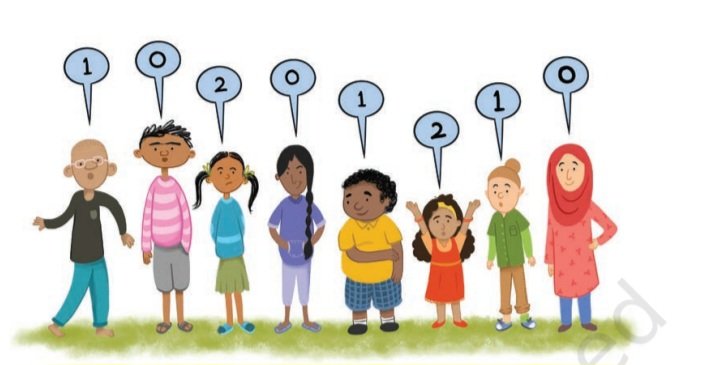
Easy Solution
The numbers tell us how many taller children are standing next to each child.
Solution
No. A child standing at an end has only one neighbour, so they cannot have two taller neighbours.
Solution
Yes. If all the children have the same height, nobody has a taller neighbour.
Solution
Yes. The arrangement shown in the chapter gives an example.
Solution
Yes. They can stand in increasing order of height.
Solution
No. A child standing at an end has only one neighbour, so the tallest child at an end cannot say 1.
Solution
Yes. A suitable arrangement of five children can produce this sequence.
Solution
At most 2 children can say 2. Put the tallest child in the middle and arrange shorter children around it suitably.
3.2 Supercells
A supercell contains a number greater than all its adjacent cells.
What is a Supercell?
A cell is a supercell if its number is larger than all its adjacent cells. In a row, the adjacent cells are immediately to the left and right. In a larger table, cells immediately above, below, left and right are neighbours.
A boundary cell may have fewer neighbours.
6828 670 9435 3780 3708 7308 8000 5583 52
Solution
p>
The supercells are numbers greater than their adjacent numbers.
One Possible Solution

There can be many correct answers.
Solution
Arrange numbers in an alternating high-low pattern. This makes every other cell a supercell.

Answer
5 supercells.
Easy Solution
For an even number of cells, the maximum number of supercells is half the cells. For an odd number of cells, it is one more than half after rounding down.
| Cells | Maximum Supercells |
|---|---|
| 1 | 1 |
| 2 | 1 |
| 3 | 2 |
| 4 | 2 |
| 5 | 3 |
| 6 | 3 |
| 7 | 4 |
| 8 | 4 |
| 9 | 5 |
Strategy: Fill high and low numbers alternately.
Solution
No. The largest number must be greater than all its neighbours, so it will always be a supercell.
Solution
Largest: Yes. It is greater than every neighbour.
Smallest: No. A neighbouring number will be greater than it.
One Possible Solution
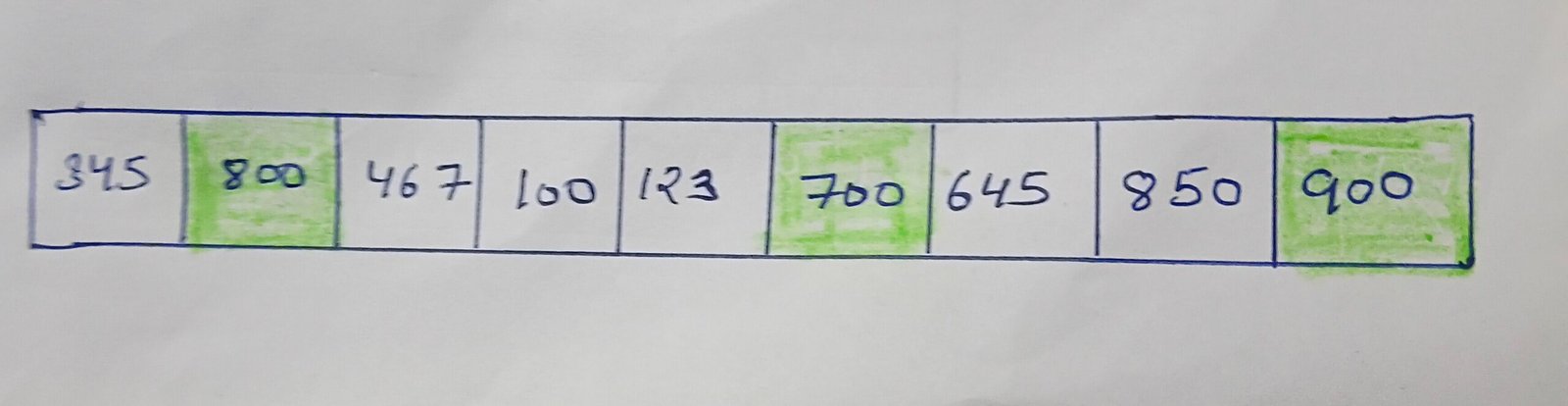
Here 900 is the largest, while 850, the second largest, is not a supercell.
Solution
Yes. One possible arrangement is:

Here the second smallest number can be made a supercell and the second largest need not be one.
Possible Challenges
- Can you make exactly 4 supercells in 9 cells?
- Can you make more than 5 supercells in 9 cells?
- Can you make the second largest number a supercell?
One Possible Solution
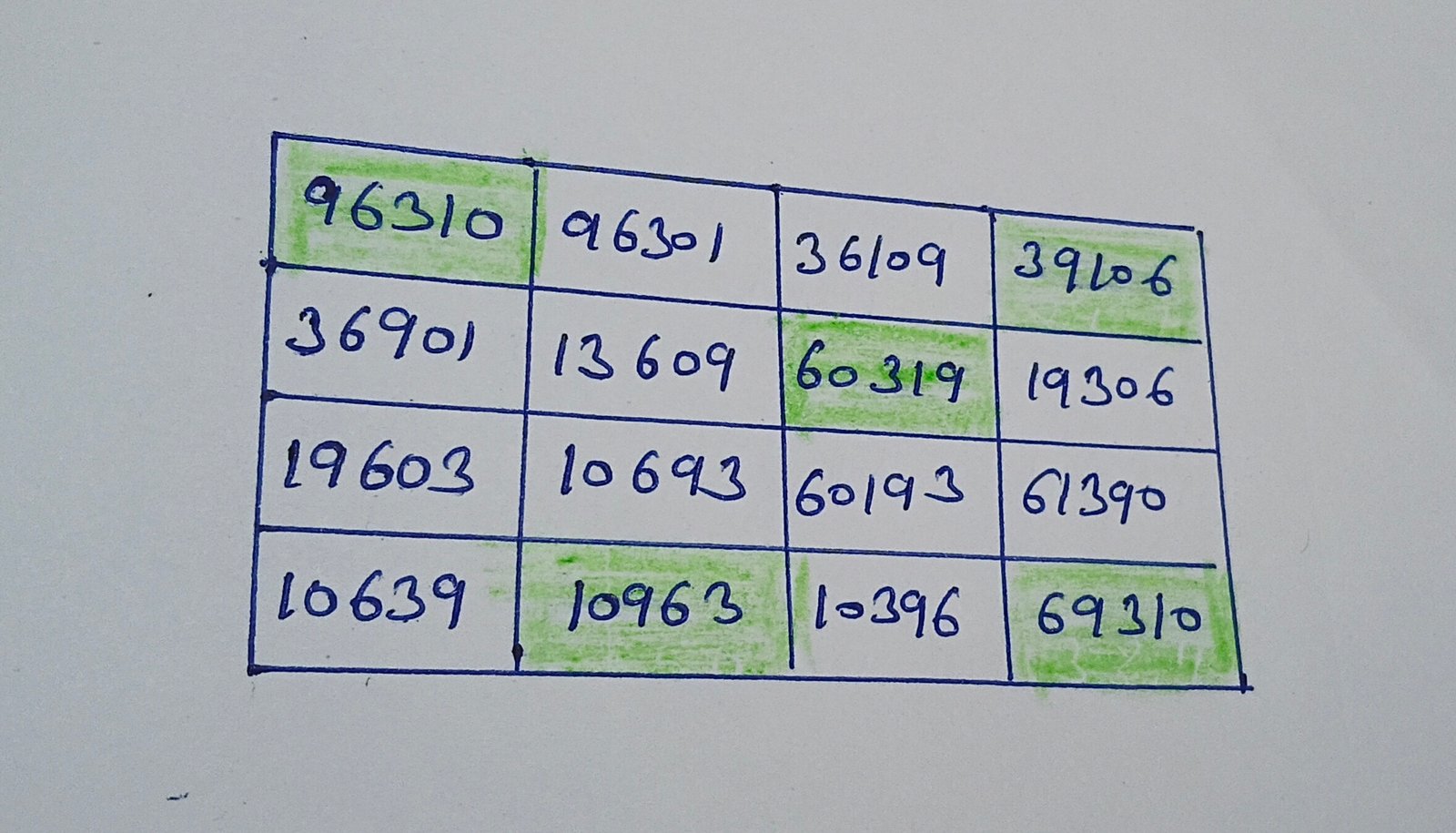
Answer
96,310
Answer
10,396
Answer
60,193
3.3 Patterns of Numbers on the Number Line
Locate, compare and order numbers.
Number Line Reminder
On a number line, numbers increase as we move to the right and decrease as we move to the left.
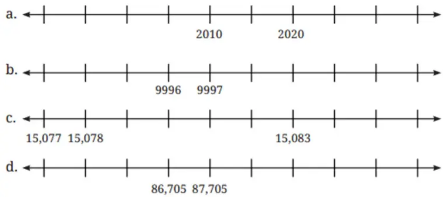
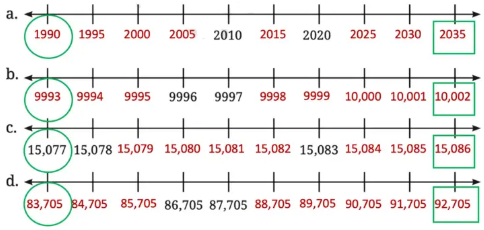
a.
2010 2020
b.
9996 9997
c.
15,077 15,078 15,083
d.
86,705 87,705
Put a circle around the smallest number and a box around the largest number in each of the sequences above.
Easy Solution
3.4 Playing with Digits
Digit counts, digit sums and digit detectives.
How Many Numbers?
| Number of digits | Numbers |
|---|---|
| 1-digit | 9 |
| 2-digit | 90 |
| 3-digit | 900 |
| 4-digit | 9,000 |
| 5-digit | 90,000 |
a. Write other numbers whose digits add up to 14.
b. What is the smallest number whose digit sum is 14?
c. What is the largest 5-digit whose digit sum is 14?
d. How big a number can you form having the digit sum of 14? Can you make an even bigger number?
Solution
a. Examples: 248, 653, 356, 815, 833, 12335.
b. 59.
c. 95,000.
d. 95, 9005, 900005, 90000005, …
Solution
| Number | Digit Sum | Number | Digit Sum |
|---|---|---|---|
| 40 | 4 | 56 | 11 |
| 41 | 5 | 57 | 12 |
| 42 | 6 | 58 | 13 |
| 43 | 7 | 59 | 14 |
| 44 | 8 | 60 | 6 |
| 45 | 9 | 61 | 7 |
| 46 | 10 | 62 | 8 |
| 47 | 11 | 63 | 9 |
| 48 | 12 | 64 | 10 |
| 49 | 13 | 65 | 11 |
| 50 | 5 | 66 | 12 |
| 51 | 6 | 67 | 13 |
| 52 | 7 | 68 | 14 |
| 53 | 8 | 69 | 15 |
| 54 | 9 | 70 | 7 |
| 55 | 10 |
The digit sum drops when the tens digit changes, then increases by 1 again.
Solution
123 → 6
234 → 9
345 → 12
456 → 15
567 → 18
678 → 21
789 → 24
Pattern: the sum increases by 3 each time.
All these sums are multiples of 3. The pattern stops after 789 because 890 is not made of three consecutive increasing digits.
Solution
From 1 to 100, digit 7 occurs 20 times.
From 1 to 1000, digit 7 occurs 300 times.
3.5 Pretty Palindromic Patterns
Numbers that read the same forwards and backwards.
Palindrome
A palindrome reads the same from left to right and from right to left.
Solution
111, 121, 131
222, 212, 232
313, 323, 333
Solution
For the 2-digit numbers considered in this activity, reversing and adding gives a palindrome.
47 + 74 = 121
Solution
The number is 12421.
It is a palindrome and is odd.
3.6 The Magic Number of Kaprekar
Discovering the famous Kaprekar constant 6174.
Kaprekar Process
- Take a 4-digit number with at least two different digits.
- Arrange its digits to make the largest number A.
- Arrange its digits to make the smallest number B.
- Subtract B from A.
- Repeat.
Solution
For the example 321:
981 − 189 = 792
972 − 279 = 693
963 − 369 = 594
954 − 459 = 495
954 − 459 = 495
So 495 starts repeating.
3.7 Clock and Calendar Numbers
Finding number patterns in clocks, dates and calendars.
Pattern Times
We can look for repeated digits, reversed digits and other patterns.
Possible Answers
4:44, 2:22, 3:33, 10:10, 11:11, 12:12, 09:09, 12:21, 05:50, 10:01
Try to find more patterns.
Possible Answers
20/04/2004, 20/06/2006 and other dates with the same digit pattern.
Possible Answers
01/02/2001, 02/02/2002 and other dates having the same palindrome pattern.
Solution
Yes. Calendars can repeat after a number of years.
The exact gap depends on leap years. A calendar may repeat after 5 or 6 years in many cases.
a. the difference between the largest and smallest numbers greater than 5085.
b. the difference between the largest and smallest numbers less than 5085.
c. the sum of the largest and smallest numbers greater than 9779.
d. the sum of the largest and smallest numbers less than 9779.
One Possible Set of Answers
a. 7431 − 1347 = 6084
b. 7433 − 3347 = 4086
c. 7433 + 3347 = 10,780
d. 7431 + 1347 = 8,778
Solution
Smallest 5-digit palindrome = 10,001
Largest 5-digit palindrome = 99,999
Difference = 99,999 − 10,001 = 89,998
Solution
Current time = 10:01.
Next palindrome = 11:11.
Time difference = 70 minutes.
Next palindrome = 12:21.
From 10:01 to 12:21 = 140 minutes.
Solution
1st RoundA = 8653
B = 3568
C = 8653 − 3568 = 5085
2nd Round
A = 8550
B = 0558
C = 8550 − 0558 = 7992
3rd Round
A = 9972
B = 2799
C = 9972 − 2799 = 7173
4th Round
A = 7731
B = 1377
C = 7731 − 1377 = 6354
5th Round
A = 6543
B = 3456
C = 6543 − 3456 = 3087
6th Round
A = 8730
B = 0378
C = 8730 − 0378 = 8352
7th Round
A = 8532
B = 2358
C = 8532 − 2358 = 6174
Result
Thus, the number 5683 reaches Kaprekar’s constant, 6174, after 7 rounds.
3.8 Mental Math
Use numbers cleverly instead of calculating one by one.
Helpful Idea
Numbers in the middle can be used as many times as needed to make a target number. For example:
3,400 = 1,500 + 1,500 + 400
Solution
1,000 cannot be made. The only number below 1,000 is 400, and 1,000 is not a multiple of 400.
15,000 = 13,000 + 400 × 5
16,000 = 1,500 × 8 + 400 × 10
So, among the thousands asked about, only 1,000 cannot be made.
5-digit + 5-digit to give a 5-digit sum more than 90,250
5-digit – 5-digit to give a difference less than 56,503
4-digit + 4-digit to give a 6-digit sum
5-digit − 4-digit to give a 4-digit difference
5-digit + 3-digit to give a 6-digit sum
5-digit – 3-digit to give a 4-digit difference
5-digit + 5-digit to give a 6-digit sum
5-digit − 5-digit to give a 3-digit difference
5-digit + 5-digit to give 18,500
5-digit − 5-digit to give 91,500
Solutions
5-digit + 5-digit > 90,250: 45,000 + 45,400 = 90,400
5-digit − 5-digit < 56,503: 80,000 − 50,000 = 30,000
4-digit + 4-digit = 6-digit: Not possible. Maximum is 9,999 + 9,999 = 19,998.
5-digit − 4-digit = 4-digit: 12,000 − 2,500 = 9,500
5-digit + 3-digit = 6-digit: 99,999 + 999 = 100,998
5-digit − 3-digit = 4-digit: 10,000 − 999 = 9,001
5-digit + 5-digit = 6-digit: 60,000 + 40,000 = 1,00,000
5-digit − 5-digit = 3-digit: 50,999 − 50,000 = 999
5-digit + 5-digit = 18,500: Not possible. The smallest sum is 10,000 + 10,000 = 20,000.
5-digit − 5-digit = 91,500: Not possible. The largest possible difference is 99,999 − 10,000 = 89,999.
a. 5-digit number + 5-digit number gives a 5-digit number
b. 4-digit number + 2-digit number gives a 4-digit number
c. 4-digit number + 2-digit number gives a 6-digit number
d. 5-digit number – 5-digit number gives a 5-digit number
e. 5-digit number – 2-digit number gives a 3-digit number
Answers
| Statement | Answer | Reason |
|---|---|---|
| a | Sometimes | 10,000 + 10,000 = 20,000, but 50,000 + 60,000 = 1,10,000. |
| b | Sometimes | 9,000 + 99 = 9,099, but 9,999 + 99 = 10,098. |
| c | Never | The greatest possible sum is 10,098. |
| d | Sometimes | Usually the difference can have fewer digits; for example 12,000 − 10,000 = 2,000. |
| e | Never | 10,000 − 99 = 9,901, which is still a 4-digit number. |
3.9 Playing with Number Patterns
Look for groups and multiply instead of adding one by one.
Quick Strategy
If the same number occurs many times, count how many times it occurs and multiply.
Easy Method
p>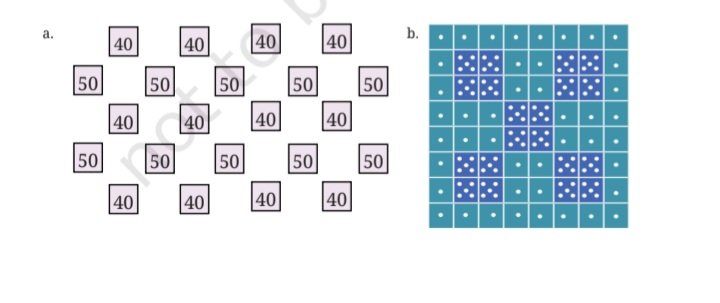
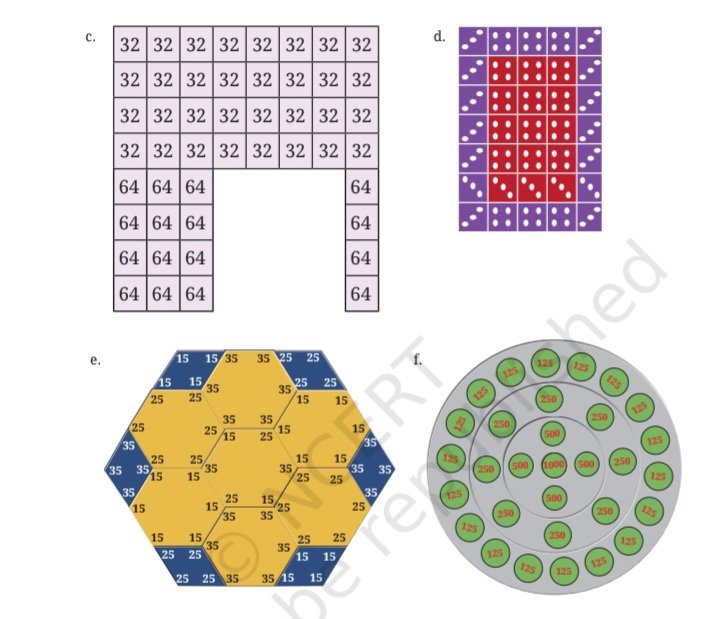
Do not add every number separately. Count identical numbers first and multiply.
- If there are n copies of 40, their total is 40 × n.
- If there are n copies of 50, their total is 50 × n.
- For 32 and 64, group the repeated rows and columns.
- For 125, 250, 500 and 1000, use multiplication and grouping.
- For figures using 15, 25 and 35, count each group separately and add the totals.
3.10 An Unsolved Mystery — the Collatz Conjecture!
A fascinating number process that mathematicians are still studying.
Collatz Rule
- If the number is even, divide it by 2.
- If the number is odd, multiply it by 3 and add 1.
- Repeat the process.
Example
28 → 14 → 7 → 22 → 11 → 34 → 17 → 52 → 26 → 13 → 40 → 20 → 10 → 5 → 16 → 8 → 4 → 2 → 1
19 → 58 → 29 → 88 → 44 → 22 → 11 → 34 → 17 → 52 → 26 → 13 → 40 → 20 → 10 → 5 → 16 → 8 → 4 → 2 → 1
These examples reach 1. However, the general conjecture is still an unsolved mathematical problem.
3.11 Simple Estimation
Sometimes an approximate answer is more useful than an exact answer.
What is Estimation?
Estimation means finding a reasonable approximate value without calculating the exact value.
For example, instead of saying exactly 487 students, we may say about 500 students.
a. From the place you are sitting to the classroom door
b. Across the school ground from start to end
c. From your classroom door to the school gate
d. From your school to your home
Solution
These are estimation questions. Count your normal walking steps or estimate the distance and divide by your average step length.
Answers will be different for different students.
a. In a minute
b. In an hour
c. In a day
Easy Estimation
First estimate the number in one minute. Then multiply.
Daily estimate = hourly estimate × 24
a. a few thousand in number
b. more than ten thousand in number
Possible Answers
A few thousand: car numbers, 4-digit PIN possibilities.
More than ten thousand: mobile numbers, large collections of objects.
a. More than 5000
b. Less than 5000
Solution
This is an estimation activity. Count words on one page, multiply by the approximate number of pages and compare with 5000.
a. More than 200
b. Less than 200
Solution
Estimate this from the number of buses and the approximate number of students in each bus.
Solution
It may be possible if small quantities and inexpensive fruits are purchased.
With costly fruits or larger quantities, ₹100 may not be enough.
Hint: Look at the map of India to locate these cities.
Answer
About 2,500 kilometres.
Solution
No.
13,000 ÷ 1,200 ≈ 10.8 years.
A Grade 6 student has usually spent much fewer years in school, so 13,000 hours is too high.
a. Your current location to one of your favourite places nearby.
b. Your current location to any neighbouring state’s capital city.
c. The southernmost point in India to the northernmost point in India.
Solution
These are estimation activities. Estimate the distance, then divide by your walking speed.
The answers will vary according to the places chosen.
Examples
- How many students are there in your school?
- How many hours does a person sleep in a lifetime on an average?
- How many books are there in your school library?
3.12 Games and Winning Strategies
Use number patterns to find a winning strategy.
Game 21 — Key Idea
In Game 1, players can add 1, 2 or 3. A useful winning pattern is to reach:
After the other player adds a number, add enough to make the next target.
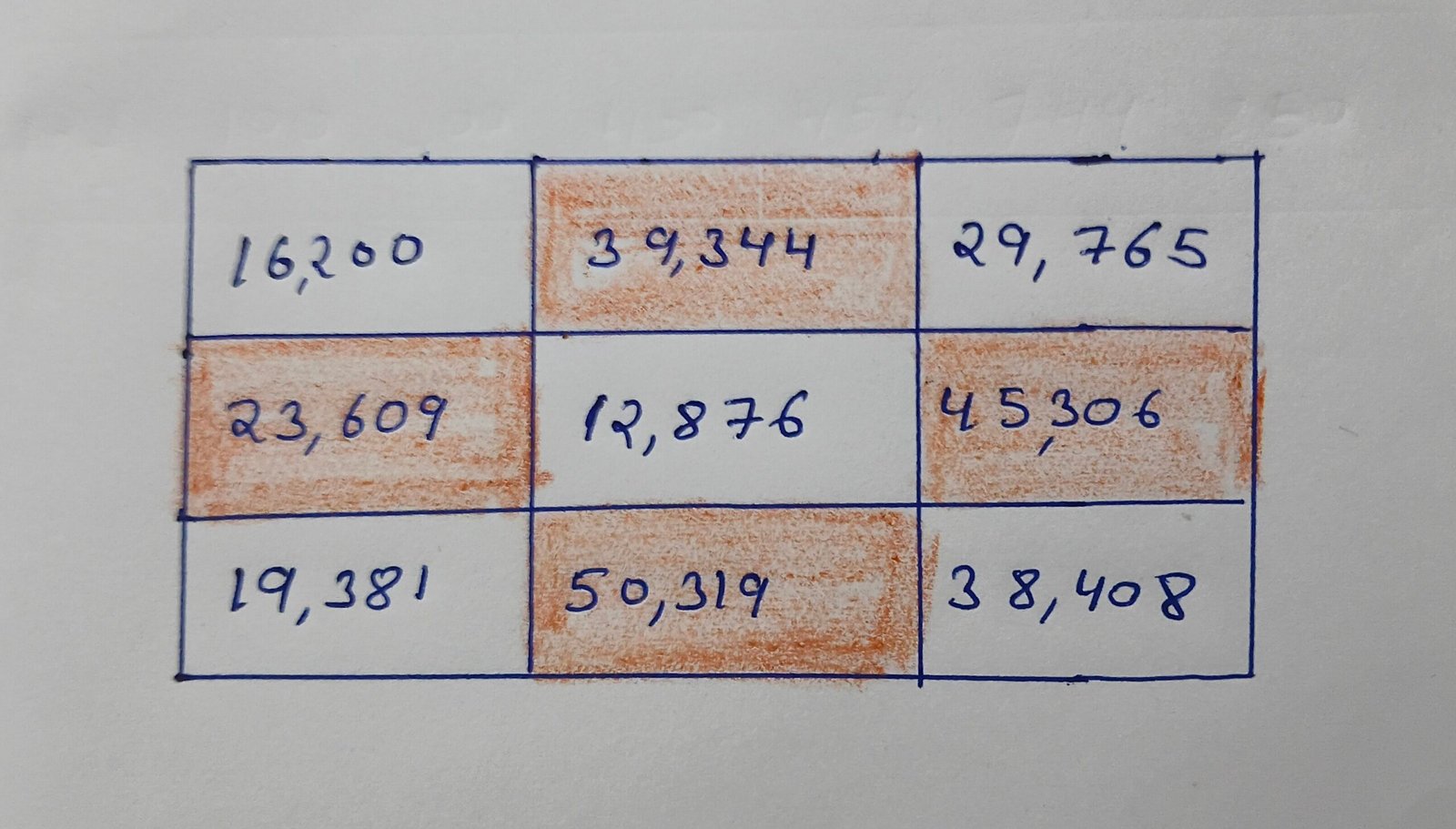
16,200 39,344 29,765
23,609 62,871 45,306
19,381 50,319 38,408
Solution
Exchange the digits 1 and 6 in 62,871.
It becomes 12,876, producing the required supercell arrangement.
Solution
Use your own birth year. do it yourself
Solution
With repetition allowed:
- Largest = 73,999
- Smallest = 35,111
- Closest to 50,000 = 51,111
If digits are not repeated:
- Largest = 73,951
- Smallest = 35,179
- Closest to 50,000 = 51,379
Solution
This is an estimation activity.
Count weekends, school vacations and festival holidays. Then compare your estimate with the actual school calendar.
Possible Estimates
| Object | Possible capacity |
|---|---|
| Mug | About 0.25–0.5 litre |
| Bucket | About 10–20 litres |
| Overhead tank | About 500–2,000 litres |
Actual values depend on the objects.
One Answer
One Possible Answer
Choose 250.

Many other patterns are possible.
Solution
Every positive power of 2 is even.
So the Collatz rule keeps dividing it by 2:
Therefore these starting numbers always reach 1.
Solution
Yes, for 100 the sequence reaches 1.
Winning Strategy
The first player can say 2.
After that, keep making the two players’ additions total 4.
If the other player adds 1, add 3. If the other player adds 2, add 2. If the other player adds 3, add 1.
In this way the first player reaches 22.
Chapter Summary
Number Play — Quick Revision
Remember These Ideas
- Numbers can give information about objects, people and situations.
- A supercell contains a number greater than all its neighbours.
- Number lines help us compare and locate numbers.
- The digit sum is found by adding the digits of a number.
- A palindrome reads the same forwards and backwards.
- 6174 is called the Kaprekar constant for the 4-digit Kaprekar process.
- 495 is the repeating number for the example 3-digit Kaprekar process.
- Collatz rule: even numbers are divided by 2; odd numbers are multiplied by 3 and increased by 1.
- Estimation gives a useful approximate answer.
- Patterns can help us solve number games and puzzles quickly.
- Some mathematical problems, such as the Collatz conjecture, remain unsolved.
Important Number Patterns
| Topic | Key Idea |
|---|---|
| Supercell | Greater than all neighbours |
| Palindrome | Same forwards and backwards |
| Kaprekar | 4-digit process reaches 6174 |
| 3-digit Kaprekar example | 495 repeats |
| Collatz | Even: ÷2; Odd: ×3+1 |
| Estimation | Reasonable approximate value |
Quick Practice
1. What is the smallest 5-digit number?
2. What is the largest 5-digit number?
3. Is 121 a palindrome?
4. What is the Kaprekar constant?
5. What happens to an even number in the Collatz process?
6. What does estimation mean?
Answers
1. 10,000
2. 99,999
3. Yes
4. 6174
5. It is divided by 2.
6. Finding a reasonable approximate value.
Practice Class 6 Maths Chapter 3 with this easy and engaging worksheet. This worksheet is useful for practice, revision and exam preparation.
Class 6 Maths Chapter 3, Number Play, Class 6 Maths notes, Class 6 Maths solutions, NCERT Class 6 Maths Chapter 3, Class 6 Maths worksheet, number patterns, divisibility, factors, multiples, number games, Class 6 Maths questions and answers.