Class 6 Maths Chapter 10 – The Other Side of Zero | Notes, Solutions & Worksheet
Class 6 Maths Chapter 10 The Other Side of Zero – easy notes, concepts, NCERT book solutions, important questions, worksheet and answers. Learn about integers, positive and negative numbers, number lines, comparing integers and operations with integers in simple language.
Class 6 Maths Chapter 10 The Other Side of Zero Notes & Solutions
Integers include positive numbers, negative numbers and zero.
… −4, −3, −2, −1, 0, 1, 2, 3, 4 …
Numbers to the right of 0 on a number line are positive.
Numbers to the left of 0 are negative.
Zero is neither positive nor negative.
2. Positive and Negative Numbers
Positive numbers are greater than zero.
Negative numbers are less than zero.
Zero lies between positive and negative numbers.
Positive numbers may be written without the + sign.
3. Number Line
On a number line, smaller numbers are on the left and larger numbers are on the right.
… −3 < −2 < −1 < 0 < 1 < 2 < 3 …
Moving to the right means positive movement. Moving to the left means negative movement.
4. Additive Inverse
The additive inverse of a number is the number which, when added to it, gives zero.
+5 + (−5) = 0
−7 + (+7) = 0
The inverse of +4 is −4. The inverse of −4 is +4. The inverse of 0 is 0.
5. Addition of Integers
Positive + Positive → add the numbers.
Negative + Negative → add the numbers and keep the negative sign.
Positive + Negative → subtract the smaller absolute value from the larger and keep the sign of the larger number.
A number + its inverse = 0.
A number + 0 = the same number.
6. Subtraction of Integers
Subtracting a number is the same as adding its additive inverse.
For example:
7 − (+5) = 7 + (−5)
8 − (−2) = 8 + (+2)
7. Building of Fun / Movement Model
Starting Position + Movement = Target Position
For finding movement:
Target Position − Starting Position = Movement Needed
8. Token Model
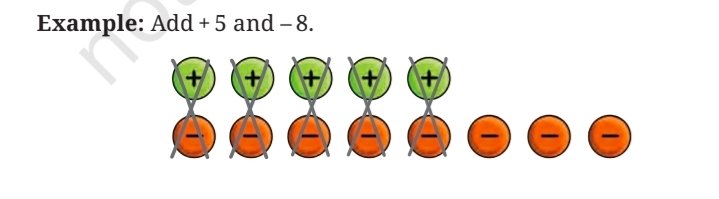
A positive token and a negative token form a zero pair because together their value is zero.
(+1) + (−1) = 0
Zero pairs can be removed without changing the value of the collection of tokens.
9. Integers in Daily Life
Credits can be represented by positive numbers.
Debits can be represented by negative numbers.
Heights above sea level can be positive.
Depths below sea level can be negative.
Temperatures below 0°C can be represented by negative numbers.
10. Important Rule
Subtracting a negative number = Adding the corresponding positive number
Example: 10 − (−3) = 10 + 3 = 13
📖 Page 242 – Introduction
Question 1
Can there be a number less than 0? Can you think of any ways to have less than 0 of something?
Solution:
Yes. Numbers less than zero are called negative numbers. Examples are −1, −2 and −10.
They can represent situations such as a debt, a temperature below 0°C or a position below ground level.
📖 Page 243 – Bela’s Building of Fun
Question 2
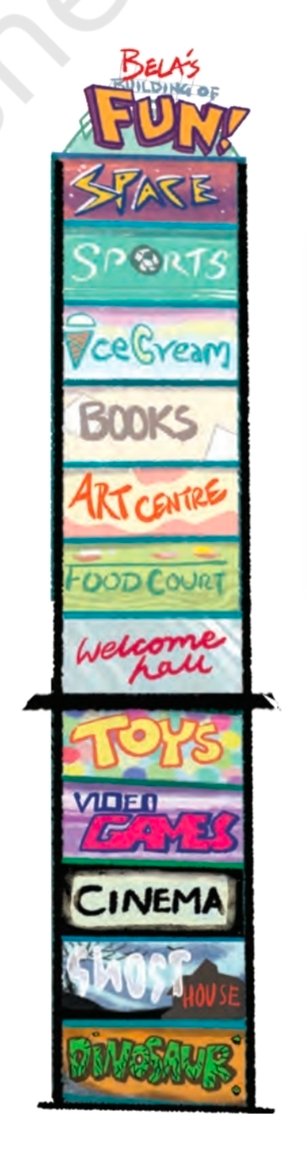
Observe that some of the floors in the ‘Building of Fun’ are below the ground. What are the shops that you find on these floors? What is there on the ground floor?
Solution:
The Toy Store and Video Games shop are below the ground floor. The ground floor is the Welcome Hall.
Question 3
A lift is used to go up and down between the floors. It has two buttons: ‘+’ to go up and ‘–’ to go down. Can you spot the lift?
Solution:
The lift is the system used to move between the different floors. The + button moves upward and the − button moves downward.
Question 4
What do you press to go four floors up? What do you press to go three floors down?
Solution:
Four floors up: + + + + or +4.
Three floors down: − − − or −3.
📖 Page 244 – Numbering the Floors
Question 5
The ground floor is called Floor 0. Can you see why?
Solution:
The ground floor is the reference or starting point. We do not move up or down from it, so it is represented by 0.
Question 6
Number all the floors in the Building of Fun.
Solution:
Floor
Place
+3
Book Store
+2
Art Centre
+1
Food Court
0
Welcome Hall
−1
Toy Store
−2
Video Games
📖 Page 245 – Addition to Keep Track of Movement
Question 7
Start from the Food Court and press + 2 in the lift. Where will you reach?
Solution:
Food Court is Floor +1. Moving +2 gives:
(+1) + (+2) = +3.
So, you reach the Book Store.
Figure it Out – Q1
You start from Floor +2 and press –3 in the lift. Where will you reach? Write an expression for this movement.
Solution:
(+2) + (−3) = −1.
You reach Floor −1, the Toy Store.
Figure it Out – Q2
Evaluate these expressions (you may think of them as Starting Floor + Movement by referring to the Building of Fun).a. (+1)+(+4) = _______ b. (+4)+(+1) = _______c. (+4)+(– 3) = _______ d. (–1)+(+2) = _______e. (–1)+(+1) = _______ f. 0+(+2) = _________g. 0+(–2) = _________
Solution:
a. (+5)
b. (+5)
c. (+1)
d. (+1)
e. 0
f. (+2)
g. (−2)
Figure it Out – Q3
Starting from different floors, find the movements required to reach Floor –5. For example, if I start at Floor +2, I must press –7 to reach Floor –5. The expression is (+2) + (–7) = –5.Find more such starting positions and the movements needed to reach Floor –5 and write the expressions.
Solution:
Some possible answers are:
(+1) + (−6) = −5
(−2) + (−3) = −5
0 + (−5) = −5
There can be many other correct possibilities.
📖 Page 246 – Combining Button Presses and Inverses
Figure it Out
Evaluate these expressions by thinking of them as the resulting movement of combining button presses:a. (+1)+(+4) = _____________ b. (+4)+(+1) = _____________c. (+4)+(– 3)+(–2) = _______ d. (–1)+(+2)+(–3) = _______
Solution:
a. (+5)
b. (+5)
c. (−1)
d. (−2)
Question – Inverses
Write the inverses of these numbers: +4, –4, –3, 0, +2, –1.
Solution:
Inverse of +4 = −4
Inverse of −4 = +4
Inverse of −3 = +3
Inverse of 0 = 0
Inverse of +2 = −2
Inverse of −1 = +1
Question – Connect the inverses
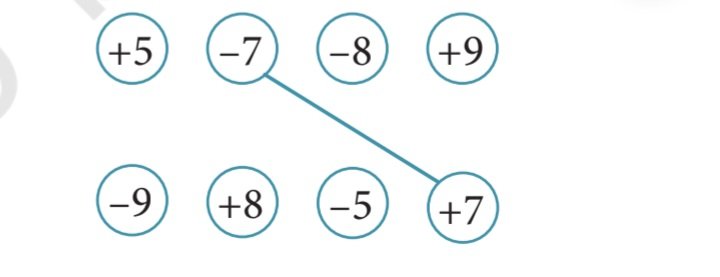
Connect the inverses by drawing lines.
Solution:
Connect each number to the number having the opposite sign and the same magnitude:
+9 ↔ −9
+7 ↔ −7
−8 ↔ +8
−5 ↔ +5
Question – Who is on the lowest floor?
Who is on the lowest floor?1. Jay is in the Art Centre. So, he is on Floor +2.
2. Asin is in the Sports Centre. So, she is on Floor ___.
3. Binnu is in the Cinema Centre. So, she is on Floor ____.
4. Aman is in the Toys Store. So, he is on Floor ____.
Solution:
1. Jay = +2
2. Asin = +5
3. Binnu = −3
4. Aman = −1
The lowest floor is −3, so Binnu is on the lowest floor.
📖 Page 247 – Comparing Numbers
Figure it Out – Q1
Compare the following numbers using the Building of Fun and fill in the boxes with < or >.a. –2 +5 b. –5 +4 c. –5 –3
d. +6 –6 e. 0 –4 f. 0 +4
Solution:
a. −2 < +5
b. −5 < +4
c. −5 < −3
d. +6 > −6
e. 0 > −4
f. 0 < +4
Figure it Out – Q2
Imagine the Building of Fun with more floors. Compare the numbers and fill in the boxes with < or >:a. –10 –12 b. +17 –10
c. 0 –20 d. +9 –9
e. –25 –7 f. +15 –17
Solution:
a. −10 > −12
b. +17 > −10
c. 0 > −20
d. +9 > −9
e. −25 < −7
f. +15 > −17
Figure it Out – Q3
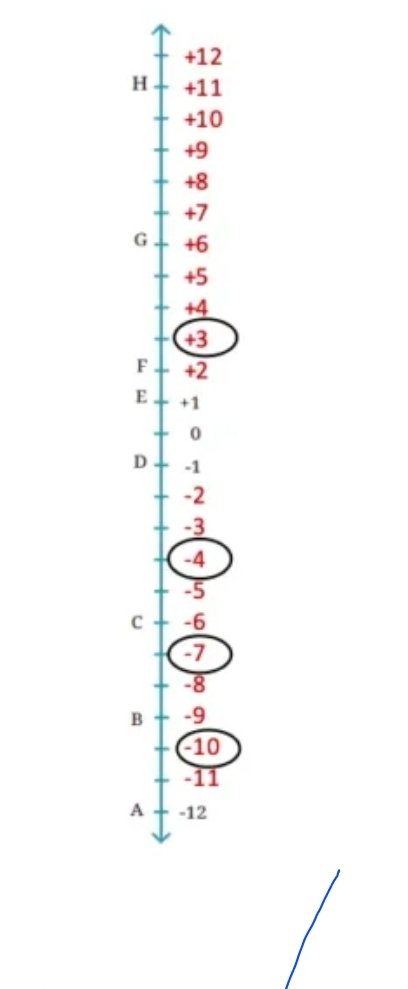
If Floor A = –12, Floor D = –1 and Floor E = +1 in the building shown on the right as a line, find the numbers of Floors B, C, F, G, and H.
Solution:
B = −9
C = −6
F = +2
G = +6
H = +11
Figure it Out – Q4
Mark the following floors of the building shown on the right.a. –7 b. – 4 c. +3 d. – 10
Solution:
📖 Page 248 – Subtraction to Find Which Button to Press
Question
Evaluate 15 – 5, 100 – 10 and 74 – 34 from this perspective.
Solution:
15 − 5 = 10
100 − 10 = 90
74 − 34 = 40
We can think of subtraction as finding the missing number that needs to be added.
Question – Button press
Your starting floor is the Art Centre and your target floor is the Sports Centre. What should be your button press?
Solution:
Art Centre = +2 and Sports Centre = +5.
Movement = +5 − (+2) = +3.
So, press +3.
📖 Page 249 – Subtraction as Movement
Figure it Out
Complete these expressions. You may think of them as finding the movement needed to reach the Target Floor from the Starting Floor.a. (+1) –(+4) = _______ b. (0)–(+2) = _________
c. (+4)–(+1) = _______ d. (0)– (–2) = _________
e. (+4) – (–3) = _______ f. (–4) –(–3) = ________
g. (–1)–(+2) = _______ h. (–2) –(–2) = ________
i. (–1) – (+1) = _______ j. (+3)– (–3) = ________
Solution:
a. −3
b. −2
c. +3
d. +2
e. +7
f. −1
g. −3
h. 0
i. −2
j. +6
📖 Page 251 – Adding and Subtracting Larger Numbers
Figure it Out
Complete these expressions.a. (+40)+ ______ = +200 b. (+40)+_______=–200
c. (–50)+ ______ = +200 d. (–50)+_______=–200
e. (–200) – (–40) = _______ f. (+200) – (+40) = _______
g. (–200) –(+40) = _______
Solution:
a. +160
b. −240
c. +250
d. −150
e. −160
f. +160
g. −240
📖 Page 252 – Infinite Lift and Number Line
Question
In the other exercises that you did above, did you notice that subtracting a negative number was the same as adding the corresponding positive number?
Solution:
Yes. Subtracting a negative number is the same as adding the corresponding positive number.
Math Talk
If, from 5 you wish to go over to 9, how far must you travel along the number line?
Solution:
You travel 4 steps to the right.
5 + 4 = 9.
📖 Page 253 – Number Line
Math Talk
Now, from 9, if you wish to go to 3, how much must you travel along the number line?
Solution:
You move 6 steps backward, so the movement is −6.
Math Talk
Now, from 3, if you wish to go to –2, how far must you travel?
Solution:
You move 5 steps backward, so the movement is −5.
Figure it Out – Q1
Mark 3 positive numbers and 3 negative numbers on the number line above.
Solution:
One possible answer is:
Positive numbers: 3, 6, 9
Negative numbers: −1, −5, −7
Other correct choices are also possible.
📖 Page 254 – Comparing and Calculating Integers
Figure it Out – Q2
Write down the above 3 marked negative numbers in the following boxes:
Solution:
Using the example markings above: −7, −5, −1.
Figure it Out – Q3
Is 2 > – 3? Why? Is –2 < 3? Why?
Solution:
Yes, 2 > −3 because 2 lies to the right of −3 on the number line.
Yes, −2 < 3 because −2 lies to the left of 3.
Figure it Out – Q4
What are a. –5+0 b. 7+(–7) c. –10+20 d. 10 –20 e. 7–(–7) f. –8–(–10)?
Solution:
a. −5
b. 0
c. 10
d. −10
e. 14
f. 2
📖 Page 255 – Unmarked Number Line
Question
Use unmarked number lines to evaluate these expressions:a. –125 + (–30) = _______
b. +105 – (–55) = _______
c. +80 – (–150) = _______
d. –99 – (–200) = _______
Solution:
a. −155
b. +160
c. +230
d. +101
📖 Page 257 – Token Model
Figure it Out – Q1
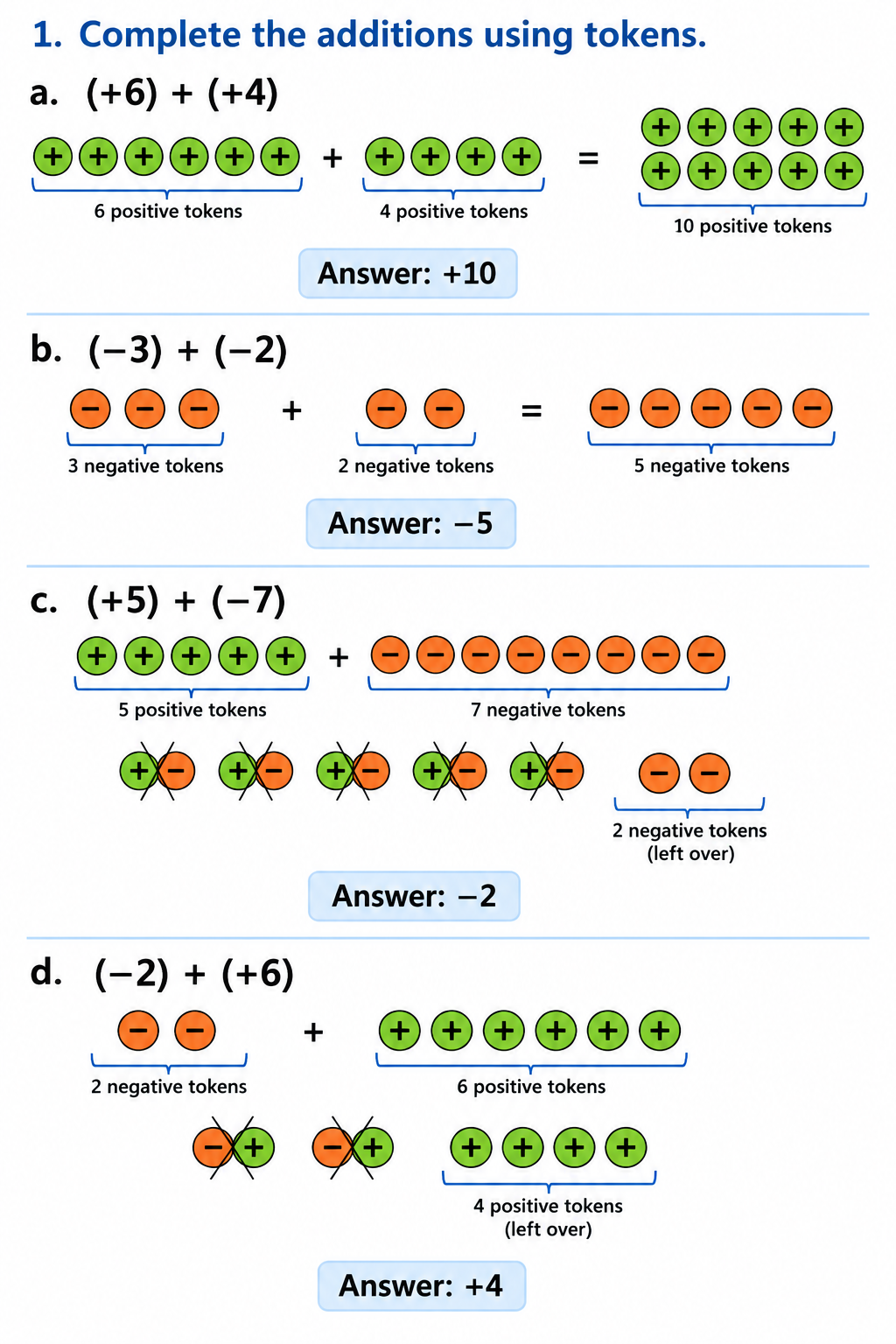
Complete the additions using tokens.a. (+6)+(+4) b. (–3) + (–2)
c. (+5)+(–7) d. (–2) + (+6)
Solution:
a. +10
b. −5
c. −2
d. +4
Figure it Out – Q2
Cancel the zero pairs in the following two sets of tokens. On what floor is the lift attendant in each case? What is the corresponding addition statement in each case?
Solution:
a. (+3) + (−5) = −2. The attendant is on Floor −2.
b. (+6) + (−3) = +3. The attendant is on Floor +3.
📖 Page 258 – Subtraction Using Tokens
Figure it Out – Q1
Evaluate the following differences using tokens. Check that you get the same result as with other methods you now know:a. (+10) –(+7) b. (–8)– (–4) c. (–9) –(–4)
d. (+9) –(+12) e. (–5)– (–7) f. (–2)– (–6)
Solution:
a. +3
b. −4
c. −5
d. −3
e. +2
f. +4
Figure it Out – Q2
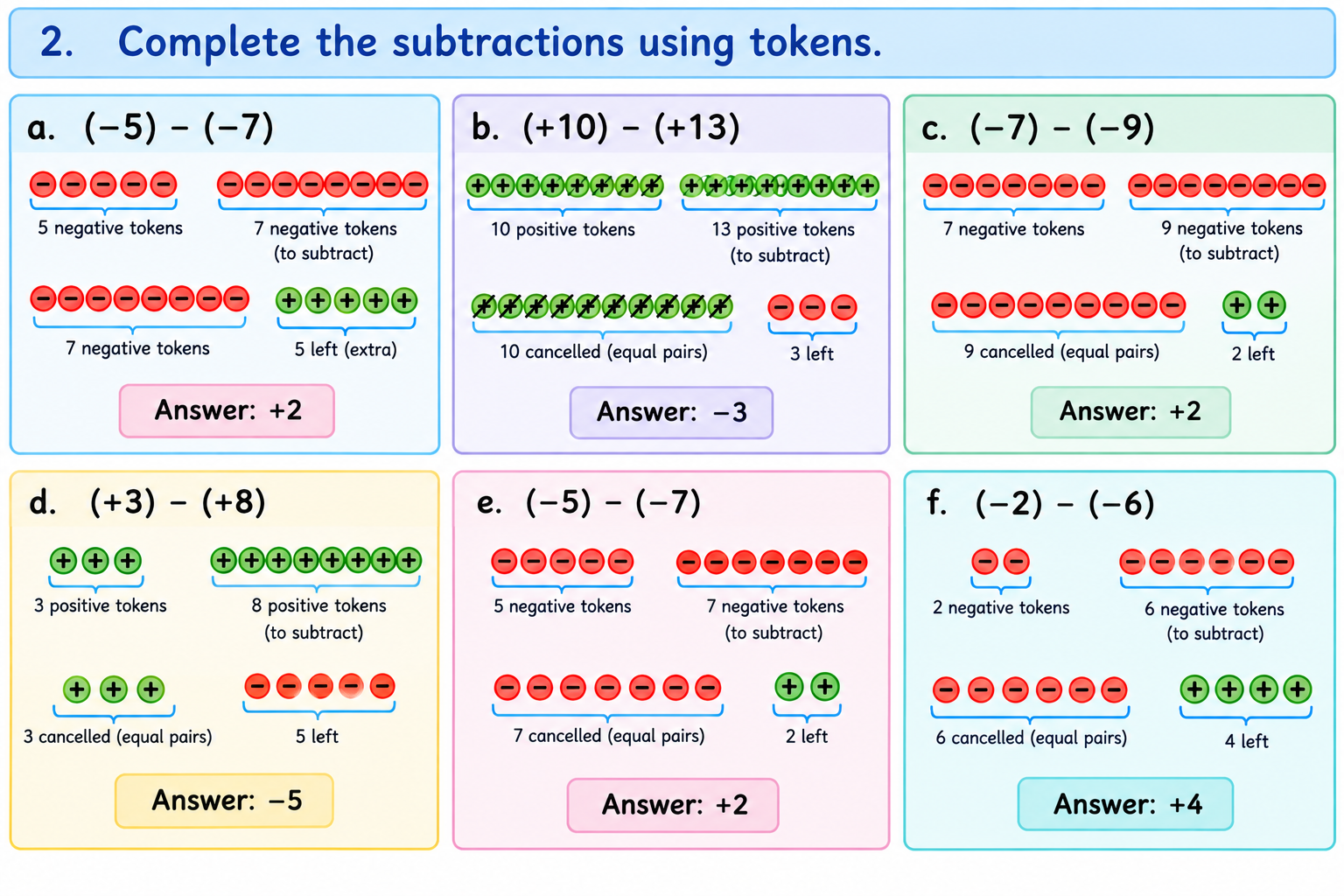
Complete the subtractions:a. (–5) –(–7) b. (+10) –(+13) c. (–7)–(–9)
d. (+3) – (+8) e. (–2)–(–7) f. (+3)–(+15)
Solution:
a. +2
b. −3
c. +2
d. −5
e. +5
f. −12
📖 Page 259 – Subtracting Negative Numbers and Credits/Debits
Figure it Out – Q1
Try to subtract: –3– (+5).
How many zero pairs will you have to put in? What is the result?
Solution:
We need 5 zero pairs so that 5 positive tokens can be removed.
Result: −3 − (+5) = −8.
Figure it Out – Q2
Evaluate the following using tokens.a. (–3) – (+10) b. (+8)– (–7) c. (–5)–(+9)
d. (–9) –(+10) e. (+6) –(–4) f. (–2)–(+7)
Solution:
a. −13
b. +15
c. −14
d. −19
e. +10
f. −9
Figure it Out – Q1
Suppose you start with ₹0 in your bank account, and then you have credits of ₹30, ₹40, and ₹50, and debits of ₹40, ₹50, and ₹60. What is your bank account balance now?
Suppose you start with ₹0 in your bank account, and then you have debits of ₹1, 2, 4, 8, 16, 32, 64, and 128, and then a single credit of ₹256. What is your bank account balance now?
Why is it generally better to try and maintain a positive balance in your bank account? What are circumstances under which it may be worthwhile to temporarily have a negative balance?
Solution:
A positive balance means we have money available to pay for our needs. A negative balance may sometimes occur temporarily because of an important payment or purchase, but it may lead to extra charges or interest.
📖 Page 261 – Geographical Cross Sections
Figure it Out – Q1
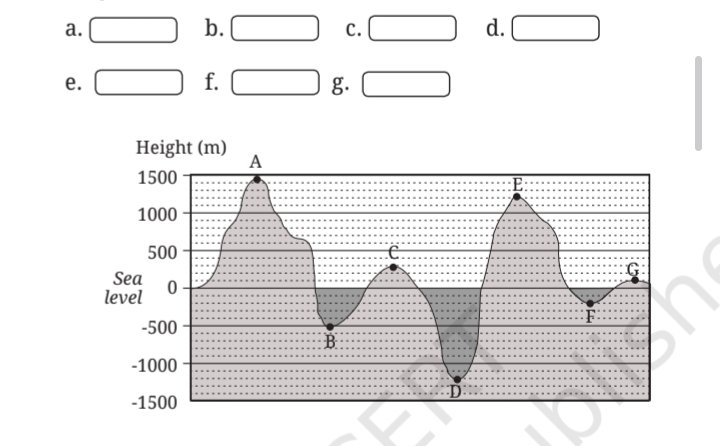
Looking at the geographical cross section, fill in the respective heights:
Solution:
Approximate heights are:
A = +1500 m
B = −500 m
C = +300 m
D = −1200 m
E = +1200 m
F = −200 m
G = +100 m
Figure it Out – Q2
Which is the highest point in this geographical cross section? Which is the lowest point?
Solution:
Highest point = A.
Lowest point = D.
Figure it Out – Q3
Can you write the points A, B, …, G in a sequence of decreasing order of heights? Can you write the points in a sequence of increasing order of heights?
Solution:
Decreasing order: A, E, C, G, F, B, D.
Increasing order: D, B, F, G, C, E, A.
Figure it Out – Q4
What is the highest point above sea level on Earth? What is its height?
Solution:
Mount Everest is the highest point above sea level. The textbook solution gives its height as approximately 8848 m.
Figure it Out – Q5
What is the lowest point with respect to sea level on land or on the ocean floor? What is its height? (This height should be negative).
Solution:
The lowest known point is Challenger Deep in the Mariana Trench in the Pacific Ocean. The textbook solution gives its depth as approximately −10994 m.
📖 Page 262 – Temperature
Question
What do you think will be the temperature during the summer when you feel very hot?
Solution:
The temperature can be high, for example around 35°C to 45°C in very hot places. The exact temperature depends on the place and day.
Figure it Out – Q1
Do you know that there are some places in India where temperatures can go below 0°C? Find out the places in India where temperatures sometimes go below 0°C. What is common among these places? Why does it become colder there and not in other places?
Solution:
Places such as Ladakh, parts of Jammu and Kashmir, Himachal Pradesh and high Himalayan regions can experience temperatures below 0°C. These places are generally at high altitudes and/or experience very cold winter conditions.
Figure it Out – Q2
Leh in Ladakh gets very cold during the winter. The following is a table of temperature readings taken during different times of the day and night in Leh on a day in November. Match the temperature with the appropriate time of the day and night.Temperature Time
Do the calculations for the second grid above and find the border sum.
Solution: Each border gives a sum of −3.
Therefore, the border sum is −3.
Figure it Out – Q2
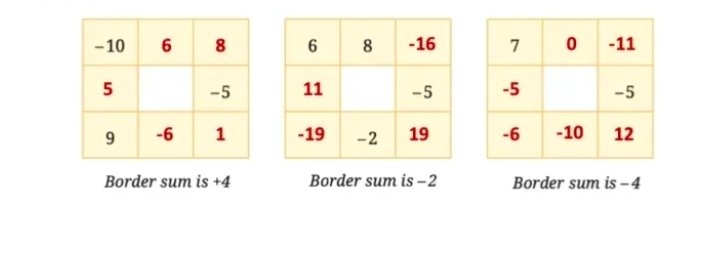
Complete the grids to make the required border sum:
Border sum is +4
Border sum is –2
Border sum is –4
Solution:
There can be more than one correct way to fill the grids. One set of fillings shown in the solution material is:
Figure it Out – Q3
For the last grid above, find more than one way of filling the numbers to get border sum –4.
Solution:
There can be more than one valid arrangement. The important point is that every required border must have a sum of −4.
Figure it Out – Q4
Which other grids can be filled in multiple ways? What could be the reason?
Solution:
A grid can have multiple solutions when the given numbers leave enough freedom to choose different numbers while keeping the required border sum unchanged.
📖 Page 264 – An Amazing Grid of Numbers
Figure it Out – Q1
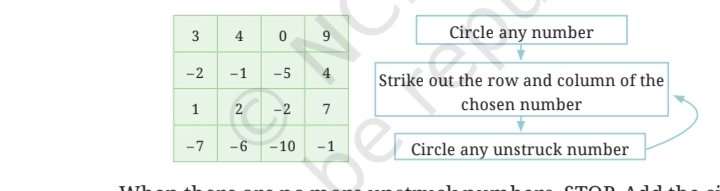
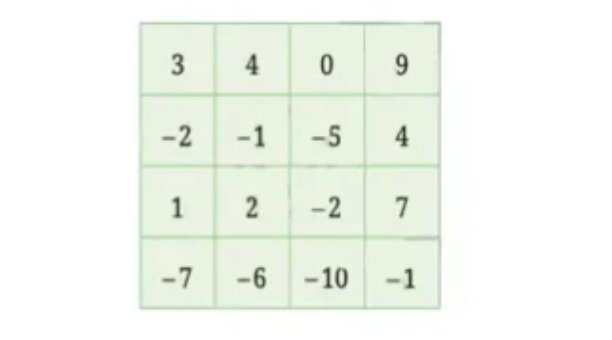
Try afresh, choose different numbers this time. What sum did you get? Was it different from the first time? Try a few more times!
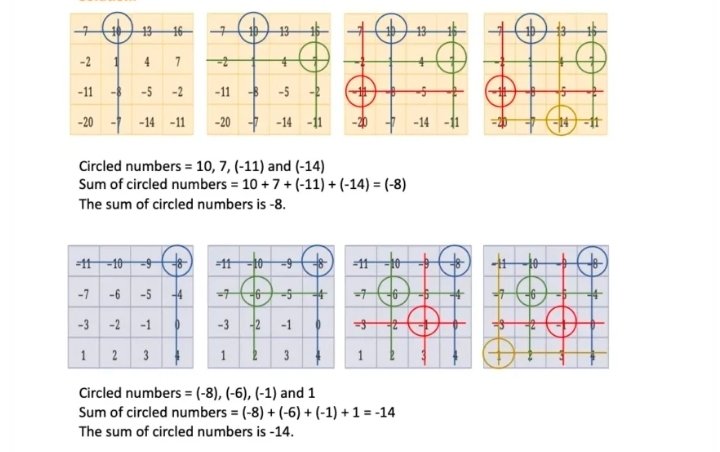
Solution:
Figure it Out – Q2
Play the same game with the grids below. What answer did you get?
Solution:
Figure it Out – Q3
What could be so special about these grids? Is the magic in the numbers or the way they are arranged or both? Can you make more such grids?
Solution:
The special feature comes from both the numbers and the way they are arranged. The arrangement creates a pattern that makes the game interesting. Similar grids can be made by creating suitable number patterns.
📖 Page 265 – Practice with Integers
Figure it Out – Q1
Write all the integers between the given pairs, in increasing order.a. 0 and –7 b. –4 and 4
c. –8 and –15 d. –30 and –23
Solution:
a. −6, −5, −4, −3, −2, −1
b. −3, −2, −1, 0, 1, 2, 3
c. −14, −13, −12, −11, −10, −9
d. −29, −28, −27, −26, −25, −24
Figure it Out – Q2
Give three numbers such that their sum is –8.
Solution:
One possible answer is:
−5 + 7 + (−10) = −8.
Other combinations are also possible.
Figure it Out – Q3
There are two dice whose faces have these numbers: –1, 2, –3, 4, –5, 6. The smallest possible sum upon rolling these dice is –10 = (–5) + (–5) and the largest possible sum is 12 = (6)+(6). Some numbers between (–10) and (+12) are not possible to get by adding numbers on these two dice. Find those numbers.
Solution:
The numbers that cannot be obtained are:
−9, −7, −5, 0, 2, 7, 9, 11.
Find the years below.a. From the present year, which year was it 150 years ago? ________
b. From the present year, which year was it 2200 years ago? _______
Hint: Recall that there was no year 0.c. What will be the year 320 years after 680 BCE? ________
Solution:
For a and b, use the present year and remember that historical BCE/CE dating has no year 0.
For c, 320 years after 680 BCE is 360 BCE because we move 320 years forward from 680 BCE.
Figure it Out – Q6
Complete the following sequences:a. (–40), (–34), (–28), (–22), _____, ______, ______
b. 3, 4, 2, 5, 1, 6, 0, 7, _____, _____, _____
c. _____, ______, 12, 6, 1, (–3), (–6), _____, ______, ______
Solution:
a. −16, −10, −4
b. −1, 8, −2
c. The sequence follows its own changing pattern; the solution material gives: 27, 19, …, −8, −9, −9.
Figure it Out – Q7
Here are six integer cards: (+1), (+7), (+18), (–5), (–2), (–9). You can pick any of these and make an expression using addition(s) and subtraction(s). Here is an expression: (+18)+(+1)–(+7) – (–2) which gives a value (+14). Now, pick cards and make an expression such that its value is closer to (– 30).
Solution:
One possible expression is:
(−2) + (−9) − (+18) − (+1) = −30.
Figure it Out – Q8
The sum of two positive integers is always positive but a (positive integer) – (positive integer) can be positive or negative. What abouta. (positive) – (negative) b. (positive) + (negative)
c. (negative) + (negative) d. (negative) – (negative)
e. (negative) – (positive) f. (negative) + (positive)
Solution:
a. Positive
b. Can be positive or negative
c. Negative
d. Can be positive or negative
e. Negative
f. Can be positive or negative
Figure it Out – Q9
This string has a total of 100 tokens arranged in a particular pattern. What is the value of the string?
Solution:
The value of the string is 20.
📖 Page 268 – A Pinch of History
Figure it Out – Q1
Can you explain each of Brahmagupta’s rules in terms of Bela’s Building of Fun, or in terms of a number line?
Solution:
Yes. On the Building of Fun, positive numbers mean moving upward and negative numbers mean moving downward. On the number line, positive numbers lie to the right of zero and negative numbers lie to the left. Adding numbers means combining movements, while subtracting a number means adding its inverse.
Class 6 Maths Chapter 10, The Other Side of Zero, Class 6 Maths notes, Class 6 Maths solutions, NCERT Class 6 Maths Chapter 10, Class 6 Maths worksheet, integers, positive numbers, negative numbers, number line, comparing integers, operations on integers, Class 6 Maths questions and answers.



 a. +10

 a. +3
 a. +2
 a. −13


 There can be more than one correct way to fill the grids. One set of fillings shown in the solution material is:

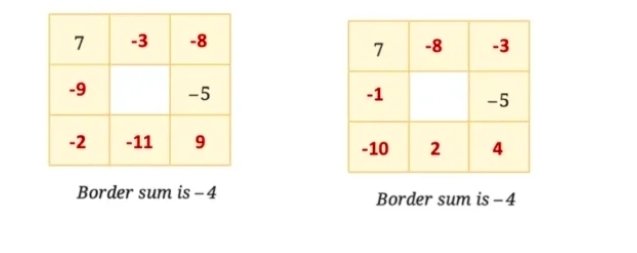 There can be more than one valid arrangement. The important point is that every required border must have a sum of −4.




 The value of the string is 20.