Class 6 Maths Chapter 1 Patterns in Mathematics – easy notes, concepts, NCERT book solutions, important questions, worksheet and answers. Learn about number patterns, visual patterns, sequences, shapes and mathematical patterns with simple explanations and step-by-step solutions.
PATTERNS IN MATHEMATICS
Class 6 Mathematics
Ganita Prakash | Chapter 1
Detailed Notes, Figure it Out Solutions, Formulas, Examples and Visual Learning
Chapter 1 — Patterns in Mathematics
What will we learn?
- Patterns in everyday life
- Patterns in numbers
- Number sequences
- Visualising numbers using pictures
- Relations between different number sequences
- Patterns in shapes
- Relations between shapes and number sequences
Page No. 1 — Section 1.1
1.1 What is Mathematics?
Mathematics is, in large part, the search for patterns, and for the explanations as to why those patterns exist.
Such patterns indeed exist all around us—in nature, in our homes and schools, and in the motion of the sun, moon, and stars. They occur in everything that we do and see, from shopping and cooking, to throwing a ball and playing games, to understanding weather patterns and using technology.
The search for patterns and their explanations can be a fun and creative endeavour. It is for this reason that mathematicians think of mathematics both as an art and as a science.
We see patterns when we count numbers, arrange objects, observe the days of a week, make designs, measure things, or calculate money.
It is important to keep in mind that mathematics aims to not just find out what patterns exist, but also the explanations for why they exist.
Page No. 2 — Section 1.1 — Figure it Out
Page No. 2–3 — Section 1.2
1.2 Patterns in Numbers
Among the most basic patterns that occur in mathematics are patterns of numbers, particularly patterns of whole numbers:
The branch of Mathematics that studies patterns in whole numbers is called number theory.
Number sequences are the most basic and among the most fascinating types of patterns that mathematicians study.
Important Number Sequences
| Sequence | Name | Easy Rule |
|---|---|---|
| 1, 1, 1, 1, 1, 1, 1, … | All 1’s | 1 is repeated. |
| 1, 2, 3, 4, 5, 6, 7, … | Counting numbers | Add 1 each time. |
| 1, 3, 5, 7, 9, 11, 13, … | Odd numbers | Add 2 each time. |
| 2, 4, 6, 8, 10, 12, 14, … | Even numbers | Add 2 each time. |
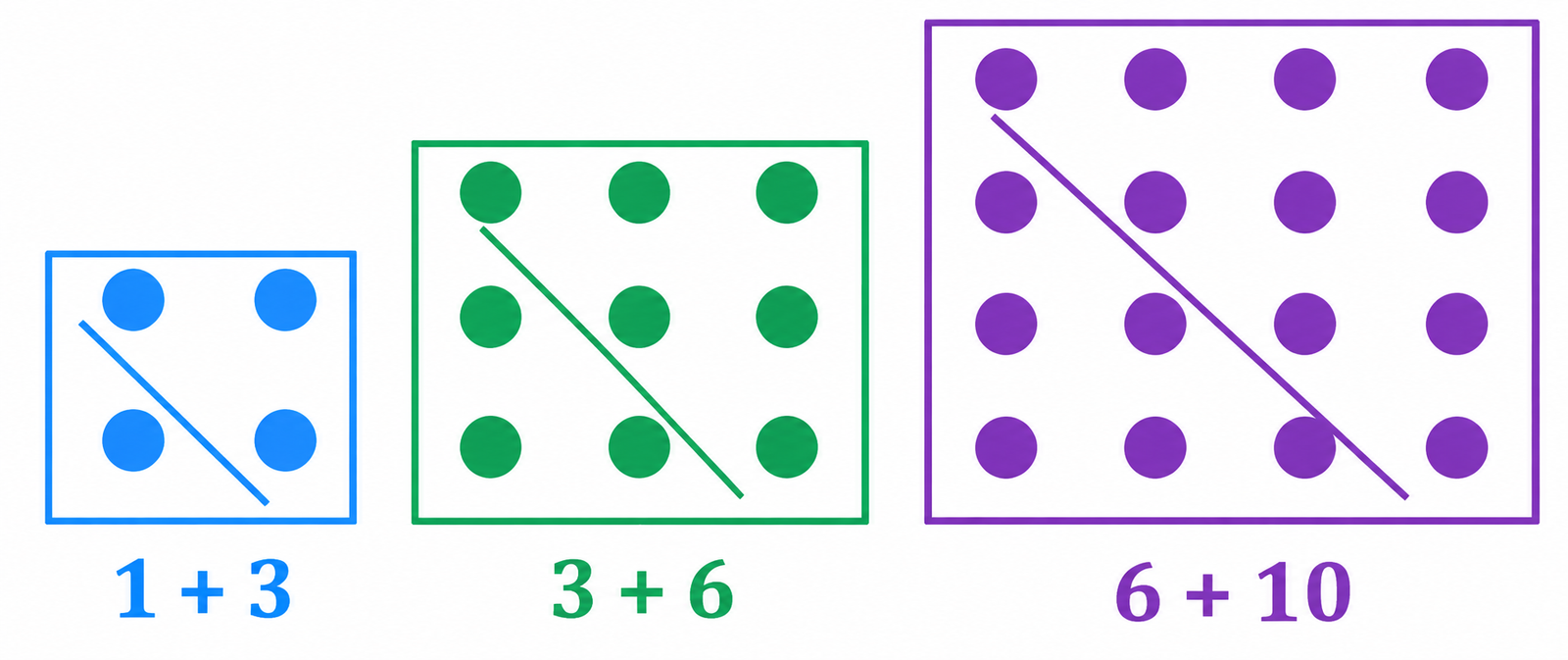
| 1, 3, 6, 10, 15, 21, 28, … | Triangular numbers | Add 2, 3, 4, 5, … |
| 1, 4, 9, 16, 25, 36, 49, … | Squares | 1×1, 2×2, 3×3, … |
| 1, 8, 27, 64, 125, 216, … | Cubes | 1×1×1, 2×2×2, 3×3×3, … |
| 1, 2, 3, 5, 8, 13, 21, … | Virahānka numbers | Add the previous two numbers. |
| 1, 2, 4, 8, 16, 32, 64, … | Powers of 2 | Multiply by 2. |
| 1, 3, 9, 27, 81, 243, 729, … | Powers of 3 | Multiply by 3. |
Page No. 3 — Section 1.2 — Figure it Out
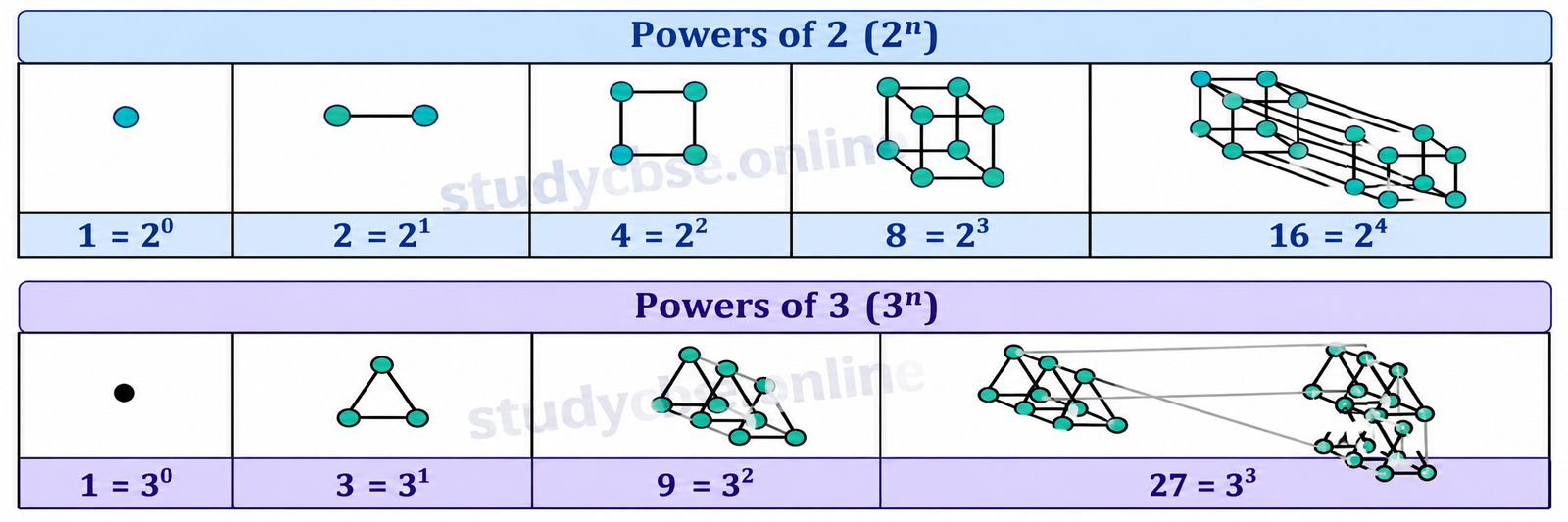
Powers of 2- 1,2,4 = 2 x 2, 8 = 2 x 2 x2 ,16 = 2 x 2 x2 x 2 x 2…
Powers of 3 – 1, 3, 9 = 3 x 3 = 27 =3 x 3 x3,…
Virahanka numbers- 1,2, 3, 5 = 2 + 3, 8 = 3 + 5, 13 = 5 + 8,….
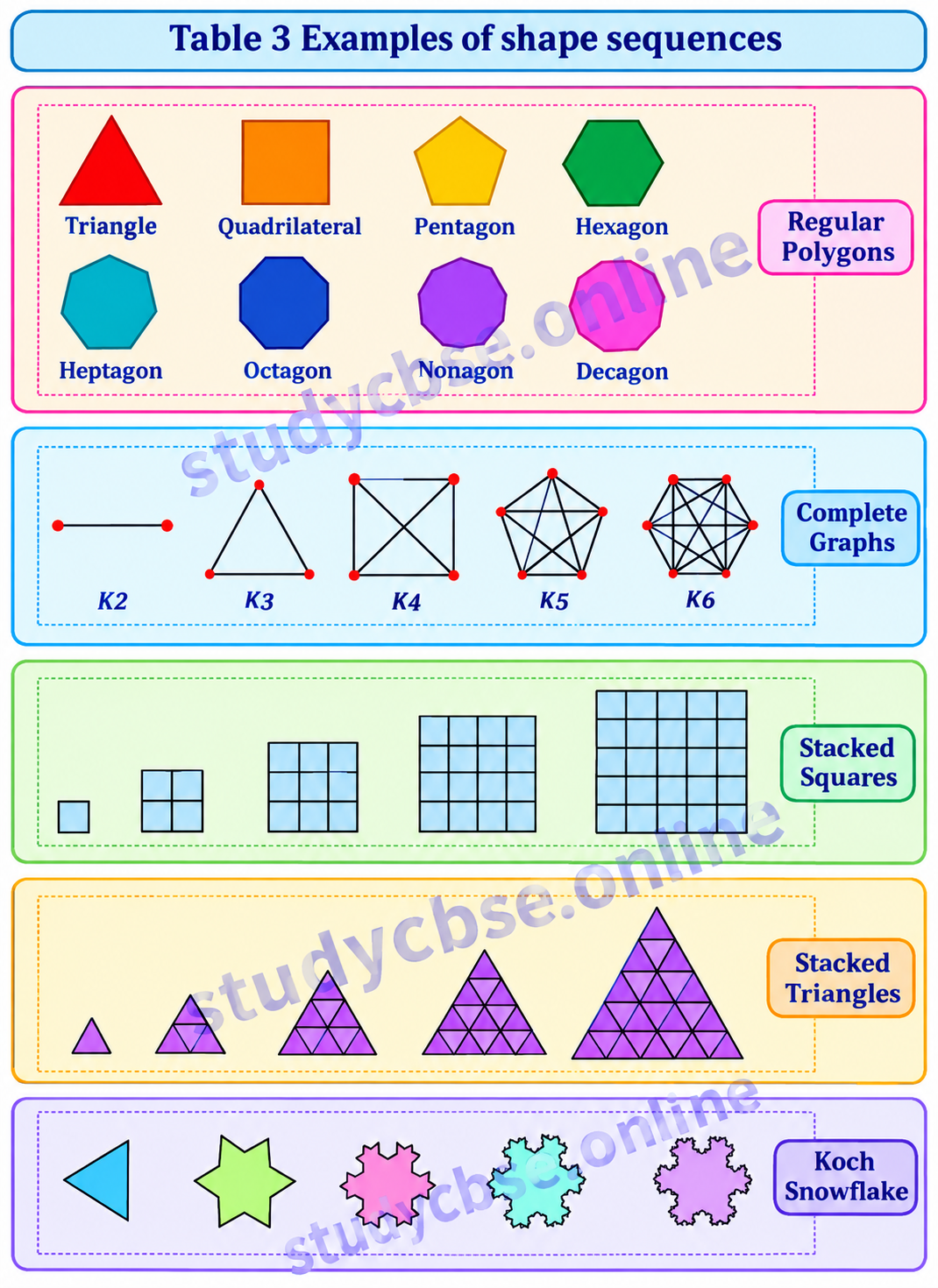
Rest of the patterns have been shown on page 4 ,Table 2
Next three: 1, 1, 1
Rule: Keep repeating 1.
Counting numbers: 1, 2, 3, 4, 5, 6, 7, …
Next three: 8, 9, 10
Rule: Add 1.
Odd numbers: 1, 3, 5, 7, 9, 11, 13, …
Next three: 15, 17, 19
Rule: Add 2.
Even numbers: 2, 4, 6, 8, 10, 12, 14, …
Next three: 16, 18, 20
Rule: Add 2.
Triangular numbers: 1, 3, 6, 10, 15, 21, 28, …
Next three: 36, 45, 55
Rule: Add 2, then 3, then 4, then 5, and so on.
Squares: 1, 4, 9, 16, 25, 36, 49, …
Next three: 64, 81, 100
Rule: 1×1, 2×2, 3×3, 4×4, …
Cubes: 1, 8, 27, 64, 125, 216, …
Next three: 343, 512, 729
Rule: 1×1×1, 2×2×2, 3×3×3, …
Virahānka numbers: 1, 2, 3, 5, 8, 13, 21, …
Next three: 34, 55, 89
Rule: Add the previous two numbers.
Powers of 2: 1, 2, 4, 8, 16, 32, 64, …
Next three: 128, 256, 512
Rule: Multiply by 2.
Powers of 3: 1, 3, 9, 27, 81, 243, 729, …
Next three: 2187, 6561, 19683
Rule: Multiply by 3.
Page No. 3–4 — Section 1.3
1.3 Visualising Number Sequences
Many number sequences can be visualised using pictures. Visualising mathematical objects through pictures or diagrams can be a very fruitful way to understand mathematical patterns and concepts.

Page No. 5 — Section 1.3 — Figure it Out
Triangular numbers can be arranged as dots in a triangle. Square numbers can be arranged in a square. Cube numbers come from multiplying the same number three times.
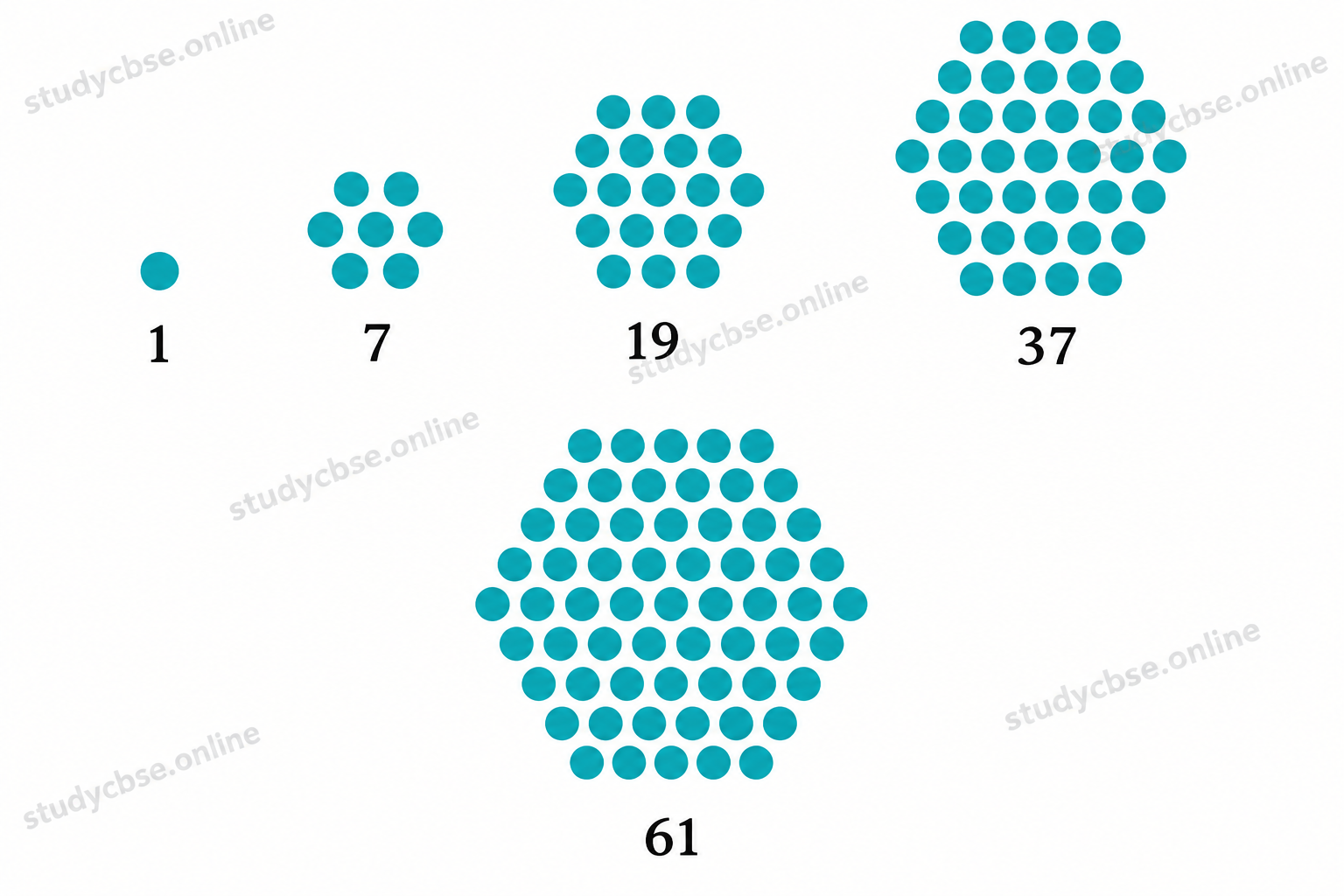
1 7 19 37
That’s right, they are called hexagonal numbers! Draw these in your notebook. What is the next number in the sequence?
1, 3, 9, 27, 81, …
Page No. 6 — Powers of 2
Here is one possible way of thinking about Powers of 2:
4 × 2 = 8
8 × 2 = 16
16 × 2 = 32
Important idea
When we multiply by the same number again and again, we get a power sequence.
Page No. 7 — Section 1.4
Relations among Number Sequences
Sometimes, number sequences can be related to each other in surprising ways.
Adding Odd Numbers
1 + 3 = 4
1 + 3 + 5 = 9
1 + 3 + 5 + 7 = 16
1 + 3 + 5 + 7 + 9 = 25
1 + 3 + 5 + 7 + 9 + 11 = 36
First 3 odd numbers:
1 + 3 + 5 = 9 = 3²
First 5 odd numbers:
1 + 3 + 5 + 7 + 9 = 25 = 5²
For n = 10:
10² = 100
For n = 100:
100² = 10,000
Adding up and down
1 + 2 + 1 = 4
1 + 2 + 3 + 2 + 1 = 9
1 + 2 + 3 + 4 + 3 + 2 + 1 = 16
This gives another way of getting square numbers — by adding the counting numbers up and then down.
Page No. 8 — Section 1.4 — Figure it Out
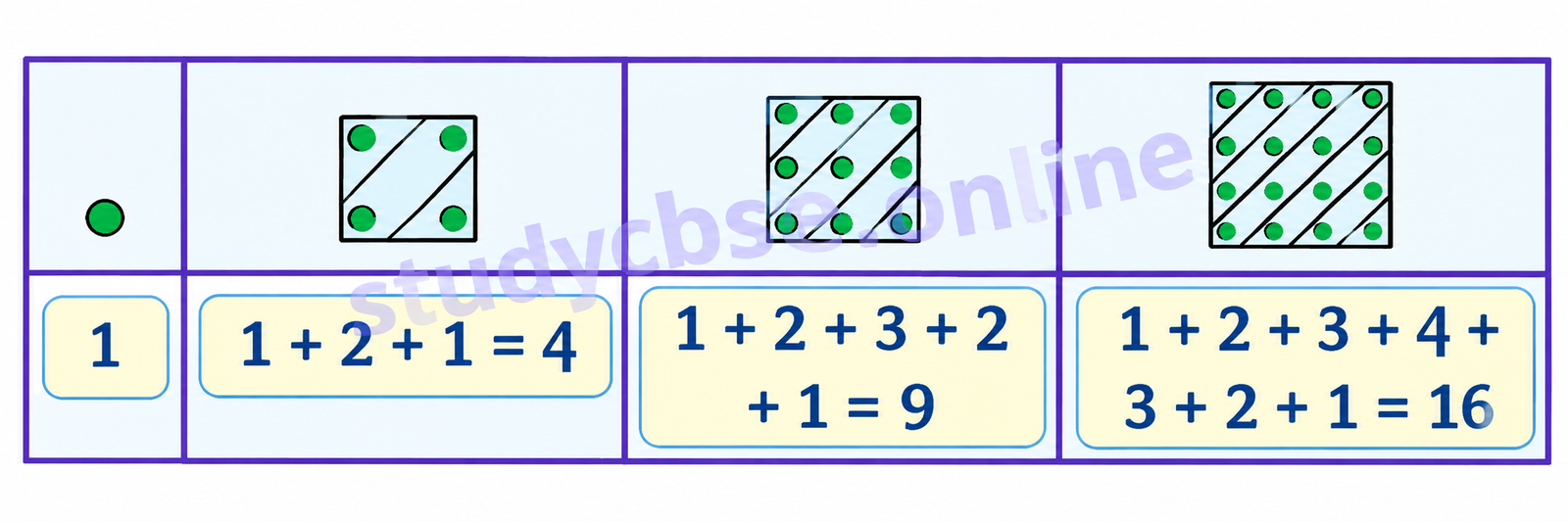
1 + 2 + 3 + 2 + 1 = 9
9 = 3²
Therefore, when the middle number is 100:
100² = 10,000
• 1, 1+(1+1) + 1, 1+(1+1) +(1+1+1) + (1+1) +1, 1+(1+1) +(1+1+1) +(1+1+1+1) + (1+1+1) + (1+1) +1, ……….