Class 6 Khel Yatra Unit 3 Fundamental Skills of Kho-Kho – easy notes, concepts, activities, questions and answers, and worksheet. Learn important Kho-Kho skills such as sitting, chasing, giving Kho, running, dodging, pole turn, chain, pole dive and toe tapping in simple language.
Fundamental Skills of Kho-Kho
Kho-Kho is an exciting Indian team sport. Players chase and try to tag their opponents while the other players try to avoid being tagged.
Kho-Kho develops speed, agility, leg strength, quick movement, coordination and teamwork.

FSA-1: Sitting Stance
What is Sitting Stance?
Sitting stance is an important starting position in Kho-Kho. The player sits on the toes and keeps the hands on the ground.
- Look straight.
- Keep the body balanced.
- Place the hands firmly on the ground.
- Keep some body weight on the hands and toes.
Lead-up Activity
Players can practise the sitting stance for 20 seconds, followed by frog jumps and duck walks.
FSA-2: Chasing
What is Chasing?
Chasing means running after the defender and trying to tag them. A chaser needs good footwork, speed and focus.
Important Points
- Start from the sitting stance.
- Use the correct leg when moving in a direction.
- Keep your head up.
- Move your arms naturally.
- Keep your eyes on the defender.
Lead-up Activity: Rise and Run
Players sit in the Kho-Kho stance. At the long whistle they run. At the short whistle they sit down again.
FSA-3: Giving Kho
What is Giving Kho?
A player gives Kho by tapping the back of a teammate and saying “Kho” at the same time.
- Use a clear touch.
- Say “Kho” clearly.
- At least one leg should be behind the cross lane.
1. Simple touch Kho
2. Early Kho
3. Late Kho
Lead-up Activity
Two teams can practise giving Kho using different techniques.
FSA-4: Running on a Straight Line
Proper Running Form
- Keep the head and chest straight.
- Keep an upright posture.
- Move the hands straight and parallel to the ground.
- Focus on moving forward.
Acceleration
Acceleration means increasing speed quickly. Quick starts and speed changes help a chaser move faster.
Modified Shuttle Run
Players run from the starting line towards the finish line and return. They must stay on the straight path.
FSA-5: Dodging
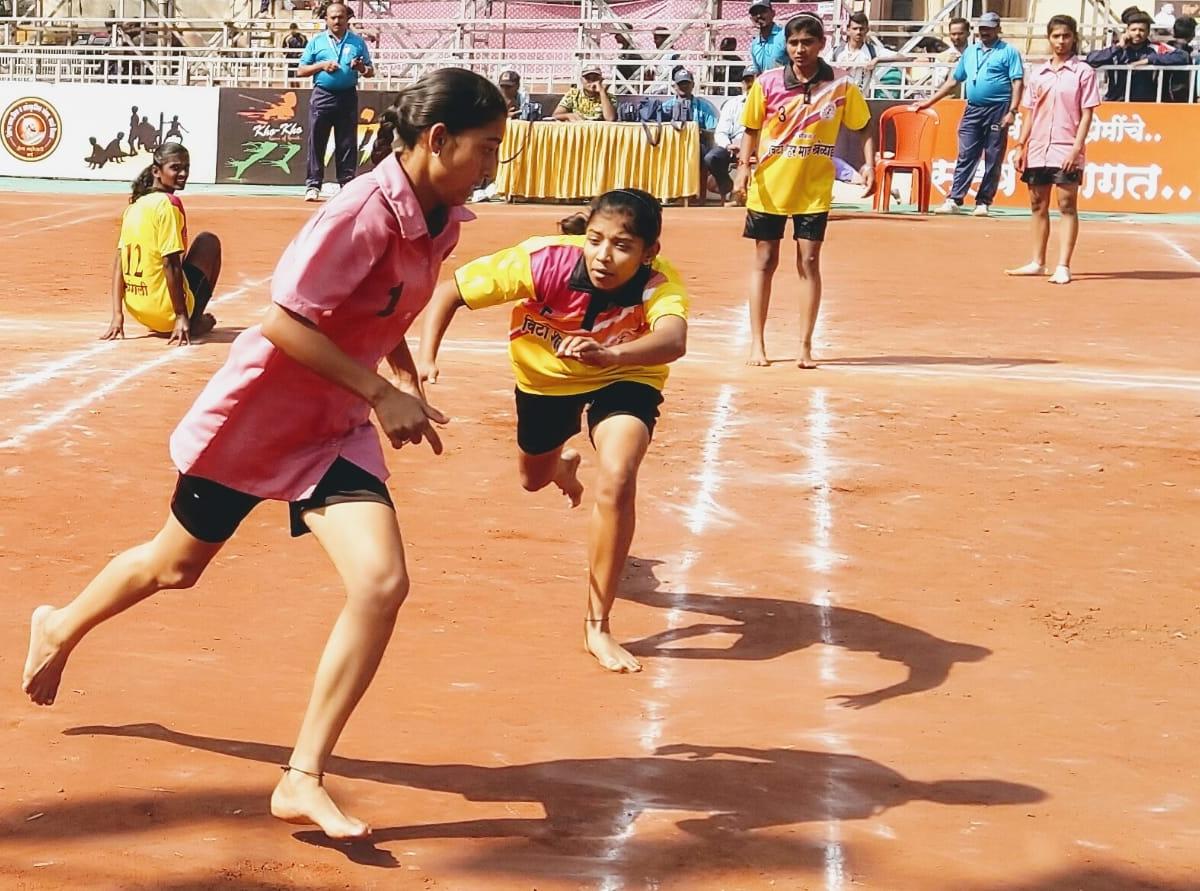
What is Dodging?
Dodging is a skill used by the defender to avoid the chaser. It needs quick footwork, agility and smart movement.
Ways to Dodge
- Leaning: Lean in one direction and move in another.
- Quick Turns: Turn quickly to change direction.
- Changing Speed: Suddenly speed up or slow down.
Lead-up Activity: Move to Safety
Runners try to reach the finish line without being tagged by the chasers.
FSA-6: Zig-Zag Running
What is Zig-Zag Running?
Zig-zag running means running while changing direction again and again.
It helps improve agility, coordination and reaction time.
How to Practise
- Start slowly.
- Practise correct footwork.
- Change direction carefully.
- Increase speed slowly.
- React quickly to signals.
Lead-up Activity
Players practise Kho-Kho using a single chain pole-to-pole running skill. The player covering the court in minimum time completes the activity fastest.
FSA-7: Pole Turn

What is Pole Turn?
Pole turn is a skill used by a chaser to make a quick turn around the pole.
Steps
- Approach the pole in a controlled way.
- Keep your eyes on the pole.
- Place the inner foot firmly on the ground.
- Turn your body around the planted foot.
- Swing the free leg around the pole.
- Push off and continue running.
Lead-up Activity: Pole Shuttle Run
Players run towards the pole, complete the turn and return to give Kho to the next player.
FSA-8: Covering Chase
What is Covering?
Covering means supporting the chaser by moving in coordination with other players.
Important Points
- Watch the defender carefully.
- Move according to the defender’s actions.
- Maintain the correct position.
- Move straight, left or right when needed.
- Work together with teammates.
Individual Pursuit Drill
One chaser practises following and chasing one runner. This helps develop speed, timing and anticipation.
FSA-9: Chain
What is a Chain?
In a chain, players work together to form a moving barrier. The aim is to prevent the runner from crossing the centre line.
Important Points
- Know your position.
- Move together with your teammates.
- Keep proper spacing.
- Use hand and verbal signals.
- Maintain good coordination.
Lead-up Activity: Sitting Relay Race
Players form teams and pass the Kho from one teammate to another. The team completes the relay together.
FSA-10: Fake Kho
What is Fake Kho?
Fake Kho is a strategy used to mislead the defender. It can make the defender think that a real Kho is going to be given.
Important Points
- Timing is important.
- The movement should look natural.
- Be unpredictable.
- React quickly to the situation.
Lead-up Activity: Ace-of-the-Fake
Teams practise giving actual Kho and fake Kho. Players try to complete the activity quickly and correctly.
FSA-11: Pole Dive

What is Pole Dive?
Pole dive is a quick movement around the pole used by a chaser. It requires careful footwork and safety.
Important Points
- Approach the pole at a controlled speed.
- Keep the body low.
- Lean in the direction of the dive.
- Use the correct foot and hand according to the direction.
- Push off safely after completing the dive.
Lead-up Activity: Elbow Lock Challenge
Two players lock elbows and try to pull each other towards their own side. The activity helps develop strength and control.
FSA-12: Toe Tapping
What is Toe Tapping?
Toe tapping is a skill in which the chaser tries to tap the defender’s toe or feet without falling over the centre line.
Important Points
- Stay ready in the sitting position.
- Watch the defender carefully.
- Anticipate the defender’s movement.
- Choose the correct time.
- Reach without crossing the centre line.
Lead-up Activity: Grab the Cone
Players run towards cones and touch the correct cone according to the teacher’s instructions while staying behind the restraining line.
FSA-13: 3-2-3 Chain
What is a 3-2-3 Chain?
The 3-2-3 chain is a defensive formation in Kho-Kho. Players form a chain with:
- 3 players in the front
- 2 players in the middle
- 3 players at the back
The players work together to create a strong defensive barrier.
Practice
- First learn your position.
- Practise the formation without a chaser.
- Move together as a team.
- Maintain coordination.
- Support your teammates.
Lead-up Activity: Standing Kho-Kho
Players form groups around a circle. One player becomes the chaser and another becomes the runner. Players change roles during the game.
Quick Revision
Sitting Stance: A ready position for Kho-Kho.
Chasing: Following and trying to tag the defender.
Giving Kho: Tapping a teammate and saying “Kho”.
Straight Running: Running forward with proper posture.
Dodging: Moving quickly to avoid the chaser.
Zig-Zag Running: Running while changing direction.
Pole Turn: Turning quickly around the pole.
Covering: Supporting the chaser through coordinated movement.
Chain: Working together to form a moving barrier.
Fake Kho: Using a fake movement to mislead the defender.
Pole Dive: A quick movement around the pole.
Toe Tapping: Trying to tap the defender’s foot safely.
3-2-3 Chain: A formation with 3 players in front, 2 in the middle and 3 at the back.
What We Learn from Kho-Kho
- Speed
- Agility
- Balance
- Quick reaction
- Strength
- Coordination
- Teamwork
- Concentration
- Sportsmanship
Looking for a practice worksheet?Try this easy and useful worksheet for unit 3 to practise what you have learned. It includes important questions and activities to help you check your understanding, strengthen your concepts and prepare better for exams
Class 6 Khel Yatra Unit 3, Fundamental Skills of Kho-Kho, Kho-Kho Class 6, Class 6 Khel Yatra, Khel Yatra Unit 3, Class 6 Physical Education, Kho-Kho skills, Class 6 Khel Yatra notes, Class 6 Khel Yatra solutions, Khel Yatra worksheet, Kho-Kho activities, Kho-Kho rules and skills.