Earth as a System: Energy, Matter, and Life
Class 9 Science | Chapter 13 | Short Concept Notes and NCERT Book Solutions
Part 1: Short Concept Notes
1. Earth as an Interconnected System
Earth works as one connected system. Energy and matter move between its different spheres. A change in one sphere can affect the others.
| Earth’s sphere | Meaning | Examples |
|---|---|---|
| Geosphere | Solid Earth, rocks and soil | Mountains, rocks, soil, Earth’s interior |
| Hydrosphere | Liquid water | Oceans, rivers, lakes, groundwater |
| Cryosphere | Frozen water | Glaciers, snow, polar ice caps |
| Atmosphere | Layer of gases surrounding Earth | Air, clouds, water vapour |
| Biosphere | All living organisms and their habitats | Plants, animals, humans, forests, plankton |
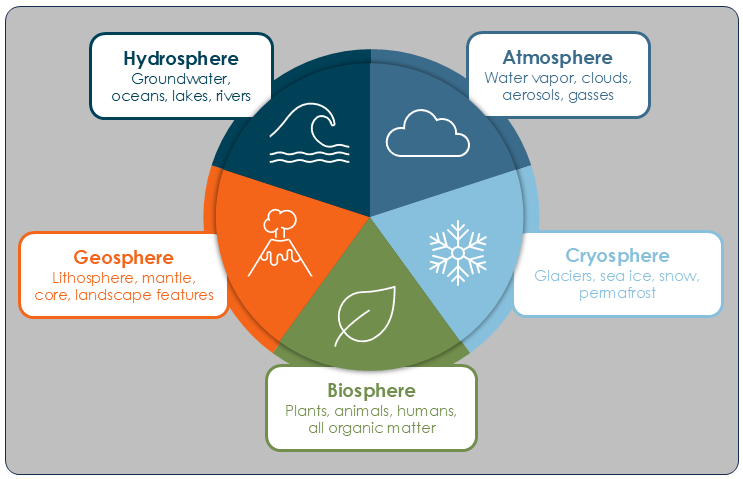
Earth’s spheres: geosphere, hydrosphere, cryosphere, atmosphere and biosphere.
Example: Less snowfall means less meltwater for lakes and rivers. This may reduce water available for plants, animals and people.
2. Solar Radiation and Insolation
The Sun is the main source of energy for Earth’s surface and climate. Solar radiation travels through space as electromagnetic waves.
- Solar radiation: Energy received from the Sun.
- Insolation: Solar radiation reaching Earth’s surface.
- Solar constant: Average solar energy received per second per square metre at the top of Earth’s atmosphere on a surface perpendicular to the Sun’s rays. It is approximately 1.4 kW/m².
- About 99% of the Sun’s energy reaching Earth is within the ultraviolet, visible and infrared regions.
- Visible light supports photosynthesis. Infrared radiation is important in warming Earth’s surface.
- The ozone layer absorbs much of the harmful ultraviolet radiation.
Example calculation: Energy received by an area is calculated using:
Energy = Intensity × Area × Time
For an intensity of 1,000 W/m² over 1 m² for one hour:
E = 1000 × 1 × 3600 = 3,600,000 J
3. Albedo and Uneven Heating
Albedo is the fraction of incoming solar radiation reflected by a surface. A high-albedo surface reflects more sunlight; a low-albedo surface absorbs more energy.
| Surface | Typical albedo | Effect |
|---|---|---|
| Snow | 0.80–0.90 | Reflects most sunlight; remains relatively cool |
| Ice | 0.50–0.70 | Reflects much of the incoming sunlight |
| Crushed rock | 0.25–0.30 | Reflects some sunlight |
| Black soil | Low | Absorbs more solar energy |
| Ocean water | Generally low, varying with conditions | Absorbs much of the incoming sunlight |
- Earth is spherical, so sunlight is more concentrated near the equator and spread over a larger area near the poles.
- This uneven heating creates temperature and pressure differences.
- These differences help drive winds and ocean currents.
- Dark roads and roofs absorb more heat than light-coloured surfaces.
4. The Atmosphere and Greenhouse Effect
The atmosphere is the layer of gases held around Earth by gravity. It contains about 78% nitrogen and 21% oxygen, along with small amounts of other gases.
| Layer | Approximate altitude | Main feature |
|---|---|---|
| Troposphere | 0–12 km | Most weather occurs here; temperature generally decreases with height. |
| Stratosphere | 12–50 km | Contains the ozone layer; temperature increases with height. |
| Mesosphere | Above the stratosphere | Many meteors burn up here. |
| Thermosphere | Above the mesosphere | Contains ionised gases and auroras. |
| Exosphere | Outermost layer | Gradually merges into space. |

The main layers of Earth’s atmosphere.
Greenhouse effect: Earth’s surface absorbs sunlight and emits infrared radiation. Greenhouse gases, including carbon dioxide, methane and water vapour, absorb some outgoing heat and keep Earth warm enough for life. Too much greenhouse gas causes additional warming.
- The ozone layer protects life by absorbing much of the Sun’s harmful UV radiation.
- CFCs caused serious ozone depletion. The Montreal Protocol helped reduce their use.
- Urban heat islands occur when built-up areas absorb and retain more heat than surrounding rural areas.
5. Winds and Ocean Currents
Wind is the movement of air from high-pressure regions towards low-pressure regions. Uneven heating by the Sun is a major cause of pressure differences.
- Valley breeze: During the day, warm air rises along mountain slopes and cooler air moves uphill from the valley.
- Mountain breeze: At night, cooler, denser air flows down the mountain slopes into the valley.
- Planetary winds: Large-scale winds produced by global pressure belts and modified by Earth’s rotation.
- Ocean currents: Continuous movement of ocean water caused by winds, temperature and salinity differences, Earth’s rotation and the arrangement of continents.
- Warm ocean currents transport heat towards cooler regions. Ocean currents also carry nutrients that support marine life.
- Earth’s rotation deflects moving air and water. Large circular ocean-current systems are called gyres.

Valley breezes during the day and mountain breezes at night.
Ocean currents move heat and nutrients around the planet.
6. Biogeochemical Cycles
A biogeochemical cycle is the movement and recycling of matter between living organisms and the non-living environment, including air, water, soil and rocks.
Water Cycle
- Evaporation: Liquid water changes into water vapour.
- Transpiration: Plants release water vapour.
- Condensation: Water vapour forms tiny droplets or ice crystals.
- Precipitation: Water falls as rain, snow or hail.
- Runoff and infiltration: Water flows over land or enters the soil.

The water cycle transfers water between the atmosphere, land and oceans.
Carbon Cycle
- Plants absorb carbon dioxide during photosynthesis and make food.
- Respiration and decomposition return carbon dioxide to the atmosphere.
- Some carbon is stored for long periods in oceans, rocks and fossil fuels.
- Burning fossil fuels and deforestation release additional carbon dioxide.
- Oceans absorb carbon dioxide, but excess carbon dioxide can make seawater more acidic.
Example: Burning coal releases carbon that was stored underground for millions of years into the atmosphere as carbon dioxide.
Nitrogen Cycle
| Process | Meaning |
|---|---|
| Nitrogen fixation | Atmospheric nitrogen is converted into usable compounds by certain bacteria, lightning or industrial processes. |
| Assimilation | Plants absorb nitrogen compounds from the soil; animals obtain nitrogen by eating plants or other animals. |
| Ammonification | Decomposers convert nitrogen in dead organisms and waste into ammonia or related compounds. |
| Nitrification | Bacteria convert ammonia into nitrites and then nitrates. |
| Denitrification | Bacteria convert nitrates back into nitrogen gas. |
Remember: Nitrogen is needed to make proteins and nucleic acids. Most organisms cannot use atmospheric nitrogen gas directly.
Oxygen Cycle
- Plants release oxygen during photosynthesis.
- Animals, plants and many microbes use oxygen during respiration.
- Combustion also consumes oxygen.
- Photosynthesis helps replenish atmospheric oxygen.

Illustration of interconnected cycles of matter in nature.
7. Human Impact on Earth’s Processes
Human activities can disturb Earth’s natural balance by changing the carbon, nitrogen and water cycles.
- Burning fossil fuels: Increases greenhouse gases and contributes to global warming.
- Deforestation: Reduces carbon absorption, transpiration and habitats; increases soil erosion.
- Excess fertilisers: Add nutrients to water bodies, causing algal blooms and eutrophication.
- Ocean acidification: Extra carbon dioxide dissolves in seawater and changes its chemistry, threatening some marine organisms.
- Vehicle emissions: Contribute to air pollution and ground-level ozone formation.
Helpful actions: Save electricity and water, reduce waste, reuse and recycle materials, plant and protect trees, use cleaner energy and support sustainable farming.
Part 2: NCERT Book Solutions
Answers are written in simple language while keeping the textbook questions unchanged.
Revise, Reflect, Refine
1. Choose the most appropriate option to describe the role of biogeochemical cycles in an ecosystem.
(i) To provide food directly to all organisms.
(ii) To recycle essential nutrients between biotic and abiotic components.
(iii) To create new elements for use by living things.
(iv) To remove pollutants and toxins from the organism.
(i) To provide food directly to all organisms.
(ii) To recycle essential nutrients between biotic and abiotic components.
(iii) To create new elements for use by living things.
(iv) To remove pollutants and toxins from the organism.
Answer: (ii) To recycle essential nutrients between biotic and abiotic components.
2. Which of the following is primarily responsible for warming of the Earth?
(i) Solar radiation is immediately absorbed by carbon dioxide, which then releases it as heat.
(ii) The atmosphere’s tiny particles absorb incoming solar radiation, which directly heats the Earth.
(iii) The Earth’s surface absorbs solar radiation, which is then re-radiated and trapped by greenhouse gases.
(iv) The Earth’s environment is heated only by the solar radiation reflected by the clouds.
Answer: (iii) The Earth’s surface absorbs solar radiation, which is then re-radiated and trapped by greenhouse gases.
3. Explain how climate change affects the water cycle. Illustrate with examples.
Answer: A warmer atmosphere holds more moisture, which can cause heavier rainfall in some places and droughts in others. Melting glaciers add water to rivers and raise sea levels. Intense rainfall can increase runoff, soil erosion and flooding, while reducing groundwater recharge.
4. Describe how albedo affects the Earth’s surface temperature and its climate.
Answer: Albedo is the fraction of sunlight a surface reflects. High-albedo surfaces, such as snow, reflect more sunlight and remain cooler. Low-albedo surfaces absorb more sunlight and warm up. These differences affect surface temperatures and climate.
5. How are mountain and valley breezes formed? Suppose there are two mountains, one covered with grass and another covered with barren rocks; would the temperature of the two mountain breezes be different? If so, how?
Answer: During the day, mountain slopes heat the air, which rises and draws cooler air uphill, creating a valley breeze. At night, the slopes cool and dense air flows downhill, creating a mountain breeze. Yes, their temperatures may differ. Barren rocks usually heat up more than grass-covered slopes during the day and lose heat differently at night, so the air above them may be warmer or cooler depending on the time and conditions.
6. You have witnessed weather phenomena, such as winds, storms, rainfall, etc. Which atmospheric layer is mainly responsible for such phenomena and what is the primary reason for its occurrence?
Answer: The troposphere. It is heated mainly from Earth’s surface. Uneven heating causes warm air to rise and creates pressure differences that drive winds, clouds, storms and rainfall.
7. Explain the processes involved in the nitrogen cycle. How would life on Earth be affected if nitrogen were not cycled?
Answer: Nitrogen fixation converts atmospheric nitrogen into usable compounds. Plants absorb these compounds, and animals obtain nitrogen by feeding. Decomposers return nitrogen from waste and dead organisms to the soil. Nitrifying bacteria form nitrates, while denitrifying bacteria return nitrogen to the atmosphere. Without this cycle, organisms would lack enough usable nitrogen to make proteins and nucleic acids, and life would be severely affected.
8. What are the impacts of deforestation on the Earth’s oxygen and carbon cycles? What are the other consequences of deforestation?
Answer: Deforestation reduces photosynthesis, so less carbon dioxide is absorbed and less oxygen is released. It can increase atmospheric carbon dioxide. Other effects include soil erosion, reduced transpiration and local rainfall, habitat destruction and loss of biodiversity.
9. Explain with suitable diagram the path that carbon takes to go back to the atmosphere. You may start from plants using CO2 from the atmosphere.
Answer: Plants absorb carbon dioxide during photosynthesis and store carbon in their food. Animals obtain carbon by eating plants or other animals. Respiration by plants and animals, decomposition of dead organisms and the burning of fossil fuels return carbon dioxide to the atmosphere.
Simple flow diagram:
Atmospheric CO₂ → Plants → Animals → Respiration → Atmospheric CO₂
Dead organisms → Decomposition → Atmospheric CO₂
Fossil fuels → Combustion → Atmospheric CO₂
Atmospheric CO₂ → Plants → Animals → Respiration → Atmospheric CO₂
Dead organisms → Decomposition → Atmospheric CO₂
Fossil fuels → Combustion → Atmospheric CO₂
10. Why is an excess of CO2 in the atmosphere considered undesirable even though it is required by plants?
Answer: Plants need carbon dioxide for photosynthesis, but excess CO₂ strengthens the greenhouse effect. It causes global warming, climate change, melting ice, rising sea levels and ocean acidification.
11. How is heat lost from the surface of the Earth? What is its significance?
Answer: Earth’s surface loses heat mainly by emitting infrared radiation. Heat is also transferred to the air by conduction and convection, and energy is used in evaporation. This energy transfer helps regulate Earth’s temperature and drives weather and the water cycle. Greenhouse gases absorb some outgoing infrared radiation and keep Earth warm enough for life.
12. If the Earth were a flat disc instead of a sphere, how would the patterns of solar radiation and temperature be different?
Answer: Sunlight would fall at different angles depending on the disc’s orientation and position, rather than producing the familiar latitude-based pattern on a sphere. The temperature distribution and wind systems would therefore be very different from those on our spherical Earth.
The Journey Beyond — End-of-Chapter Questions
y Consider two hypothetical Earth-sized planets that have an atmosphere. Assume that one planet is entirely covered by oceans and the other is entirely by land. Knowing that the Sun heats the equator more than the poles, how would the wind patterns on these planets compare with the wind systems we observe on Earth, with its combination of land and sea?
Answer: Both planets would have large-scale winds because the equator receives more solar energy than the poles. The ocean-covered planet would heat and cool more slowly, producing smaller temperature differences over time. The land-covered planet would heat and cool faster, causing stronger temperature variations. Earth has both land and sea, so its wind patterns are affected by both global heating and local differences between land and water.
y Choose any one meal you ate recently (it could be anything, for example, roti and dal, rice and sambar, idli and chutney, and so on). For each main item in the meal, find out and explain: (i) how the carbon in it originally came from carbon dioxide in the air through photosynthesis, and (ii) how the nitrogen in it likely came from the atmosphere into the soil (for example, by bacteria or through the Haber-Bosch process and fertilisers) and then into the plant. Further, list other human activities involved in producing or cooking this meal that add extra carbon dioxide or nitrogen to the environment.
Answer: Example: roti and dal.
(i) Wheat and pulses absorbed carbon dioxide through photosynthesis and stored carbon in their food molecules.
(ii) Nitrogen entered the soil through nitrogen-fixing bacteria or fertilisers. Plants absorbed nitrogen compounds and used them to make proteins.
Activities that may add emissions include operating farm machinery, making and transporting fertilisers, transporting food and cooking with fossil fuels. Excess fertiliser can also add nitrogen compounds to water and soil.
y Using data from the India Meteorological Department (IMD, https://mausam.imd.gov.in/) or newspaper records, find the average monsoon rainfall (June – September, or the local season) for your city or district for 5 years during two decades, such as the 1980s and 2020s. Note any trend you may find (increasing or decreasing, or the total number of days) with heavy rain (>50 mm). How can this be connected to the warmer Arabian Sea temperatures or changes in land use (forests to farms to cities) as discussed in the chapter?
Answer: This question requires local rainfall data from IMD or reliable records. Find the June–September rainfall totals for five years in each decade, calculate the average for each group, and compare them. A change in heavy-rain days may be linked to changing atmospheric moisture, sea temperatures and land use, but the data are needed before concluding whether rainfall has increased or decreased.
13. Suppose there is a rise in atmospheric temperature on Earth. How would this affect the cryosphere, hydrosphere and biosphere?
Answer: The cryosphere would lose ice and snow as glaciers melt. The hydrosphere would experience warmer water, changing rainfall and rising sea levels. The biosphere would face habitat loss, stress on plants and animals, and changes in ecosystems.
14. Explain how the Earth’s atmosphere helps in maintaining a suitable temperature for life to survive on the Earth.
Answer: The atmosphere absorbs and scatters some incoming solar radiation. Greenhouse gases absorb part of the infrared radiation emitted by Earth’s surface, keeping the planet warm enough for life. The atmosphere also helps distribute heat and water vapour around Earth.
15. Describe the interrelationship between different spheres of the Earth. Illustrate with example how these spheres function in a delicate balance.
Answer: Earth’s spheres interact continuously. For example, snow and glaciers belong to the cryosphere. When they melt, water enters rivers and lakes in the hydrosphere. The water supplies plants and animals in the biosphere and flows over soil and rocks in the geosphere. The atmosphere influences snowfall and melting through temperature. A change in one sphere can therefore affect all the others.
Think It Over — Opening Questions
y How does the warming of Arabian Sea water affect the southwest monsoon in India?
Answer: Warmer seawater can increase evaporation and the moisture available to the atmosphere. This can affect monsoon rainfall patterns and may increase the risk of intense rainfall in some regions, although monsoon behaviour depends on several factors.
y If a large forest is cleared, how can that affect the flow of a river in that area?
Answer: Less vegetation means less water is absorbed and held by roots and soil. Runoff and soil erosion may increase, causing heavier river flows during rain, more sediment in the river and potentially lower flows during dry periods.
y What might happen to coastal cities in India if glaciers and polar ice keep melting faster?
Answer: Melting land ice contributes to sea-level rise. Low-lying coastal cities may face more coastal flooding, erosion and saltwater entering freshwater supplies.
y How would increasing carbon dioxide levels in the atmosphere affect the ocean plankton?
Answer: More carbon dioxide dissolves in seawater and makes it more acidic. This can harm some plankton, especially species that build calcium-carbonate shells. Warmer oceans can also affect plankton growth and distribution.