Class 8 Social Science Part 2 Chapter 8 – Cultural Currents: 13th to 17th Centuries from the new NCERT textbook Exploring Society: India and Beyond. Get easy Notes and complete Book Solutions with important concepts, questions and answers, and revision material for effective learning, practice and exam preparation.
Cultural Currents:
13th to 17th Centuries
Easy Notes + Complete Book Solutions
Bhakti • Sufism • Music • Paintings • Gardens • Women • Education • Science • Architecture • Food • Clothing • Literature
— Mahatma Gandhi
📚 Chapter Navigator
1Chapter at a Glance
🪔 Cultural Continuity
Older Indian traditions continued while new ideas were accepted and adapted.
🙏 Bhakti
Devotion, equality, love and oneness became important messages of many saints.
🕌 Sufism
Sufi traditions focused on devotion, inner spiritual search, love and unity.
🎵 Music & Art
Indian music, dance, painting and storytelling developed through regional and cultural interactions.
📚 Knowledge
Education, mathematics, astronomy, medicine and craft traditions continued through different institutions.
🍲 Daily Life
Food, clothing, language and architecture show many examples of cultural exchange.
The Big Questions
- How did Indian culture endure and continue to grow richer during this period despite invasions and an unstable political context?
- What were the major cultural trends and movements of the time?
- How did the various cultural currents of this period interact and mingle?
2Culture, Continuity and Change
Indian Cultural Strength
- Deep historical roots
- Timeless values
- Scientific and questioning spirit
- Rich philosophical traditions
- Strong artistic traditions
- Ability to adapt new ideas
Three Common Patterns
- Traditional practices continued.
- Rulers supported arts, languages, literature and philosophy.
- People from different sections of society participated.
Cultural Interaction
Merchants, scholars, travellers and rulers came to India from Persia, Central Asia, Greece, East Asia and other regions. They brought new foods, languages, clothes, artistic styles and ideas.
Indian society did not simply copy everything. Many influences were adapted to local traditions. This produced new forms of art, music, language, food and architecture.

3The Power of the Bhakti Tradition
Main Ideas
- Love and devotion towards God
- Equality and compassion
- Oneness of God
- Simple language
- Participation of common people
- Music, songs and dance
Important Saints
- Kabir
- Ravidas
- Guru Nanak
- Mirabai
- Chaitanya Mahaprabhu
- Tukaram
- Dnyaneshwar
- Namdev
- Purandaradasa
- Kanakadasa
Kabir
Kabir lived in the 15th century in present-day Uttar Pradesh. His compositions spoke of one God and criticised empty rituals. His teachings appealed to people from different communities.
Ravidas
Ravidas promoted equality and oneness and challenged rigid social divisions.
Guru Nanak
Guru Nanak travelled across regions and taught the message of one God and equality of all people. His teachings, along with hymns of other saints, are preserved in the Guru Granth Sahib.
Other Regional Saints
Mirabai — Rajasthan | Chaitanya Mahaprabhu — East India | Tukaram, Dnyaneshwar and Namdev — West India | Purandaradasa and Kanakadasa — South India

4Sufism and Cultural Interaction
Important Ideas
- Love of God
- Inner spiritual search
- Meditation
- Devotion
- Unity and compassion
Important Sufis
- Khwaja Moinuddin Chishti
- Nizamuddin Auliya
- Rumi
- Amir Khusro
Sufi music became an important part of spiritual life. Devotional songs called qawwalis combined local musical traditions with Sufi ideas.
Bhakti and Sufi Traditions
The two traditions sometimes overlapped. Poets and spiritual teachers shared ideas about devotion, love and unity. This interaction enriched Indian literature and music.
5Musical Traditions — Continuation and Evolution
Hindustani Music
Developed mainly in North India. Persian and other influences interacted with older Indian traditions.
Carnatic Music
Developed mainly in South India and continued with strong links to older Indian musical traditions.
Purandaradasa
Purandaradasa lived during the 15th–16th centuries and became an important devotional composer. He is traditionally called the father of Carnatic music.
Tansen
Tansen was a famous musician associated with Akbar’s court. He became one of Akbar’s nine ratnas. His compositions included devotional themes.
Amir Khusro
Amir Khusro was an Indo-Persian Sufi poet and singer. He is associated with the development of qawwali and the blending of Indian, Persian and Arabic musical traditions.
6From Walls to Paper — Miniature Paintings
After paper reached India, artists increasingly transferred artistic traditions from walls to paper. Miniature painting became an important form.
Rajput Painting
- Traditional Hindu themes
- Scenes from epics and Puranas
- Nature and animals
- Bright decorative forms
- Regional styles
Mughal Miniatures
- Strong Persian influence
- Portraits
- Landscapes
- Court scenes
- Manuscript illustrations

Mughal and Rajput painters influenced one another. Techniques, colours, plants, gardens, animals and court scenes appeared across different painting traditions.
7Changing Landscapes — Gardens
Gardens have been part of Indian landscapes since ancient times. Earlier traditions included gardens around temples, ponds and tanks.
🌳 Persian Charbagh
The Mughals introduced and developed the charbagh design, in which a garden is divided into four parts with water channels, fountains and terraces.
- Gardens were built around forts, tombs and mosques.
- Water channels had both practical and decorative purposes.
- Mughal garden ideas influenced some later Indian gardens.
- Nishat Bagh is an important example.
- The gardens at Amer Fort also show geometric planning.
8Women in Society
Women’s experiences were different in different regions and social groups. Political and military changes affected women’s lives, but women continued to participate in administration, education, arts, literature and public activities in many places.
Razia Sultan
Razia Sultan ruled the Delhi Sultanate in the first half of the 13th century. She personally led military campaigns and took part in administration.
Nur Jahan
Nur Jahan was highly influential during Jahangir’s reign. She participated in governance, issued royal orders and supported art, architecture and trade.
Women in South India
Elite women participated in administration, public activities, donations, arts and education. Inscriptions record several public works supported by women.
9Education and Knowledge Traditions
Institutions
- Gurukulas
- Maṭhas
- Temple schools
- Buddhist vihāras
- Jain pallis
- Pāṭhaśhālās
- Madrasās
Subjects
- Sanskrit and Prakrit grammar
- Astronomy
- Law
- Medicine
- Mathematics
- Philosophy
- Sacred texts
Important Centres
Kanchipuram and Sringeri were known for advanced learning. The Kerala School of Mathematics made important contributions to mathematics and infinite series.
Loss of Major Universities
The destruction of large universities such as Nalanda and Vikramaśhilā was a major cultural loss. However, smaller decentralised learning systems continued.
Vocational Learning
Many skills were taught through apprenticeships. Craftspeople learned directly from family members or experienced masters.
Banarasi Textiles
Weavers from Gujarat moved to Banaras with Akbar’s encouragement. Zari, zardozi and brocade traditions became part of Banarasi silk weaving.
Pashmina
Pashmina shawls are made from fine cashmere wool associated with Ladakh and Kashmir. Mughal patronage helped make them symbols of nobility.
10Growth of Literature and Language
Literature flourished in Sanskrit, Tamil, Telugu, Kannada, Odia, Hindavi, Bengali, Marathi and other languages.
Bhakti Literature
Saints used accessible poetry and songs to spread ideas of devotion, equality and spiritual unity.
Persian Influence
Persian became important in administration and court culture. Sanskrit works were also translated into Persian.
Regional Languages
Regional languages became stronger in both everyday communication and literary expression.
Dara Shikoh
Dara Shikoh supported dialogue between Hindu and Muslim traditions. He helped arrange translations of Upanishads from Sanskrit into Persian.
Development of Urdu
Urdu developed in the Ganga-Yamuna plains from Hindi/Hindavi while incorporating words from Persian and Arabic. In the Deccan it developed regional forms such as Dakhini.
11Developments in Science and Technology
Mathematics
Narayana Pandita wrote Gaṇitakaumudī, a major mathematical work.
Kerala School
Madhava and later scholars made important contributions to infinite series, trigonometry and mathematics.
Astronomy
Nilakantha Somayaji developed a planetary model in which Mercury and Venus travelled around the Sun.
Chemistry & Medicine
India had important traditions of metallurgy, perfumes, refrigeration methods and medical systems.
Major Knowledge Traditions
- Pure zinc production used a special distillation process.
- Indian saltpetre was used in gunpowder and cooling.
- Itr Jahangir was a rose-based perfume.
- Ayurveda, Siddha and Unani medicine were widely practised.
- Knowledge was transmitted through texts and oral traditions.
12Regional Architectural Developments
Between the 13th and 17th centuries, Indian architecture combined older traditions with new techniques, materials and artistic ideas.
Konark
The Sun Temple at Konark is famous for its carved stone wheels and architectural design.
Ranakpur
The Ranakpur temple is a major Jain architectural achievement in Rajasthan.
Sheesh Mahal
The Sheesh Mahal at Amer Fort is decorated with tiny mirrors that create a sparkling effect.
Hampi
Hampi became a major centre of urban planning and temple construction under the Vijayanagara Empire.
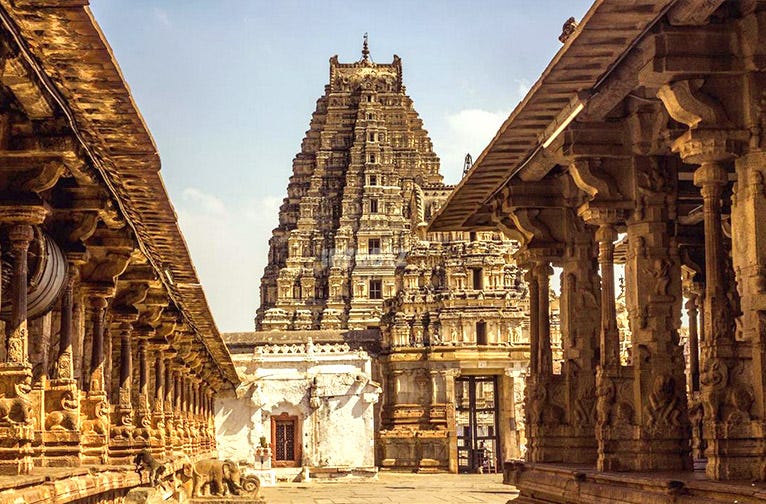
Temple Reconstruction
The rebuilding of damaged temples shows the continuity and resilience of religious and cultural traditions. The Sri Ranganathaswamy Temple at Srirangam is one example.
13Cultural Exchange in Daily Life
🍲 Food
- Samosa developed from the Persian sambūseh.
- Jalebi is related to Persian zalabiyeh.
- Naan shows Persian influence.
- Spices such as cardamom and black pepper were widely used.
- Indian dishes developed new regional forms.
👗 Clothing
- Cotton, muslin and silk production expanded.
- Jama and pyjama were adopted in courtly dress.
- Dupattas developed different styles.
- The sari continued with regional variations.
- Angrakha was influenced by Persian court fashion and adapted to India.
14Before We Move On — Quick Revision
Culture
Indian culture continued while also adapting new influences.
Bhakti & Sufism
Both encouraged devotion and helped create cultural connections.
Music
Hindustani and Carnatic traditions developed while retaining important Indian roots.
Painting
Rajput and Mughal traditions interacted in styles, techniques and themes.
Knowledge
Education, mathematics, astronomy, medicine and crafts continued.
Daily Life
Food, clothing, language and architecture show cultural exchange.
15In-text Questions & Activities — Easy Answers
16Complete Book Questions & Solutions
- Kabir — North India: One God and rejection of empty rituals.
- Mirabai — Rajasthan: Deep personal devotion to Krishna.
- Chaitanya Mahaprabhu — East India: Devotion to Krishna through singing and dancing.
- Mughal miniature painting influenced by Persian traditions.
- Rajput and Mughal painting styles influencing each other.
- Qawwali combining Sufi ideas with Indian musical traditions.
- New musical forms and instruments developing through cultural interaction.
- Architecture combining Indian and external techniques.
Kabir was a 15th-century saint and poet. His teachings stressed devotion to one God and questioned empty religious rituals.
One famous idea in his poetry is that the difference between Ram and Rahim disappears when a person understands the unity of the divine.
His message appealed to common people because he used simple language and familiar examples from daily life. He spoke about equality and inner devotion.
His message remains meaningful because people still need respect, equality, understanding and harmony among communities.
What has changed and what has remained the same over time?
What are your thoughts on why certain elements continued while others changed?
You can present your report in any form — as an illustrated report, or digital presentation, or in any other creative way.
We studied food traditions in our region. Traditional dishes, spices and cooking methods have continued. However, some ingredients and presentation styles have changed.
Some traditions continued because families pass them from one generation to another. Other things changed because of new ingredients, technology, travel, health awareness and changing lifestyles.
The project can be presented through photographs, interviews, a poster, a digital presentation or a short report.
17Quick Revision Table
| Topic | Remember This |
|---|---|
| Culture | Shared way of life including values, traditions, arts and knowledge. |
| Bhakti | Path of devotion; promoted devotion, equality and spiritual unity. |
| Kabir | One God, equality and criticism of empty rituals. |
| Guru Nanak | One God and equality of all people. |
| Sufism | Inner spiritual search, devotion, love and unity. |
| Hindustani Music | Major classical music tradition of North India. |
| Carnatic Music | Major classical music tradition of South India. |
| Tansen | Famous musician associated with Akbar’s court. |
| Amir Khusro | Indo-Persian poet and singer associated with qawwali. |
| Rajput Painting | Traditional Hindu themes and regional artistic styles. |
| Mughal Painting | Persian influence, portraits, court scenes and manuscripts. |
| Charbagh | Four-part garden design with water channels and terraces. |
| Razia Sultan | Female ruler of the Delhi Sultanate who actively governed. |
| Nur Jahan | Influential Mughal woman involved in governance and patronage. |
| Education | Continued through gurukulas, temples, pāṭhaśhālās, madrasās and apprenticeships. |
| Kerala School | Important contributions to mathematics, astronomy and infinite series. |
| Urdu | Developed from Hindi/Hindavi with Persian and Arabic influences. |
| Dara Shikoh | Supported Hindu-Muslim intellectual exchange and translation. |
| Architecture | Tradition and innovation blended across regions. |
| Food Exchange | Samosa, jalebi and naan show cultural interaction. |
18Important Keywords
Bhakti
Devotional path towards God.
Sufism
Islamic spiritual tradition focusing on inner devotion.
Zikr
Remembrance of God through repeated chanting or silent recitation.
Qawwali
Sufi devotional music.
Atelier
An artist’s studio.
Charbagh
Four-part garden design.
Hindavi
Early Hindi-Urdu form with Indian, Persian and Arabic vocabulary.
Brocade
Rich fabric with raised patterns, often using gold or silver thread.
Saltpetre
Potassium nitrate used in gunpowder and other applications.
GI Tag
Protection identifying goods connected with a particular geographical region.
19⭐ Exam-Ready Points
Why did Indian culture survive?
Because traditions continued, people participated, knowledge systems survived locally, and Indian society adapted useful external influences.
Role of Bhakti
Bhakti spread devotion through local languages, songs, music and gatherings and promoted equality and oneness.
Role of Sufism
Sufism encouraged devotion, spiritual search, music, love and unity and interacted with Indian traditions.
Cultural Exchange
It influenced language, food, clothing, painting, architecture and music.
Knowledge
Mathematics, astronomy, medicine, metallurgy and education continued through many institutions and traditions.
Continuity + Change
Indian culture retained its core traditions while adapting new ideas to local needs and tastes.
Prepare more, practise more and learn better! This NCERT Class 8 Social Science Part 2 worksheet for Chapter 8 includes important questions and revision exercises to help students understand key concepts, improve their practice and strengthen their preparation for class tests and examinations.
Class 8 Social Science Part 2 Chapter 8, Class 8 Social Science Chapter 8 Notes, Cultural Currents 13th to 17th Centuries, Class 8 Social Science Part 2 Chapter 8 Notes and Book Solutions, Cultural Currents Notes, Cultural Currents Book Solutions, Class 8 Social Science Questions and Answers, Class 8 Social Science Part 2 Solutions, NCERT Class 8 Social Science, NCERT Class 8 Social Science Part 2, CBSE Class 8 Social Science, Class 8 Social Science Study Material, Class 8 Social Science Revision Notes, Class 8 Social Science Worksheets