Class 7 Maths Chapter 1 Geometric Twins notes and book solutions from Ganita Prakash Part 2. Get easy explanations, concepts, examples and complete textbook question answers for revision and exam preparation.
Class 7 Maths Chapter 1 Geometric Twins | Notes, Concepts & Book Solutions
📐 Geometric Twins
Class 7 Mathematics – Ganita Prakash Part II – Chapter 1
Congruent figures are figures having exactly the same shape and size.
They can be placed one over another and will fit exactly.
Most important idea:
If two figures can be superimposed exactly after suitable rotation or flipping,
they are congruent.
Important Congruence Conditions
SSS Side–Side–Side
SAS Side–Angle–Side
ASA Angle–Side–Angle
AAS Angle–Angle–Side
RHS Right angle–Hypotenuse–Side
Remember: SSA generally does not guarantee congruence.
Important Triangle Facts
Angles opposite equal sides of an isosceles triangle are equal.
All three angles of an equilateral triangle are 60°.
The sum of the three angles of a triangle is 180°.
The side opposite the right angle is called the hypotenuse.
Page 1
1.1 Geometric Twins
The symbol on this signboard needs to be recreated on another board.
How do we do it?
One way is to trace the outline of this symbol on tracing paper to
reconstruct the figure. But this is difficult for big symbols. What else can
we do?
Can we take some measurements that would allow us to exactly recreate
this figure? If yes, what measurements should we take?
Let us name the corner points of this symbol as shown.
Are the arm lengths AB and BC sufficient to exactly recreate this figure?
Suppose these lengths are AB = 4 cm, BC = 8 cm. We observe that
several such symbols can be constructed with the same lengths.
To get the exact replica, would it help to take any other measurement?
The measure of ∠ABC, along with the two arm lengths AB and BC, fix the
shape and size of this figure.
Can you draw the symbol if it is known that AB = 4 cm, BC = 8 cm, and
∠ABC = 80°?
Concept: Three measurements — two sides and the included angle — can fix the exact shape and size of the symbol.
These three measurements can help us create an exact replica of the
symbol on the signboard. Figures that are exact copies of each other
or have the same shape and size are said to be congruent. Congruent
figures can be superimposed exactly, one over the other.
Congruent figures can be rotated or flipped before superimposing.
Easy meaning: Congruent means same shape + same size.
Page 3
Figure it Out
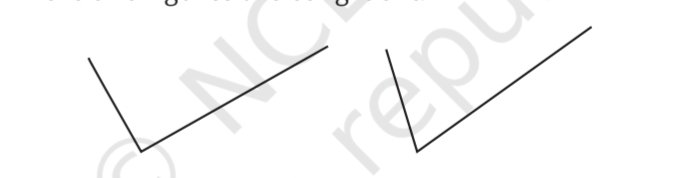
1. Check if the two figures are congruent.
Solution:
yes, they are congruent.
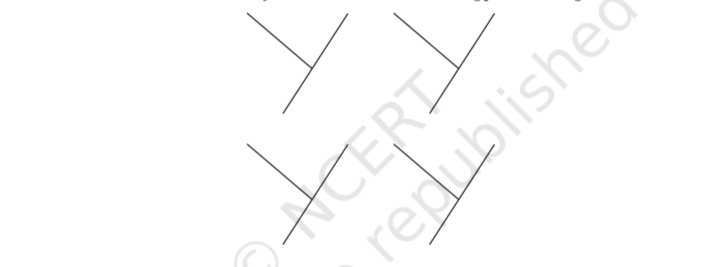
2. Circle the pairs that appear congruent.
Solution:
3. What measurements would you take to create a figure congruent to a given:
(a) Circle (b) Rectangle
Solution:
(a) Circle: Measure its radius or diameter.
(b) Rectangle: Measure its length and breadth.
These measurements determine the size and shape of the figures.
Using this, state how would you check if two—
(a) Circles are congruent?
Solution:
Measure their radii. If their radii are equal, the circles are congruent.
(b) Rectangles are congruent?
Solution:
Compare their corresponding lengths and breadths. If both are equal,
the rectangles are congruent.
4. How would we check if two figures like the one below are congruent?
Solution:
Measure the corresponding sides and angles. If the required corresponding
measurements are equal and one figure can be superimposed exactly on the
other, the figures are congruent.
Use this to identify whether each of the following pairs are congruent.
Easy method:
Compare corresponding lengths and angles. If they match and the figures
fit exactly after moving, rotating or flipping, they are congruent.
Conventions to Express Congruence
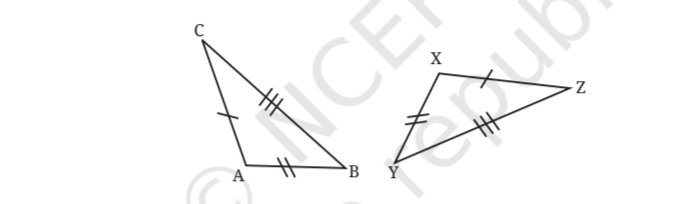
The two triangles given below are congruent. How can these two triangles
be superimposed? Which vertices of ∆XYZ and ∆ABC should we overlap?
Overlapping Vertex A over Vertex X, Vertex B over Vertex Y and Vertex
C over Vertex Z will ensure that equal sides overlap, making the triangles
fit exactly over each other.
Are there other ways of overlapping the vertices so that the triangles fit
exactly over each other?
The fact that these triangles are congruent shows that their respective
angles are equal:
∠A = ∠X, ∠B = ∠Y, ∠C = ∠Z
Page 6
Thus, when two triangles are congruent, there are corresponding
vertices, sides and angles which fit exactly over each other when the
triangles are made to overlap.
Corresponding Vertices: A and X, B and Y, C and Z
Corresponding Sides: AB and XY, BC and YZ, AC and XZ
Corresponding Angles: ∠A and ∠X, ∠B and ∠Y, ∠C and ∠Z
∆ABC ≅ ∆XYZ
This means:
A ↔ X
B ↔ Y
C ↔ Z
By writing this, we mean that:
the first vertex in the name of ΔABC corresponds to the first vertex
in the name of ΔXYZ,
the second vertex in the name of ΔABC corresponds to the second
vertex in the name of ΔXYZ, and
similarly with the third vertices in the names of ΔABC and ΔXYZ.
By this convention, it is incorrect to write for these two triangles that
ΔACB ≅ ΔXYZ.
However, another correct way of saying it is
ΔACB ≅ ΔXZY.
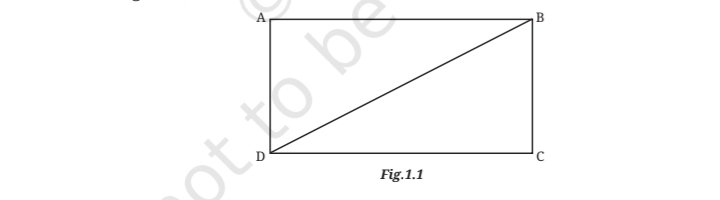
Can you identify a pair of congruent triangles below? Why are they congruent?
Solution:
Consider ΔABD and ΔCDB. Since ABCD is a rectangle:
AB = CD
AD = CB
BD is common to both triangles.
Therefore, the three corresponding sides are equal.
So, by SSS, the triangles are congruent.
Correct correspondence: ΔABD ≅ ΔCDB.
Page 8
Figure it Out
1. Suppose ΔHEN is congruent to ΔBIG. List all the other correct ways
of expressing this congruence.
Solution:
Given:
ΔHEN ≅ ΔBIG
Correspondence is H ↔ B, E ↔ I and N ↔ G.
The other correct orderings are:
ΔENH ≅ ΔIGB
ΔNHE ≅ ΔGBI
ΔHNE ≅ ΔBIG
ΔNEH ≅ ΔGBI
ΔEHN ≅ ΔIBG
2. Determine whether the triangles are congruent. If yes, express the
congruence.
Solution:
The three corresponding side lengths are equal:
RE=AJ = 3.5 cm (GIVEN)
ED=AM= 5 cm (GIVEN)
RD=MJ= 6 cm (GIVEN)
Therefore, by SSS, the triangles are congruent.
Answer: ΔRED ≅ ΔJAM.
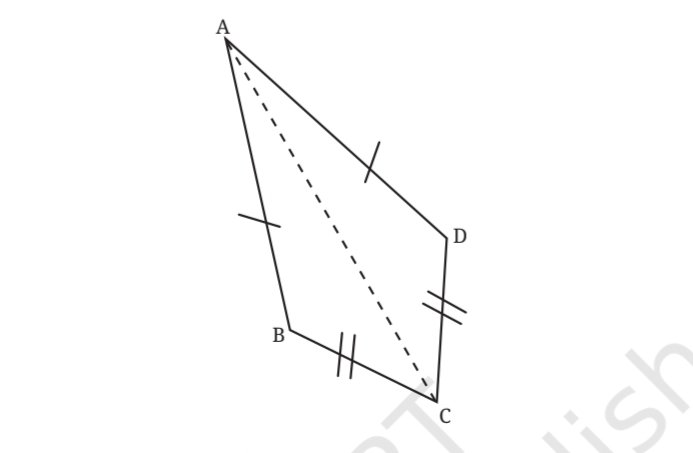
3. In the figure below, AB = AD, CB = CD.
Can you identify any pair of congruent triangles? If yes, explain why
they are congruent.
Solution:
Consider ΔABC and ΔADC.
AB = AD (given)
CB = CD (given)
AC = AC (common side)
Therefore, by SSS:
ΔABC ≅ ΔADC
Does AC divide ∠BAD and ∠BCD into two equal parts? Give reasons.
Solution:
Yes.
Since ΔABC ≅ ΔADC, corresponding angles are equal.
Therefore:
∠BAC = ∠CAD
∠BCA = ∠ACD
Hence AC bisects both ∠BAD and ∠BCD.
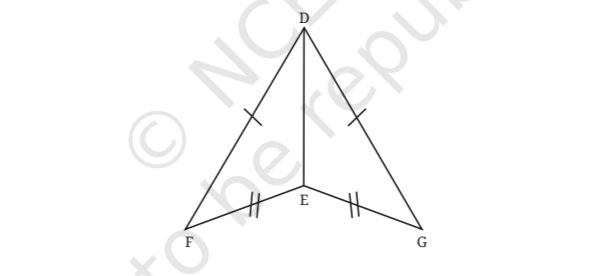
4. In the figure below, are ΔDFE and ΔGED congruent to each other? It
is given that DF = DG and FE = GE.
Solution:
We are given:
DF = DG
FE = GE
DE = DE (common side)
Therefore, all three corresponding sides are equal.
Hence, by SSS:
ΔDFE ≅ ΔDGE
Page 13
Figure it Out
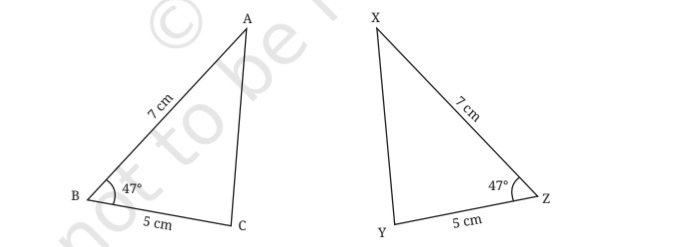
1. Identify whether the triangles below are congruent. What conditions
did you use to establish their congruence? Express the congruence.
Solution:
The corresponding two sides are equal and the included angle is equal:
AB = XZ = 7 cm
BC = YZ = 5 cm
∠B = ∠Z = 47°
Therefore, by SAS:
ΔABC ≅ ΔXZY
2. Given that CD and AB are parallel, and AB = CD, what are the other
equal parts in this figure? (Hint: When the lines are parallel, the alternate angles are equal. Are the two resulting triangles congruent?
If so, express the congruence.)
Solution:
Because AB ∥ CD, alternate interior angles are equal.
Together with AB = CD and the common/intersecting side, the two triangles
satisfy a congruence condition.
AB = CD (GIVEN)
∠B = ∠D (ALTERNATE INTERIOR ANGLES)
∠A = ∠C (ALTERNATE INTERIOR ANGLES)
Therefore, by SAS:
ΔABO ≅ ΔCDO
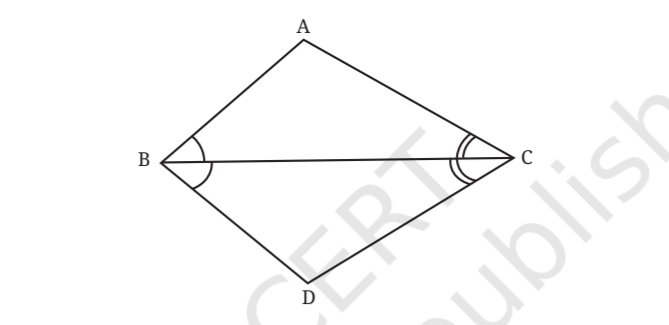
3. Given that ∠ABC = ∠DBC and ∠ACB = ∠DCB, show that
∠BAC = ∠BDC. Are the two triangles congruent?
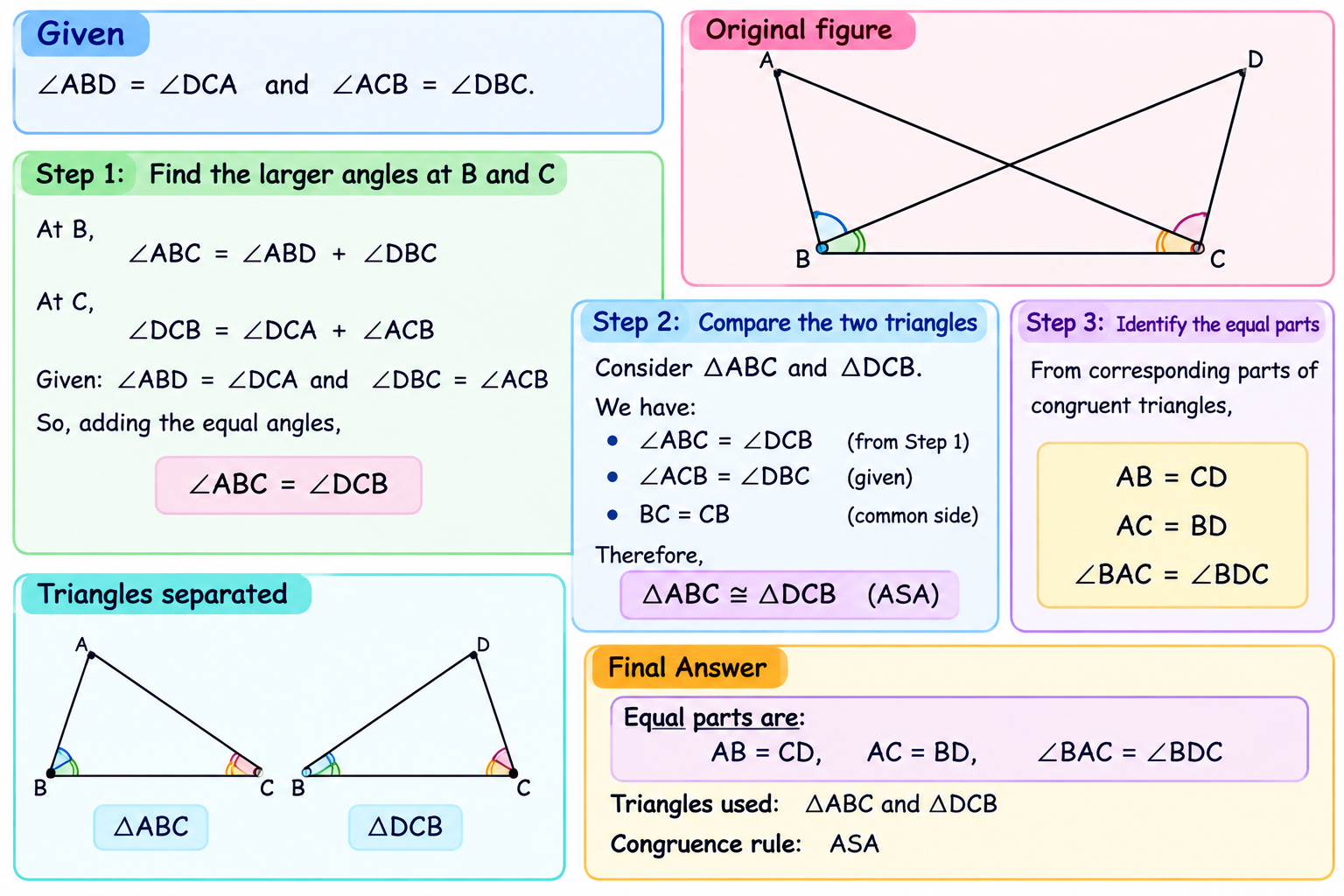
4. Identify the equal parts in the following figure, given that ∠ABD =
∠DCA and ∠ACB = ∠DBC.
Solution:
Page 14
Measuring Two Angles and a Non-Included Side
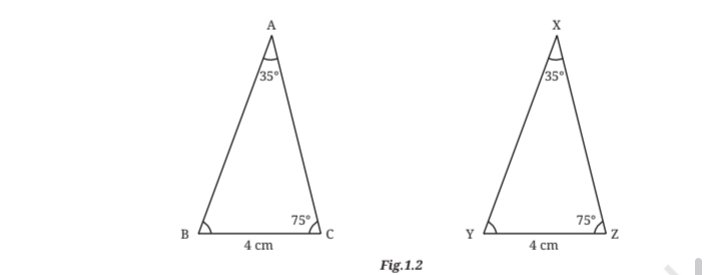
The following triangles ΔABC and ΔXYZ are such that ∠A = ∠X = 35°,
∠C = ∠Z = 75°, and BC = YZ = 4 cm. Are the triangles congruent? Give a reason.
What are the measures of ∠B and ∠Y?
Solution:
The sum of angles of a triangle is 180°.
For ΔABC:
∠B + 35° + 75° = 180°
∠B + 110° = 180°
∠B = 70°
Similarly:
∠Y = 70°
Does this help in showing that ΔABC and ΔXYZ are congruent?
The two triangles now satisfy ASA:
∠B = ∠Y
BC = YZ
∠C = ∠Z
ΔABC ≅ ΔXYZ
In Fig. 1.2, the equalities are between two angles and the non-included
side of the two triangles. This condition is referred to as the
AAS (Angle Angle Side) condition.
As we have seen, the AAS condition guarantees congruence.
Conditions that are sufficient to guarantee congruence
SSS Side Side Side
SAS Side Angle Side
ASA Angle Side Angle
AAS Angle Angle Side
RHS Right Hypotenuse Side
Page 17
1.3 Angles of Isosceles and Equilateral Triangles
ΔABC is isosceles with AB = AC, and ∠A = 80. What can we say about ∠B
and ∠C?
Construct the altitude from A to BC.
We have:
AB = AC (given)
∠ADB = ∠ADC = 90° (from construction)
AD is a common side of the two triangles ΔADB and ΔADC.
Thus, the triangles satisfy the RHS condition.
Hence, ΔADB ≅ ΔADC.
This shows that ∠B = ∠C, as they are corresponding parts of congruent
triangles.
Can you use this fact to find ∠B and ∠C?
Solution:
Given ∠A = 80°.
Since AB = AC, ∠B = ∠C.
Let each be x.
80° + x + x = 180°
2x = 100°
x = 50°
Therefore:
∠B = 50°, ∠C = 50°
Angles in an Equilateral Triangle
Equilateral triangles are those in which all the sides have equal lengths.and all the angles are equal.
What could be the measures of these angles?
As the three angles should add up to 180°, we have
3 × angle in an equilateral triangle = 180°
Each angle = 60°
Verify this by construction.
Key result: Every angle of an equilateral triangle is 60°.
Congruent Triangles in Real Life
Congruent triangles can be seen in various constructions and designs
from ancient to modern times.
World-famous Louvre Museum in Paris
World-famous Egyptian Pyramid of Giza
Dome design
Rangoli design
Rabindra Setu or Howrah Bridge
Page 19
Figure it Out
1. ΔAIR ≅ ΔFLY. Identify the corresponding vertices, sides and angles.
Solution:
Corresponding vertices:
A ↔ F
I ↔ L
R ↔ Y
Corresponding sides:
AI = FL
IR = LY
AR = FY
Corresponding angles:
∠A = ∠F
∠I = ∠L
∠R = ∠Y
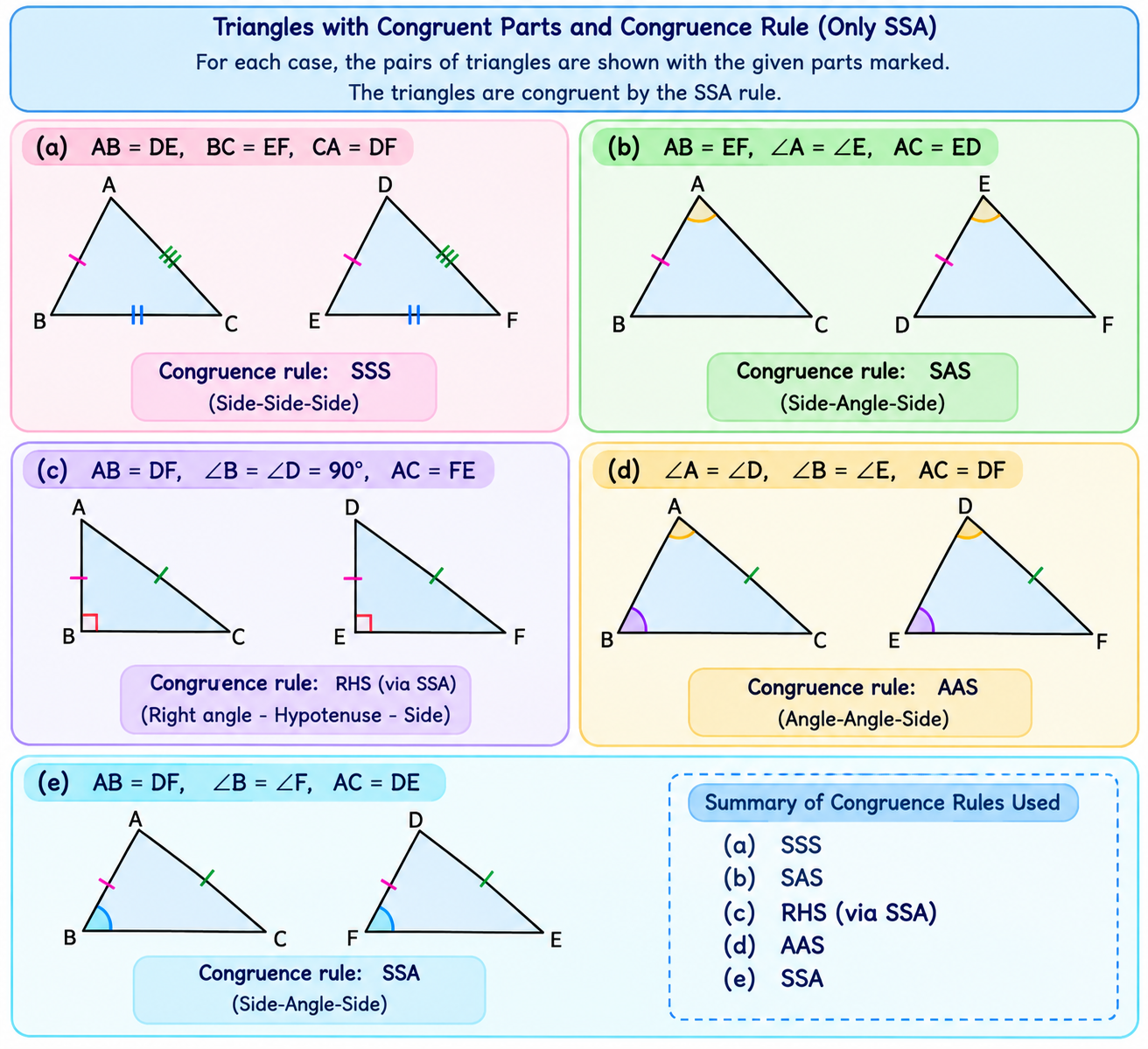
2. Each of the following cases contains certain measurements taken
from two triangles. Identify the pairs in which the triangles are
congruent to each other, with reason. Express the congruence
whenever they are congruent.
(a) AB = DE
BC = EF
CA = DF
(b) AB = EF
∠A = ∠E
AC = ED
(c) AB = DF
∠B = ∠D = 90°
AC = FE
(d) ∠A = ∠D
∠B = ∠E
AC = DF
(e) AB = DF
∠B = ∠F
AC = DE
Solution:
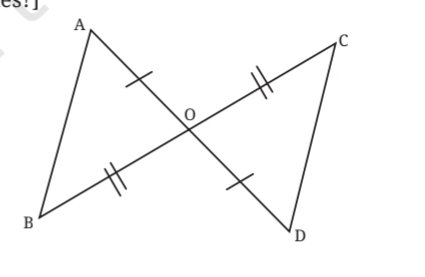
3. It is given that OB = OC, and OA = OD. Show that AB is parallel to CD.
[Hint: AD is a transversal for these two lines. Are there any equal
alternate angles?]
Solution:
Consider ΔAOB and ΔDOC.
OA = OD (given)
OB = OC (given)
∠AOB = ∠DOC (vertically opposite angles)
Therefore, by SAS:
ΔAOB ≅ ΔDOC
Hence corresponding angles are equal:
∠BAO = ∠ODC
These are alternate interior angles made by transversal AD.
Therefore:
AB ∥ CD
Page 20
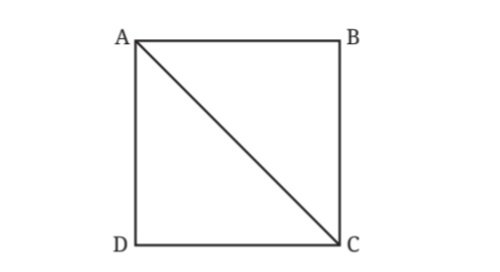
4. ABCD is a square. Show that ΔABC ≅ ΔADC. Is ΔABC also congruent
to ΔCDA?
Solution:
Since ABCD is a square:
AB = AD (side of a square)
BC = CD (side of a square)
AC is common.
Therefore, by SSS:
ΔABC ≅ ΔADC
Yes, ΔABC is also congruent to ΔCDA because the corresponding vertices
can be named in another correct order:
ΔABC ≅ ΔCDA
Give more examples of two triangles where one triangle is
congruent to the other in two different ways, as in the case above.
Solution:
A simple example is two congruent isosceles triangles. Because two sides
are equal, more than one correspondence can sometimes be used while
writing their congruence.
For example, if the correspondence allows interchange of equal vertices,
two correct names may be obtained.
Can you give an example of two triangles where one is congruent to
the other in six different ways?
Solution:
Yes. Take two equilateral triangles.
All their sides and all their angles are equal, so the vertices can be
matched in all possible 6 orders.
3! = 6 ways
5. Find ∠B and ∠C, if A is the centre of the circle.
Solution:
A is the centre, so AB = AC because both are radii of the same circle.
Therefore ΔABC is isosceles.
Hence:
∠B = ∠C
The angles of a triangle add to 180°:
∠B + ∠C + 120° = 180°
2∠B = 60°
∠B = 30°
Therefore:
∠B = 30°, ∠C = 30°
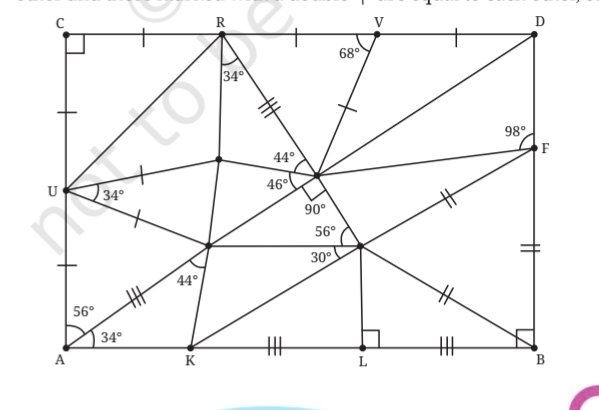
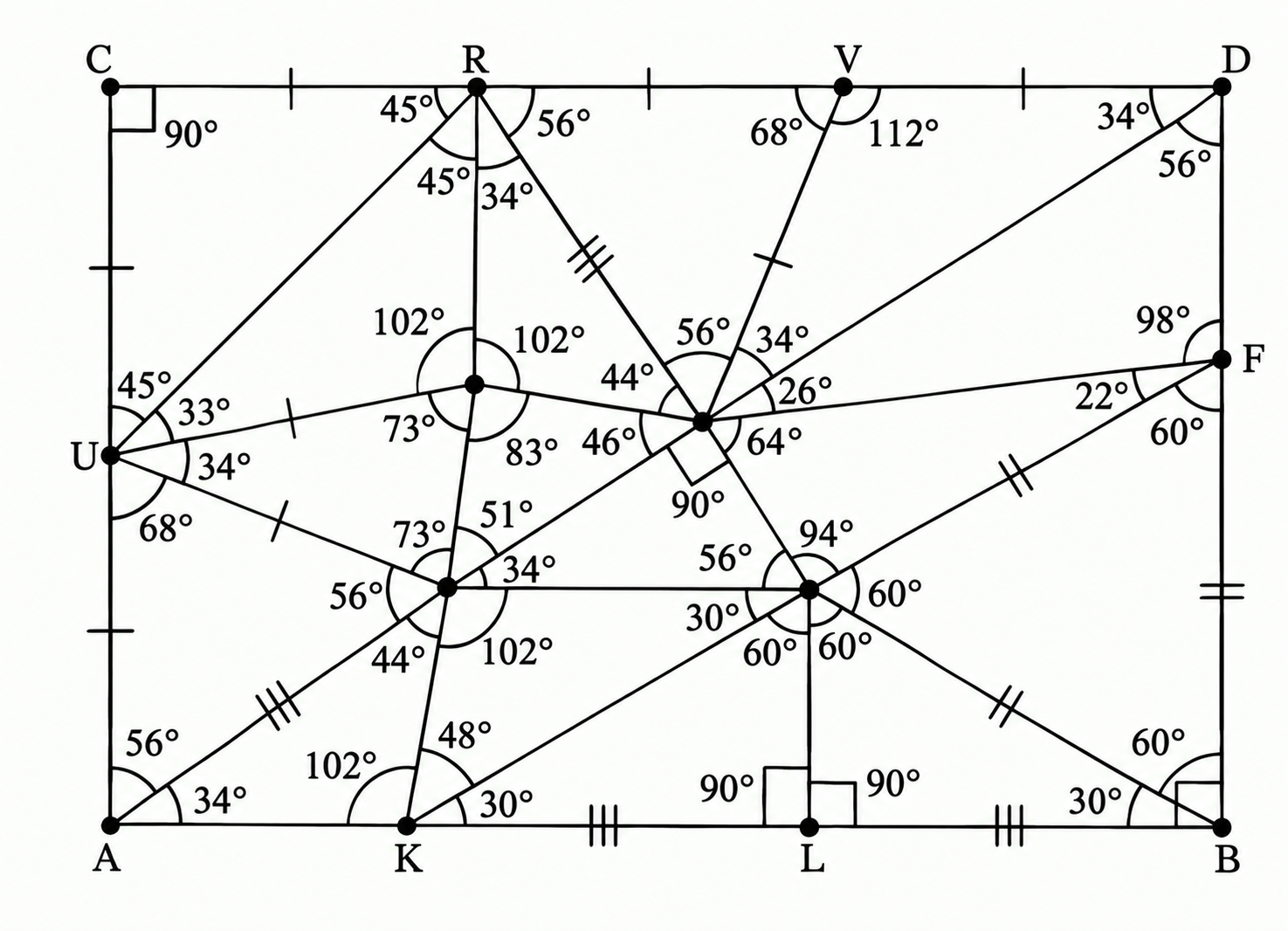
6. Find the missing angles. As per the convention that we have been
following, all line segments marked with a single ‘|’ are equal to each
other and those marked with a double ‘|’ are equal to each other, etc.
Solution:
Use these two rules repeatedly:
Angles opposite equal sides are equal.
The angles of a triangle add up to 180°.
For every small isosceles triangle, first identify the equal sides.
The opposite angles must then be equal. Finally use the 180° angle-sum
property to find the remaining angle.
Tip for students: Work from the smallest triangles first and write
each newly found angle beside the diagram. This makes the larger angles
much easier to calculate.
Page 21–22
📚 Chapter Summary
Figures that have the same shape and size are said to be congruent. These figures can be superimposed so that one fits exactly over the other.
While verifying congruence, a figure can be rotated or flipped to make it fit exactly over the other figure via superimposition.
When two triangles have the same sidelengths, we say that the SSS (Side Side Side) condition is satisfied. The SSS condition guarantees congruence.
When two sides and the included angle of one triangle are equal to the two sides and the included angle of another triangle, we say that the SAS (Side Angle Side) condition is satisfied. The SAS condition also guarantees congruence.
When two angles and the included side of one triangle are equal to the two angles and the included angle of another triangle, we say that the ASA (Angle Side Angle) condition is satisfied. The ASA condition guarantees congruence. Congruence holds even if the side is not included between the angles AAS (Angle Angle Side) condition.
In a right-angled triangle, the side opposite to the right angle is called the hypotenuse.
When a side and a hypotenuse of a right-angled triangle are equal to a side and the hypotenuse of another right-angled triangle, we say that the RHS (Right Hypotenuse Side) condition is satisfied. The RHS condition also guarantees congruence.
Two triangles need not be congruent if two sides and a non-included angle are equal.
In a triangle, angles opposite to equal sides are equal.
The angles in an equilateral triangle are all 60°.
⭐ Quick Revision Table
Condition
Meaning
Guarantees Congruence?
SSS
Three corresponding sides equal
✅ Yes
SAS
Two sides and included angle equal
✅ Yes
ASA
Two angles and included side equal
✅ Yes
AAS
Two angles and non-included side equal
✅ Yes
RHS
Right angle, hypotenuse and one side equal
✅ Yes
SSA
Two sides and non-included angle
❌ Not always
🧠 Super Easy Memory Trick
SSS: 3 Sides SAS: Side, Angle, Side ASA: Angle, Side, Angle AAS: Angle, Angle, Side RHS: Right angle + Hypotenuse + Side
🧩 Expression Engineer!
Draw lines and split the region consisting of white squares into 6
smaller congruent regions.
Draw lines and split the region consisting of white squares into 6 smaller congruent regions.
Solution:
One simple approach is to divide the larger square arrangement into
six regions having the same shape and size. The lines should be placed
symmetrically so that each resulting region can be matched with another
by rotation or reflection.
The important idea is that all six regions should have the same shape
and size, so that they are congruent.
🎯 Final Chapter Practice
Explain congruence in your own words.
Write the five main conditions that guarantee triangle congruence.
Why does SSA not always guarantee congruence?
Give one example of SSS congruence.
Give one example of SAS congruence.
Explain why the base angles of an isosceles triangle are equal.
Why is every angle of an equilateral triangle 60°?
Explain the difference between ASA and AAS.
What is the hypotenuse?
What does RHS mean?
🌟 Remember: Congruence means exact matching of shape and size.
When checking triangles, carefully identify the corresponding sides and
angles before writing the congruence statement.
Prepare for your exams with this easy and student-friendly worksheet based on Class 7 Maths Chapter 1 from Ganita Prakash Part 2. Practice all the questions carefully to revise the chapter, strengthen your concepts, and improve your mathematical understanding.
📐
CLASS 7 • MATHEMATICS PART 2
Class 7 Maths Part 2 Chapter 1 Worksheet
Practice worksheet for Class 7 Mathematics Part 2 Chapter 1
with important questions, extra practice and answer key.