Class 7 Khel Yatra Unit 6 Chapter 1 – Yoga for Daily Life with easy Notes, Solutions, Questions & Answers and Worksheet. Learn the importance of yoga and healthy daily practices with simple and student-friendly Class 7 study material.
Yoga
Class 7 Khel Yatra
Yoga for Daily Life
Reprint 2026–27 | Pages 153–162
About Yoga
Yoga is an ancient practice designed to harmonise the body and mind. It helps us develop physically, mentally, emotionally and socially. Regular yoga practice can encourage self-awareness, discipline and responsible behaviour.
The word Yoga is derived from the Sanskrit root ‘Yuj’, meaning ‘to join’, ‘to unite’ or ‘to integrate’. It represents the union of body, mind and the inner self.
Yoga can help us develop a stronger body, a calmer mind and more balanced emotions. It can also help us become better students, friends, family members and responsible citizens.
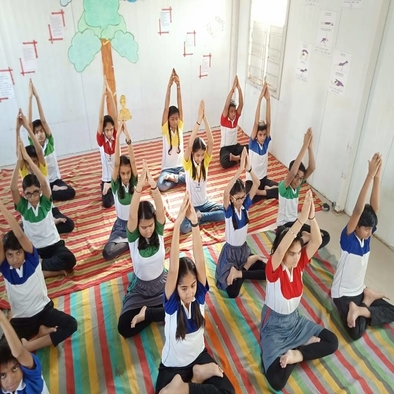
Yoga Session Structure
A yoga session begins with a prayer and ends with a closing prayer. The session includes different yogic activities that help students develop the body, mind and inner self.
General instructions to begin and end a Yoga session
- Sit comfortably in Sukhāsana with your spine, neck and head straight.
- Close your eyes, relax your face and bring your awareness to your breath.
- Place your hands in Chin Mudra. Observe your breath for a few moments. Then, take a deep and slow breath. As you exhale, gently chant “Om.”
- Gently place your hands in Namaskāra Mudra and chant prayer given in the following page.
- Notice how you feel after chanting Om.
- Gently rub your palms together, place them over your closed eyes and then slowly open your eyes to the warmth of your hands.
Opening Prayer
ॐ सह नाववतु
सह नौ भुनक्तु।
सह वीर्यं करवावहै।
तेजस्वि नावधीतमस्तु मा विद्विषावहै।
ॐ शान्तिः शान्तिः शान्तिः॥
Om Saha Nāvavatu.
Saha Nau Bhunaktu.
Saha Viryam Karavāvahai.
Tejasvi-Nāvadhitamastu Mā Vidvisāvahai.
Om Śāntih Śāntih Śāntih.
Meaning of the Prayer
May we both (Guru and Śiśya) be protected. May we both be nourished. May we practice with great vigour and energy. Let our studies be fruitful and enlightening. May we not hate each other.
Closing Prayer
ॐ सर्वे भवन्तु सुखिनः
सर्वे सन्तु निरामयाः।
सर्वे भद्राणि पश्यन्तु
मा कश्चिद्दुःखभाग्भवेत्।
ॐ शान्तिः शान्तिः शान्तिः॥
Om Sarve Bhavantu Sukhinah
Sarve Santu Nirāmayāh.
Sarve Bhadrāni Paśyantu
Mā Kaśhcidduhkhabhagbhāvet.
Om Śāntih Śāntih Śāntih.
Meaning of the Prayer
May all be happy. May all be free from illness. May all see what is auspicious. May no one suffer. Let there be peace everywhere.
Chapter 1 – Yoga for Daily Life
Yoga can be included in our daily routines. The chapter explains ‘Yoga in action’ (Karma Yoga), as taught by Shri Krishna in the Bhagavad Gita.
It means ‘Yoga is skill in action.’ It teaches us to perform our tasks in a relaxed and focused way to get the best results.
A Kho-Kho player is not only required to run fast. The player also needs to remain calm and focused when the game becomes intense. Similarly, while studying, playing or learning a new skill, we can try to stay calm, focus our attention and enjoy the process.
Sri Aurobindo highlights yoga as a means of overall personality development at the physical, mental, intellectual, emotional and spiritual levels.
Yoga and Holistic Development
A healthy tree needs its roots, trunk, branches and leaves to grow together. In the same way, we need balanced development in different areas of life.
Yoga helps us understand the connection between our body, mind and inner self.
The Pancha Kosha concept in the Taittiriya Upanishad describes five layers of our existence. These are often compared with the layers of an onion.

Pancha Kosha – Five Sheaths
Physical Sheath
Energy Sheath
Mind Sheath
Wisdom Sheath
Bliss Sheath
1. Annamaya Kosha – Physical Sheath
This is the outermost layer and represents our physical body. It is the part that we can see, touch and feel.
It is connected with the food we eat. Playing sports, running, eating healthy food, living with nature and sleeping well can help us maintain a healthy body.
2. Pranamaya Kosha – Energy Sheath
Pranamaya Kosha is associated with Prana, or life energy. Breathing connects us with the air around us.
Practices such as Prānāyāma, Mudra and Kriyā are described as ways to work with this layer.
3. Manomaya Kosha – Mind Sheath
This layer is related to our thoughts, feelings and perceptions. It includes how we think, feel and react.
Activities such as meditation, mantra chanting (japa), listening to music, singing, painting and Trataka can help refine this layer.
4. Vijnanamaya Kosha – Wisdom Sheath
This layer helps us distinguish between right and wrong and supports decision-making, knowledge, wisdom and understanding.
It helps us understand our strengths and weaknesses and make better choices.
5. Anandamaya Kosha – Bliss Sheath
This is described as the innermost layer and the source of pure joy or bliss.
Peace and happiness may be experienced while spending time in nature, playing with pets, pursuing hobbies, singing, listening to songs, helping others or contributing to society.
Pancha Kosha – Quick Revision
| Kosha | Meaning | Main Idea |
|---|---|---|
| Annamaya Kosha | Physical Sheath | Body and physical health |
| Pranamaya Kosha | Energy Sheath | Prana and breathing |
| Manomaya Kosha | Mind Sheath | Thoughts and emotions |
| Vijnanamaya Kosha | Wisdom Sheath | Knowledge and decision-making |
| Anandamaya Kosha | Bliss Sheath | Joy and contentment |
Ashtāṅga Yoga – Eight Limbs of Yoga
To achieve all-around development, Mahashri Patanjali created a systematic process known as Ashtāṅga Yoga.
Social discipline and ethics
Personal discipline
Physical postures
Regulation of breath
Mastery over senses
Concentration
Meditation
State of ultimate joy and bliss
Activity – My Daily Yoga Plan to strengthen the Panchakosha
Create your own daily yoga plan:
(a) Imagine your self in the future. What kind of person do you want to be, and what skills, values and qualities will help you get there?
(b) What small things you do today to start becoming that person?
(a) I want to become a kind, responsible and hardworking person. Honesty, discipline, patience and knowledge will help me.
(b) I can study regularly, help others, speak politely and complete my work on time.
Yama and Niyama
Yama and Niyama are guidelines for a balanced and fulfilling life. Yama refers to moral principles that guide our behaviour with others.
Five Yamas
Being kind to all living beings.
Always telling the truth and being honest.
Not to take things that belongs to others.
Having self-control.
Not being greedy.
Niyama
Niyama are personal habits that help us take care of ourselves and transform us into better persons.
Five Niyamas
Cleanliness.
Being happy and content with what we have.
Self-discipline and determination to achieve.
Self-study.
Recognising the divinity.
Ishwara Pranidhana
Ishwara Pranidhana is one of the Niyamas. It is about recognising the divinity within ourselves and surrendering to it.
It also teaches us to see our body as a temple and to offer our actions, senses, breath and happiness to the divine within us.
It encourages us to recognise sacredness inside and around us and to be grateful.
Divinity in All
We usually think places of worship and prayer rooms are sacred. But yoga teaches that everything can be seen as sacred.
Pranidhana means seeing the divine in everything – nature, friends, family and even daily work.
A Journey of Oneness
Guru Nanak was a great spiritual teacher who believed that God is everywhere.
One day, he was on a pilgrimage to a holy city. Tired from the journey, he laid down to rest. A devotee saw Guru Nanak and was concerned.
“Your feet are pointing towards our holy place of worship,” he said. “It’s disrespectful.”
Guru Nanak politely asked the devotee to place his feet where there is no holy place.
But no matter which way the devotee moved Nanak’s feet, he still saw the place of worship in front of them. Then devotee recognised divinity of Guru Nanak and apologised to him.
This story shows us that for Guru Nanak, every place was divine. He believed that God is present in all directions, places and in all creations.
Activity
Quick Revision – Questions and Answers
Quick Matching Activity
| Term | Meaning |
|---|---|
| Annamaya Kosha | Physical Sheath |
| Pranamaya Kosha | Energy Sheath |
| Manomaya Kosha | Mind Sheath |
| Vijnanamaya Kosha | Wisdom Sheath |
| Anandamaya Kosha | Bliss Sheath |
| Ahimsa | Kindness |
| Satya | Truthfulness |
| Asteya | Not taking others’ things |
| Brahmacharya | Self-control |
| Aparigraha | Not being greedy |
Note for the Teacher
- Explain to students how yoga can nourish and balance the Panchakosha through asanas, pranayama, and meditation.
- Encourage the students to take a walk in nature.
- Let students notice the beautiful things around them and understand how everything works together.
- Students can keep a gratitude journal and list five or more things they are grateful for every day.
Yoga Practice – Safety Reminder
Practise yoga gently and according to your ability. Do not force the body into a posture. Follow the guidance of a teacher during practice and stop if you feel pain or discomfort.
One-Page Revision
Union of body, mind and inner self.
Five layers: physical, energy, mind, wisdom and bliss.
Social discipline and ethical principles.
Personal discipline and habits.
Eight limbs of yoga for systematic development.
Eight Limbs
Yama → Niyama → Āsana → Prāṇāyāma → Pratyāhāra → Dhāraṇa → Dhyāna → Samādhi
Five Yamas
Ahimsa, Satya, Asteya, Brahmacharya, Aparigraha
Five Niyamas
Sauhca, Santosha, Tapas, Swadhyaya, Ishwara Pranidhana
Practice important questions and revision exercises with this easy Class 7 Khel Yatra worksheet for unit 6 chapter 1 . It is useful for chapter revision, practice and exam preparation
Class 7 Khel Yatra Unit 6 Chapter 1, Class 7 Khel Yatra Yoga for Daily Life, Yoga for Daily Life Class 7, Class 7 Yoga Notes, Class 7 Khel Yatra Unit 6 Chapter 1 Notes, Class 7 Khel Yatra Yoga Solutions, Yoga for Daily Life Questions and Answers, Class 7 Khel Yatra Worksheet, Yoga for Daily Life Worksheet Class 7, Class 7 Khel Yatra Unit 6 Notes, Class 7 Yoga Study Material