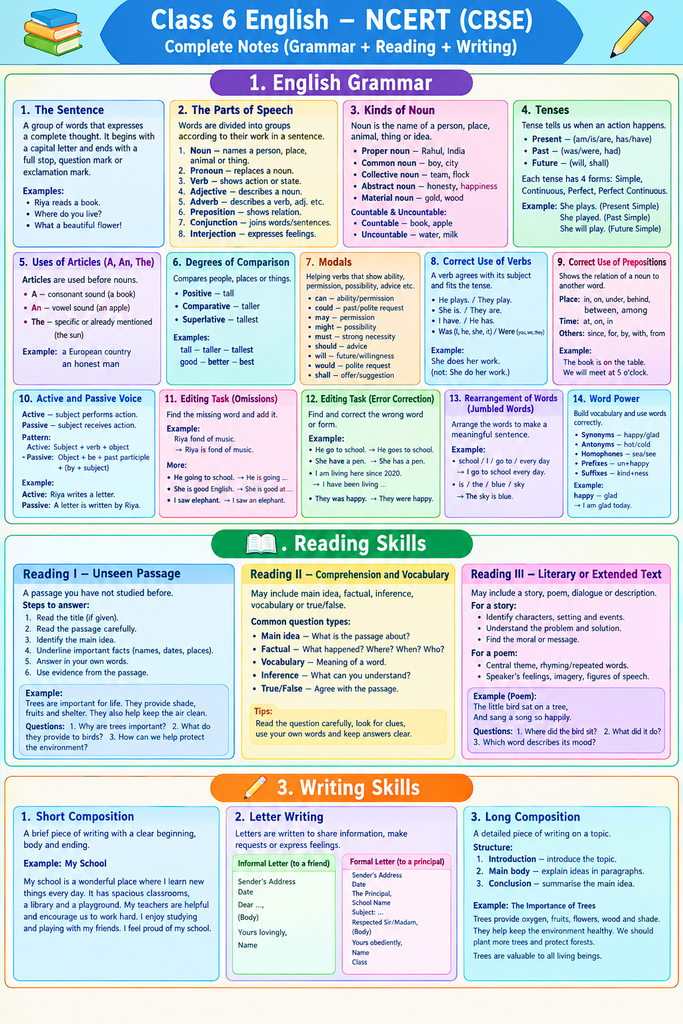
Class 6 English – Complete Notes
CBSE | NCERT | English Grammar, Reading Skills and Writing Skills
Part 1: English Grammar
1. The Sentence
A sentence is a group of words that expresses a complete thought. It begins with a capital letter and usually ends with a full stop, question mark or exclamation mark.
- Riya reads a book.
- Where do you live?
- What a beautiful flower!
Kinds of Sentences
- Assertive Sentence: Makes a statement.
Example: The sun rises in the east. - Interrogative Sentence: Asks a question.
Example: What is your name? - Imperative Sentence: Gives an order, request or advice.
Example: Please open the door. - Exclamatory Sentence: Expresses a strong feeling.
Example: How wonderful! - Optative Sentence: Expresses a wish or prayer.
Example: May you succeed in life!
Incorrect: School I to go every day.
Correct: I go to school every day.
2. The Parts of Speech
Words are divided into different groups according to the work they do in a sentence. These groups are called parts of speech.
- Noun: Names a person, place, animal or thing.
Examples: teacher, Delhi, tiger, pencil. - Pronoun: Used in place of a noun.
Examples: I, you, he, she, they. - Verb: Shows an action or state.
Examples: run, write, sing, is. - Adjective: Describes a noun or pronoun.
Examples: beautiful flower, clever boy. - Adverb: Describes a verb, adjective or another adverb.
Examples: runs quickly, very tall. - Preposition: Shows the relationship of a noun or pronoun to another word.
Examples: in, on, under, between. - Conjunction: Joins words or sentences.
Examples: and, but, because, or. - Interjection: Expresses sudden feelings.
Examples: Wow! Alas! Hurrah!
- The – article/determiner
- clever – adjective
- boy – noun
- runs – verb
- quickly – adverb
3. Kinds of Noun
A noun is the name of a person, place, animal, thing or idea.
- Proper Noun: The special name of a person, place or thing.
Examples: Rahul, India, Monday. - Common Noun: A general name.
Examples: boy, city, river. - Collective Noun: Names a group.
Examples: team, flock, bunch, class. - Abstract Noun: Names a quality, feeling, state or idea.
Examples: honesty, kindness, happiness, childhood. - Material Noun: Names a material or substance.
Examples: gold, silver, wood, cotton.
Countable and Uncountable Nouns
- Countable Nouns: book, apple, chair.
- Uncountable Nouns: water, milk, rice, sugar.
- Delhi is a large city. (Delhi – proper noun; city – common noun.)
- The team won the match. (Team – collective noun.)
- Honesty is the best policy. (Honesty – abstract noun.)
4. Tenses
Tense tells us when an action happens: in the present, past or future. Each basic tense has four commonly taught forms.
A. Present Tense
| Form | Structure | Example |
|---|---|---|
| Simple Present | Subject + base verb (s/es with he, she, it) | She plays tennis. |
| Present Continuous | is/am/are + verb-ing | She is playing tennis. |
| Present Perfect | has/have + past participle | She has played tennis. |
| Present Perfect Continuous | has/have been + verb-ing | She has been playing for an hour. |
B. Past Tense
| Form | Structure | Example |
|---|---|---|
| Simple Past | Subject + past form | She played tennis. |
| Past Continuous | was/were + verb-ing | She was playing tennis. |
| Past Perfect | had + past participle | She had played tennis. |
| Past Perfect Continuous | had been + verb-ing | She had been playing for an hour. |
C. Future Tense
| Form | Structure | Example |
|---|---|---|
| Simple Future | will + base verb | She will play tennis. |
| Future Continuous | will be + verb-ing | She will be playing tennis. |
| Future Perfect | will have + past participle | She will have played tennis. |
| Future Perfect Continuous | will have been + verb-ing | She will have been playing for an hour. |
- He works.
- She has finished.
- Did you go?
- They will come.
5. Uses of Articles (A, An and The)
Articles are words used before nouns.
- A: Used before a singular countable noun beginning with a consonant sound.
Examples: a book, a teacher, a university. - An: Used before a singular countable noun beginning with a vowel sound.
Examples: an apple, an umbrella, an hour. - The: Used for a particular person or thing, or something already mentioned.
Examples: the sun, the door.
- I saw a dog. The dog was brown.
- The sun rises in the east.
- Please close the door.
- A European country.
- An honest man.
6. Degrees of Comparison
Adjectives can compare people, animals, places or things.
- Positive Degree: Describes one person or thing.
Example: Riya is tall. - Comparative Degree: Compares two people or things.
Example: Riya is taller than Sita. - Superlative Degree: Compares one with a group of three or more.
Example: Riya is the tallest girl in the class.
| Positive | Comparative | Superlative |
|---|---|---|
| tall | taller | tallest |
| small | smaller | smallest |
| happy | happier | happiest |
| large | larger | largest |
| beautiful | more beautiful | most beautiful |
| good | better | best |
| bad | worse | worst |
| little | less | least |
| many/much | more | most |
7. Modals
Modals are helping verbs that express ability, permission, possibility, advice, duty or necessity.
| Modal | Use | Example |
|---|---|---|
| Can | Ability or permission | I can swim. |
| Could | Past ability or polite request | Could you help me? |
| May | Permission or possibility | May I come in? |
| Might | Possibility | It might rain. |
| Must | Strong necessity | You must follow the rules. |
| Should | Advice | You should eat healthy food. |
| Will | Future or willingness | I will help you. |
| Would | Polite request or imagined situation | Would you like some tea? |
| Shall | Offers or suggestions | Shall we begin? |
Incorrect: She can dances.
8. Correct Use of Verbs
A verb must agree with its subject and fit the tense of the sentence.
Subject–Verb Agreement
- He plays cricket.
- They play cricket.
- The girl is happy.
- The boys are happy.
- I am ready.
- Incorrect: She do her work.
Correct: She does her work. - Incorrect: He did not went there.
Correct: He did not go there. - Incorrect: She have a pen.
Correct: She has a pen.
9. Correct Use of Prepositions
A preposition shows the relationship of a noun or pronoun to another word in a sentence.
Prepositions of Place
- In: The keys are in the box.
- On: The book is on the table.
- Under: The cat is under the chair.
- Behind: The boy is behind the door.
- Between: The school is between the bank and the park.
- Among: She stood among her friends.
Prepositions of Time
- At: at 6 o’clock, at noon.
- On: on Monday, on 10 October.
- In: in July, in 2026, in the morning.
Other Common Prepositions
- Since: since Monday.
- For: for two hours.
- By: Finish it by Friday.
- With: Write with a pen.
- From: She comes from India.
10. Active and Passive Voice
Voice tells us whether the subject performs an action or receives it.
Active Voice: The subject performs the action.
Example: The boy kicks the ball.
Passive Voice: The subject receives the action.
Example: The ball is kicked by the boy.
Basic Pattern
- Active: Subject + verb + object.
- Passive: Object + suitable form of be + past participle + (by + subject).
| Active Voice | Passive Voice |
|---|---|
| Riya writes a letter. | A letter is written by Riya. |
| He cleans the room. | The room is cleaned by him. |
| They played the match. | The match was played by them. |
| She is reading a book. | A book is being read by her. |
11. Editing Task (Omissions)
An omission is a missing word in a sentence or passage. The missing word must be identified and inserted in the correct place.
- Incorrect: Riya fond of music.
Correct: Riya is fond of music. - He going to school. → He is going to school.
- She is good English. → She is good at English.
- I saw elephant. → I saw an elephant.
12. Editing Task (Error Correction)
Error correction means finding and correcting an incorrect word or grammatical form.
| Incorrect Sentence | Correct Sentence |
|---|---|
| He go to school. | He goes to school. |
| She have a pen. | She has a pen. |
| I am living here since 2020. | I have been living here since 2020. |
| They was happy. | They were happy. |
| She is an university student. | She is a university student. |
Common areas of error include subject–verb agreement, tense, articles, prepositions, pronouns and singular/plural forms.
13. Rearrangement of Words (Jumbled Words)
Jumbled words are words given in the wrong order. Arrange them to make a meaningful sentence.
- school / I / every day / go to
I go to school every day. - is / the / blue / sky
The sky is blue. - playing / children / are / the / outside
The children are playing outside.
To arrange words, identify the subject and verb, place the object or remaining information correctly, and begin the sentence with a capital letter.
14. Word Power
Word power means building vocabulary and learning to use words correctly.
A. Synonyms
Words with similar meanings.
- happy – glad
- begin – start
- large – big
- quick – fast
B. Antonyms
Words with opposite meanings.
- hot – cold
- early – late
- strong – weak
- kind – cruel
C. Homophones
Words that sound alike but have different meanings or spellings.
- sea – see
- right – write
- pair – pear
- son – sun
D. Prefixes
Letters added at the beginning of a word to change its meaning.
- unhappy = un + happy
- rewrite = re + write
- incorrect = in + correct
E. Suffixes
Letters added at the end of a word.
- kindness = kind + ness
- helpful = help + ful
- teacher = teach + er
F. Using New Words
Learn a word with its meaning and an example sentence.
Word: happy
Meaning: feeling pleased or joyful
Sentence: I am glad to see you.
Part 2: English Reading Skills
Reading I – Unseen Passage
An unseen passage is a text that you have not studied before. You read it and answer questions based on the information given.
How to Answer Questions
- Read the title, if provided.
- Read the passage carefully.
- Identify the main idea.
- Underline important names, dates, places and facts.
- Answer in your own words where appropriate.
- Use evidence from the passage rather than guessing.
Trees are important for life. They provide shade, fruits and shelter to birds. They also help keep the air clean. We should plant more trees and protect forests.
Questions- Why are trees important?
- What do trees provide to birds?
- How can we help protect the environment?
- Trees provide many benefits and help keep the air clean.
- They provide shelter to birds.
- We can plant more trees and protect forests.
Reading II – Comprehension and Vocabulary
A reading exercise may ask you to identify the central idea, word meanings, synonyms, antonyms, details or the writer’s purpose.
Common Question Types
- Main Idea: What is the passage mainly about?
- Factual Question: What happened? Where? When? Who?
- Vocabulary: What does a particular word mean in the passage?
- Inference: What can you understand from the information?
- True or False: Decide whether a statement agrees with the passage.
Reading III – Literary or Extended Text
This type of reading activity may include a story, poem, dialogue or descriptive passage. Questions may test understanding of characters, events, feelings, imagery and the message of the text.
Reading a Story
- Identify the main characters.
- Note the setting and important events.
- Understand the problem and its solution.
- Identify the moral or message, if any.
Reading a Poem
- Identify the central theme.
- Notice rhyming words and repeated words.
- Understand the speaker’s feelings.
- Explain figures of speech or imagery when asked.
The little bird sat on a tree,
And sang a song so happily.
- Where did the bird sit?
- What did the bird do?
- Which word describes the bird’s mood?
- The bird sat on a tree.
- It sang a song.
- Happily.
Part 3: English Writing Skills
1. Short Composition
A short composition is a brief piece of writing on a given topic. It usually has a clear beginning, a few supporting details and a suitable ending.
Structure
- Introduction: Introduce the topic.
- Body: Add relevant facts, examples or details.
- Conclusion: End with a final thought.
Example: My School
My school is a wonderful place where I learn new things every day. It has spacious classrooms, a library and a playground. My teachers are helpful and encourage us to work hard. I enjoy studying and playing with my friends. I feel proud of my school.
2. Letter Writing
Letters are written to share information, make requests, express feelings or communicate formally.
A. Informal Letter
An informal letter is written to friends, relatives or people we know well.
Format and Example10, Green Park
Dehradun
10 October 2026
Dear Riya,
How are you? I am fine and hope you are doing well. I am writing to tell you about my school picnic. We visited a beautiful park, played games and enjoyed our lunch together. It was a memorable day.
I hope to see you soon. Please convey my regards to your parents.
Yours lovingly,
Neha
B. Formal Letter
A formal letter is written to a principal, teacher, official or another person for an official purpose.
Format and ExampleSender’s Address
Dehradun
10 October 2026
The Principal
ABC School
Dehradun
Subject: Request for Two Days’ Leave
Respected Sir/Madam,
I am a student of Class 6. I am unable to attend school for two days because I am unwell. Kindly grant me leave for these two days.
Thank you for your consideration.
Yours obediently,
Neha
Class 6
3. Long Composition
A long composition develops a topic in greater detail. It may be a descriptive paragraph, an essay, a story or an account of an event.
Structure
- Introduction: Introduce the topic.
- Main Body: Explain ideas in separate, logically connected paragraphs.
- Conclusion: Summarise the main idea or give a final thought.
Example: The Importance of Trees
Trees are an essential part of our environment. They provide oxygen, fruits, flowers, wood and shade. They also give shelter to birds and many other animals.
Trees help keep the environment healthy. Their roots hold the soil together and help reduce soil erosion. Trees also make our surroundings cooler and more beautiful.
Unfortunately, many trees are cut down to build roads and buildings. We should plant more trees and protect existing forests. We must also avoid wasting paper and encourage others to care for nature.
Trees are valuable to all living beings. By protecting them today, we can help create a greener and healthier future.
Revision