Class 9 Science: Exploring Mixtures and their Separation
NCERT Curiosity | Chapter 5 | Concept Notes and Book Solutions
PART 1: SHORT CONCEPT NOTES
1. Types of Mixtures
A mixture contains two or more substances physically combined.
- Homogeneous mixture: Has a uniform composition throughout. Examples: salt solution, sugar solution, vinegar and air.
- Heterogeneous mixture: Does not have a uniform composition throughout. Examples: sand and water, oil and water, muddy water.
2. Solutions, Suspensions and Colloids
Solution: A homogeneous mixture in which the solute dissolves in the solvent. Example: salt water.
Suspension: A heterogeneous mixture containing large, undissolved particles that may settle on standing. Example: chalk powder in water.
Colloid: A mixture containing particles that do not settle on standing and cannot be separated by ordinary filtration. Examples: milk, fog and blood.
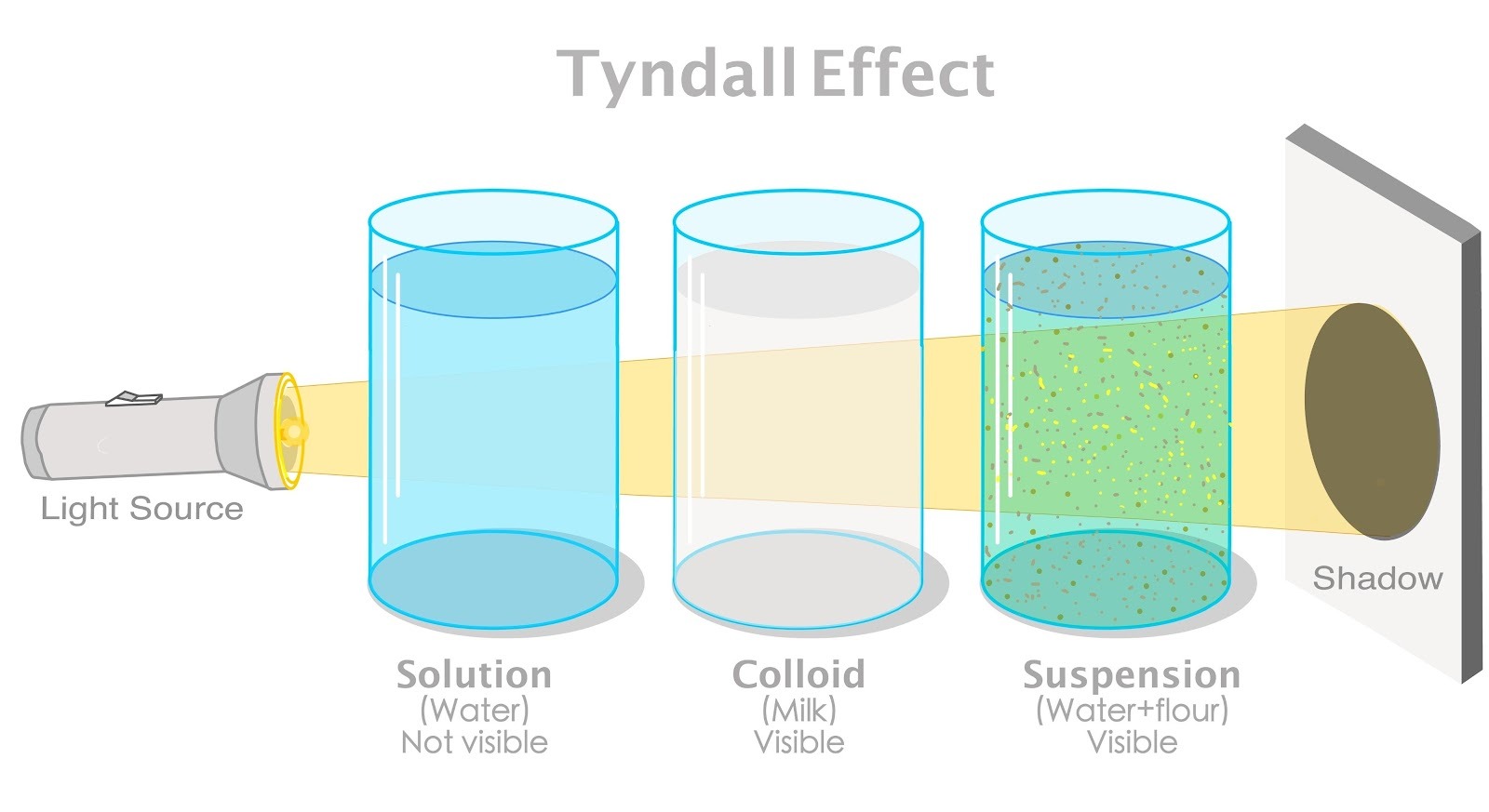
| Property | Solution | Suspension | Colloid |
|---|---|---|---|
| Nature | Homogeneous | Heterogeneous | Heterogeneous, often appears uniform |
| Particle size | Less than 1 nm | More than 1000 nm | 1–1000 nm |
| Particles visible? | No | Yes | No, not to the naked eye |
| Settle on standing? | No | Usually yes | No |
| Ordinary filtration | Does not separate solute | Can separate particles | Does not separate colloidal particles |
| Tyndall effect | No | Can occur | Yes |
3. Solute, Solvent and Concentration
- Solute: The substance that dissolves.
- Solvent: The substance that dissolves the solute.
- Solution: The mixture formed by a solute and a solvent.
- Concentration: The amount of solute present in a given amount of solution.
Important formulas
% m/m = (Mass of solute ÷ Mass of solution) × 100
% m/v = (Mass of solute in g ÷ Volume of solution in mL) × 100
% v/v = (Volume of solute ÷ Volume of solution) × 100
Mass of solution = 10 + 90 = 100 g
Mass percentage = (10 ÷ 100) × 100 = 10%
4. Solubility and Saturated Solutions
Solubility: The maximum amount of a substance that dissolves in a fixed amount of solvent at a given temperature.
Saturated solution: A solution that cannot dissolve more solute at that temperature.
- The solubility of most solid substances in water increases with temperature.
- The solubility of most gases in liquids decreases when temperature increases.
- A solubility curve shows how solubility changes with temperature.
5. Crystallization
Crystallization is the process of obtaining solid crystals from a solution. It is used to purify solids.
Example: Obtaining copper sulfate crystals from a saturated solution or obtaining salt crystals from concentrated brine.
Slow cooling often produces larger, better-shaped crystals than rapid cooling.

6. Evaporation and Distillation
Evaporation: A liquid changes into vapour from its surface. It can be used to obtain a dissolved solid, such as salt from salt water.
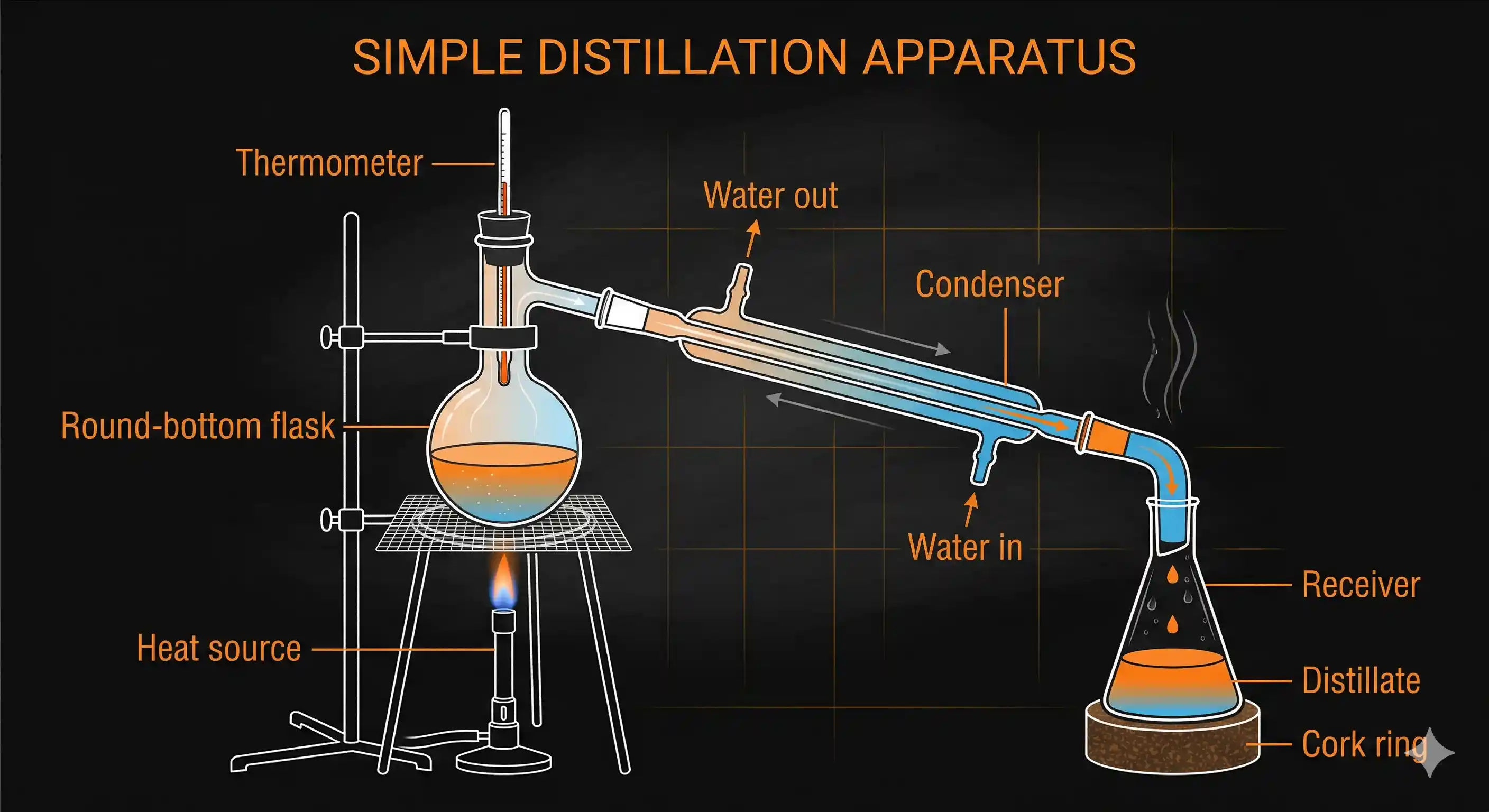
Distillation: A liquid is heated to form vapour, which is cooled to obtain the liquid again. It can recover a solvent or separate suitable mixtures of liquids with different boiling points.
Fractional distillation: Used to separate miscible liquids whose boiling points are relatively close. It is used to separate crude petroleum into useful fractions.
7. Paper Chromatography
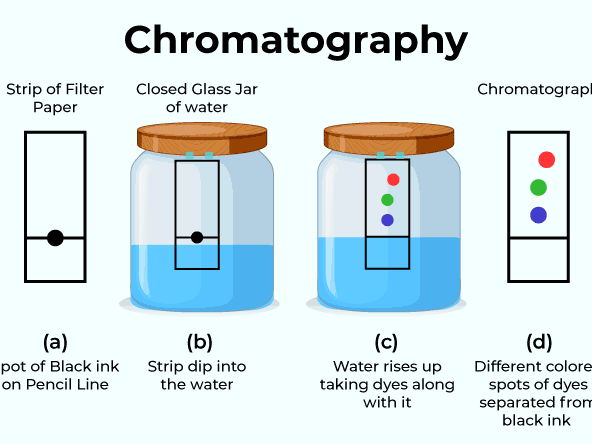
Paper chromatography separates substances because different components move at different speeds through paper with a suitable solvent.
Example: Separating the different coloured dyes present in black ink.
8. Separating Immiscible Liquids
Immiscible liquids do not mix and form separate layers. A separating funnel separates them because of their different densities.
Example: Oil and water. Oil is usually the upper layer because it is less dense than water.

9. Sublimation
Sublimation is the direct change of a solid into vapour without passing through the liquid state. Deposition is the change of vapour directly into a solid.
Example: Camphor or naphthalene can be separated from sand using sublimation because these substances sublime on heating while sand does not.
10. Centrifugation and Coagulation
Centrifugation: A mixture is spun rapidly to separate its components. It is used to separate blood cells from plasma.
Coagulation: A substance called a coagulant makes tiny suspended particles form larger clumps. These clumps settle and can be removed.
Examples: Alum helps remove fine impurities from muddy water. Lemon juice or vinegar helps coagulate milk proteins to make paneer.
11. Tyndall Effect and Emulsions
Tyndall effect: Scattering of light by particles in a colloid, making the path of light visible.
Examples: Sunlight passing through dusty air and a beam of light passing through milk.
Dispersed phase: The particles distributed in a colloid.
Dispersion medium: The substance in which the particles are distributed.
Emulsion: A colloid formed by two liquids. Examples include milk and butter.
PART 2: TEXTBOOK QUESTIONS AND SOLUTIONS
The questions below retain the wording and order of the supplied textbook extract. The original figures for Questions 5, 11 and 15, and Table 5.5 for Question 15, were not included in the supplied text. Those missing visual details are identified where needed.
Revise, Reflect, Refine
1. Which of the following mixtures are correctly classified as homogeneous (Hm) and heterogeneous (Ht)? Choose the correct option.
(i) Air — Hm, Milk — Ht, Sugar solution — Hm, Smoke — Hm
(ii) Brass — Ht, Fog — Ht, Vinegar — Ht, Muddy water — Hm
(iii) Copper sulfate solution — Hm, Salt solution — Hm, Milk — Hm, Bronze — Hm
(iv) Muddy water — Ht, Milk — Ht, Blood — Ht, Brass — Hm
Answer: Option (iv).
Muddy water, milk and blood are heterogeneous mixtures. Brass is a homogeneous alloy.
2. Choose the correct options, and explain the reason for the correct and incorrect options.
Which among the following mixtures show the Tyndall Effect? A mixture of:
(a) air and dust particles
(b) copper sulfate and water
(c) starch and water
(d) acetone and water
(i) a and b (ii) b and d (iii) a and c (iv) c and d
Answer: Option (iii), a and c.
Dust in air and starch dispersed in water scatter light. Copper sulfate solution and acetone mixed with water are true solutions and do not show the Tyndall effect.
3. A mixture can be categorised as a solution, a suspension, or a colloid, each possessing distinct properties. Utilise the words or phrases provided in the box to fill in the Table 5.2. Words and phrases may be used more than once.
Words and Phrases
Large-sized particles; Particles remain evenly distributed; Small-sized particles (less than 1 nm diameter); Moderate-sized particles (1 – 1000 nm); Settles down when left undisturbed (more than 1000 nm in diameter); Does not settle down; Scatters light; Separates by filtration; Transparent; Salt solution; Milk; Sand in water; Smoke; Heterogeneous mixture; Cannot be separated by filtration; Mud; Butter; Brass.
Complete the Table 5.2.
Table 5.2
| Solution | Suspension | Colloid |
|---|---|---|
| Properties Homogeneous; particles smaller than 1 nm; transparent; does not settle; cannot be separated by ordinary filtration. | Properties Heterogeneous; large particles above 1000 nm; particles may be visible; settles on standing; separates by filtration. | Properties Heterogeneous but often appears uniform; particles 1–1000 nm; particles remain distributed; does not settle; cannot be separated by ordinary filtration; scatters light. |
| Examples Salt solution, brass | Examples Sand in water, mud | Examples Milk, smoke, butter |
4. Solve the following problems:
(i) A cake recipe uses dry ingredients, namely 75 g of sugar for 420 g of all-purpose flour and 5 g of sodium hydrogencarbonate. Express the concentration of each component in the mixture using an appropriate method.
Answer: Total mass = 75 + 420 + 5 = 500 g.
Sugar = (75 ÷ 500) × 100 = 15% m/m.
Flour = (420 ÷ 500) × 100 = 84% m/m.
Sodium hydrogencarbonate = (5 ÷ 500) × 100 = 1% m/m.
(ii) A brass alloy contains 70% copper by mass. Calculate the quantities of copper and zinc present in 120 g of brass.
Answer: Copper = 70% of 120 = 84 g.
Zinc = 120 − 84 = 36 g.
5. The label on a cooking oil pack says one litre (910 g). If this oil is mixed with water, will it form a separate layer? If so, which substance will be on top? How will you separate the two layers? Also, draw the diagram of the apparatus used.
Answer: Yes. Oil and water form separate layers because they are immiscible. Oil will be on top because its density is lower than that of water.
A separating funnel can be used. Allow the layers to settle, open the stopcock to drain the lower water layer, and collect the oil separately.
The supplied text refers to an apparatus diagram, so a relevant labelled separating-funnel reference image is shown above.
6. Assertion (A): Solutions do not exhibit the Tyndall effect.
Reason (R): The particles in solutions are larger than 100 nm, so they cannot scatter light.
Choose the correct option:
(i) Both A and R are true, and R is the correct explanation of A.
(ii) Both A and R are true, but R is not the correct explanation of A.
(iii) A is true, but R is false.
(iv) A is false, but R is true.
Answer: Option (iii). Assertion A is true, but Reason R is false. Solution particles are smaller than 1 nm, not larger than 100 nm.
7. How would you separate the mixtures given in Table 5.3? Mention the reason for choosing your method. If a mixture cannot be separated, explain why.
Table 5.3
| Mixture | Method of separation | Reason for selection |
|---|---|---|
| Mud from muddy water | Coagulation followed by sedimentation and decantation, or filtration | Coagulation helps fine particles clump together; filtration removes particles. |
| Plasma from other components in the blood sample | Centrifugation | Blood components separate according to their densities. |
| Naphthalene and sand | Sublimation | Naphthalene sublimes; sand does not. |
| Chalk powder and common salt | Add water, filter, then evaporate or crystallize the filtrate | Salt dissolves in water; chalk does not. |
| Common salt and water | Evaporation or crystallization; distillation if water must also be recovered | Water evaporates; salt remains or crystallizes. |
| Oil from water | Separating funnel | Oil and water are immiscible and form separate layers. |
| Pigments of the flower | Paper chromatography | Different pigments move at different rates in a suitable solvent. |
8. Two miscible liquids, A and B, are present in a mixture. The boiling point of A is 60 °C and the boiling point of B is 90 °C. Suggest a method to separate them. Also, draw a labelled diagram of the method suggested.
Answer: Simple distillation is suitable because the boiling points differ by 30 °C. Liquid A boils first at 60 °C, its vapour is cooled in a condenser, and the liquid is collected in a receiver. Liquid B mostly remains in the flask at first.
9. Compare evaporation, crystallization and distillation. In which situation, would you prefer each of these over the others?
| Method | How it works | When preferred |
|---|---|---|
| Evaporation | The solvent changes into vapour and leaves the solute behind. | When recovering a dissolved solid and the solvent need not be collected. |
| Crystallization | Crystals form from a saturated solution, often on cooling. | When a purer solid is required as crystals. |
| Distillation | Vapour is cooled and collected as a liquid. | When recovering the solvent or separating suitable liquids with different boiling points. |
10. Blood is an example of a colloidal mixture. (i) What would happen if blood behaved like a true suspension inside the body? (ii) In a blood sample, identify the dispersed phase and the dispersion medium.
(i) Answer: If blood cells settled like particles in a suspension, blood circulation could be disrupted and the body would not receive oxygen and nutrients properly.
(ii) Answer: In the colloidal component of blood, proteins and other dispersed substances form the dispersed phase, while plasma acts as the dispersion medium. Whole blood also contains cells, so it is more complex than a simple colloid.
11. You are given a mixture of sand, common salt and naphthalene (Fig. 5.25a). The Fig. 5.25b depicts various steps used to separate the components of this mixture. Identify and write down the correct sequence of separation techniques.
Answer:
- Sublimation: Heat the mixture carefully to separate naphthalene as vapour, then cool the vapour to collect solid naphthalene.
- Dissolution and filtration: Add water to the remaining sand and salt. Salt dissolves, but sand remains insoluble. Filter to separate sand.
- Evaporation or crystallization: Evaporate the water from the filtrate or allow it to crystallize to obtain common salt.
12. Why is distillation an effective method for separating a mixture of water and acetone?
Answer: Acetone boils at about 56 °C, while water boils at 100 °C. Acetone vaporises first and can be cooled and collected separately, making distillation effective.
13. Answer the following questions with the help of the data given in Table 5.4.
Table 5.4: Solubility of various salts (in g per 100 g of water) at different temperatures
| Salt | 10 °C | 20 °C | 30 °C | 40 °C | 60 °C | 80 °C |
|---|---|---|---|---|---|---|
| Potassium nitrate | 21 | 32 | 45 | 62 | 106 | 167 |
| Sodium chloride | 36 | 36 | 36.3 | 36.5 | 37 | 37 |
| Potassium chloride | 35 | 35 | 37.4 | 40 | 46 | 54 |
| Ammonium chloride | 24 | 37 | 41 | 41 | 55 | 66 |
(i) What mass of potassium nitrate would be needed to prepare its saturated solution in 50 g of water at 40 °C?
Answer: At 40 °C, 62 g dissolves in 100 g water.
For 50 g water: (62 ÷ 100) × 50 = 31 g.
(ii) A student makes a saturated solution of potassium chloride in water at 80 °C and leaves the solution to cool at room temperature (25 °C). What would she observe as the solution cools? Explain.
Answer: Some potassium chloride crystals will form as the solution cools because its solubility decreases. At 80 °C, 54 g dissolves in 100 g water; at 25 °C, the solubility is between the listed values for 20 °C and 30 °C.
(iii) What is the effect of a change in temperature on the solubility of salts? Also, compare the changes in the solubility of the four given salts with increasing temperature from 10 °C to 80 °C.
Answer: The solubility of all four salts increases overall with temperature, but by different amounts.
- Potassium nitrate: increases from 21 g to 167 g, a rise of 146 g.
- Sodium chloride: increases from 36 g to 37 g, a rise of 1 g.
- Potassium chloride: increases from 35 g to 54 g, a rise of 19 g.
- Ammonium chloride: increases from 24 g to 66 g, a rise of 42 g.
Potassium nitrate shows the greatest increase, while sodium chloride shows the smallest.
14. Three students, A, B and C, are preparing sugar solutions for an experiment:
Student A dissolves 20 g of sugar in 80 g of water.
Student B dissolves 20 g of sugar in 100 g of water.
Student C dissolves 30 g of sugar in 80 g of water.
(i) Calculate the mass percentage (% m/m) concentration of sugar in each student’s solution.
Student A: Total mass = 20 + 80 = 100 g.
Mass percentage = (20 ÷ 100) × 100 = 20%.
Student B: Total mass = 20 + 100 = 120 g.
Mass percentage = (20 ÷ 120) × 100 = 16.67% approximately.
Student C: Total mass = 30 + 80 = 110 g.
Mass percentage = (30 ÷ 110) × 100 = 27.27% approximately.
(ii) Whose solution is the most concentrated? Explain why.
Answer: Student C’s solution is the most concentrated because it has the highest sugar mass percentage, about 27.27%.
The Journey Beyond
15. Examine Fig. 5.26.
(i) Identify the separation technique marked as ‘S’.
(ii) Label the apparatus A, B and C.
(iii) Which of the following mixtures can be separated by the technique identified above? Use the data given in Table 5.5. Mixtures:
(a) water — acetone (b) water — salt
(c) acetone — alcohol (d) sand — salt
(e) alcohol — chloroform (f) alcohol — benzene
S …………………………………….
A
B
C
Answer: The supplied chapter text does not include Fig. 5.26 or Table 5.5, so the exact technique marked S and labels A, B and C cannot be verified from the available material.
If Fig. 5.26 shows a fractional distillation apparatus, it is used to separate suitable miscible liquids with close boiling points. Water and acetone have a boiling-point difference of about 44 °C, so simple distillation is generally suitable. Water and salt can be separated by distillation, but sand and salt are separated by dissolving, filtration and crystallization rather than fractional distillation. The remaining choices should be checked against Table 5.5 and the actual figure.
Quick Revision
Choose a separation method according to the properties of the substances: solubility, particle size, density, boiling point, and ability to sublime.