Reproduction: How Life Continues
Class 8 Science | Chapter 11
Short Concept Notes and NCERT Book Solutions
studycbse.online
Part 1: Colourful Short Notes
1. What is reproduction?
Reproduction is the biological process by which living organisms produce new individuals of their own kind. It helps continue life on Earth.
Examples: Cows give birth to calves, dogs to puppies, and mango plants produce seeds that can grow into new plants.
2. Two main types of reproduction
| Asexual reproduction | Sexual reproduction |
|---|---|
| Usually involves one parent. | Involves the contribution of male and female gametes. |
| Offspring are usually genetically identical to the parent. | Offspring inherit a combination of genetic information. |
| Examples: budding in yeast and hydra; vegetative propagation in plants. | Examples: reproduction in humans and flowering plants. |
3. Asexual reproduction in plants
Vegetative propagation is the formation of new plants from vegetative parts such as roots, stems and leaves instead of seeds.
- Potato: New plants grow from buds called eyes on the tuber.
- Ginger: New plants grow from its underground stem.
- Sugarcane: New plants can grow from stem cuttings.
- Money plant: Stem cuttings can develop roots and shoots.
- Bryophyllum: Small plantlets grow along the edges of its leaves.
Artificial methods include cutting, grafting, layering and tissue culture. They help produce many plants with desirable characteristics.

Image reference: IITian Academy biology notes.
4. Asexual reproduction in microorganisms
- Budding: A small outgrowth develops on the parent and may separate to become a new individual. Examples: yeast and hydra.
- Spore formation: Fungi such as bread mould produce spores that can grow under favourable conditions.
- Mitosis: Cell division that produces daughter cells with the same chromosome number as the parent cell.
- Clones: Genetically identical individuals produced through asexual reproduction.
Louis Pasteur’s experiments helped establish that microorganisms do not arise spontaneously from non-living matter under ordinary conditions.
Image reference: Integration and Application Network.
5. Sexual reproduction and variation
Sexual reproduction involves the fusion of male and female gametes. It creates new combinations of genetic information.
- Chromosomes: Thread-like structures that carry genetic information.
- Meiosis: Cell division that reduces the chromosome number to half when gametes are formed.
- Gametes: Reproductive cells; sperm is the male gamete in humans and the egg is the female gamete.
- Variation: Differences among individuals of the same species. Variation can help populations adapt to changing environments.
6. Parts of a flower
| Part | Function |
|---|---|
| Sepal | Protects the flower bud. |
| Petal | Often attracts pollinators through colour and scent. |
| Stamen | Male reproductive part of a flower; consists of anther and filament. |
| Anther | Produces pollen grains containing male reproductive cells. |
| Pistil | Female reproductive part; includes stigma, style and ovary. |
| Stigma | Receives pollen grains. |
| Style | Connects the stigma to the ovary. |
| Ovary | Contains ovules. |
| Ovule | Contains the egg cell and usually develops into a seed after fertilisation. |
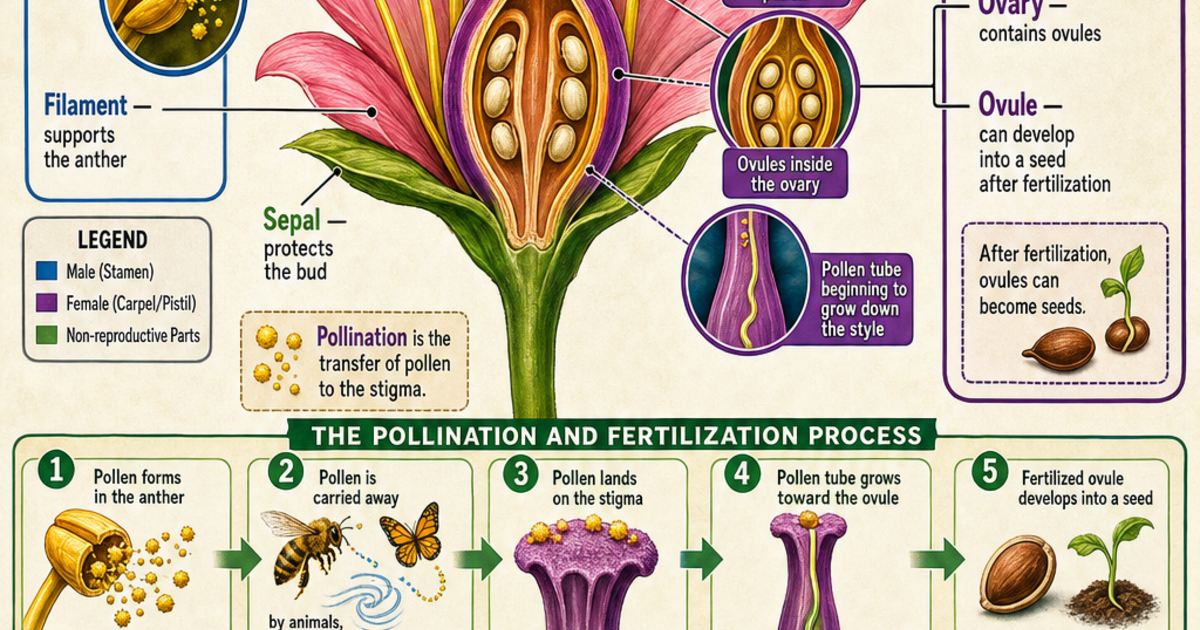
Image reference: LivePhysics.
7. Pollination
Pollination is the transfer of pollen grains from the anther to the stigma of a flower.
- Self-pollination: Pollen reaches the stigma of the same flower or another flower on the same plant.
- Cross-pollination: Pollen is transferred to a flower on another plant of the same species.
Pollinating agents: Wind, water, insects and birds.
Wind-pollinated plants often produce large amounts of light pollen. Insect-pollinated flowers often attract insects with colour, scent and nectar.
8. Fertilisation and seed formation in plants
Fertilisation is the fusion of male and female gametes.
- Pollen lands on a compatible stigma.
- A pollen tube grows through the style towards the ovary.
- The male gamete reaches the ovule and fuses with the egg.
- A zygote forms and develops into an embryo.
- The ovule develops into a seed, and the ovary usually develops into a fruit.
- Under suitable conditions, a seed germinates into a new plant.
9. Sexual reproduction in animals
| External fertilisation | Internal fertilisation |
|---|---|
| Fusion of gametes takes place outside the female’s body, commonly in water. | Fusion of gametes takes place inside the female’s body. |
| Examples: many fish and frogs. | Examples: reptiles, birds and mammals. |
| Many eggs are produced because many may not survive. | The embryo or fertilised egg is generally better protected. |
Some animals pass through larval stages and undergo major changes during development. This transformation is called metamorphosis, as in butterflies and frogs.
10. Human reproductive system
Male reproductive system:
- Testes: Produce sperm and the hormone testosterone.
- Scrotum: Holds the testes and keeps them cooler than normal body temperature.
- Vas deferens: Carries sperm.
- Seminal vesicles and prostate gland: Add fluids that support sperm.
- Urethra: Passage through which urine leaves the body and, in males, semen is discharged.
Female reproductive system:
- Ovaries: Produce eggs and hormones.
- Oviducts (fallopian tubes): Carry the egg; fertilisation usually occurs here.
- Uterus: Where the embryo implants and the foetus develops.
- Cervix: Narrow opening between the uterus and vagina.
- Vagina: Passage connecting the cervix to the outside of the body.
For reference, consult the textbook’s labelled male and female reproductive system diagrams.
11. Gametogenesis, fertilisation and pregnancy
- Gametogenesis: Formation of reproductive cells or gametes.
- Ovulation: Release of a mature egg from an ovary.
- Zygote: The cell formed when sperm and egg fuse.
- Implantation: Attachment of the developing embryo to the uterine lining.
- Embryo: Early stage of development after fertilisation.
- Foetus: The developing human after the early embryonic stage.
Human pregnancy usually lasts about nine months and is divided into three trimesters. Good nutrition, medical check-ups, rest and emotional support are important for the mother and developing baby.
12. Menstruation and the menstrual cycle
If an egg is not fertilised, it degenerates. The thickened uterine lining is shed through the vagina along with blood. This is called menstruation.
- A menstrual cycle commonly lasts around 28 days, but a range of 21–35 days can be typical.
- Ovulation does not always happen on day 14; its timing varies from person to person and from cycle to cycle.
- Menstruation is a normal biological process and is not something to be ashamed of.
- Menstrual products should be changed regularly, hands should be washed, and used products should be disposed of properly.
13. Preventing unwanted pregnancies and infections
- Condoms: Help prevent pregnancy and reduce the risk of sexually transmitted infections (STIs).
- Oral contraceptive pills: Help prevent pregnancy but do not protect against STIs.
- Intra-uterine devices (IUDs): Such as Copper-T, are placed in the uterus by a trained healthcare professional to prevent pregnancy.
- Surgical methods: Vasectomy and tubal ligation are methods of permanent contraception.
Responsible decisions, accurate information and appropriate healthcare help protect reproductive health. Prenatal sex determination for sex selection is prohibited by law in India.
Part 2: Revise, Reflect, Refine — Book Solutions
The textbook questions are reproduced below with simple answers.
1. A flower’s anthers are removed before it matures. Later, pollen from another plant of the same species is dusted onto its stigma and seeds are produced. Which process has been ensured here?
(i) Self-pollination (ii) Cross-pollination
(iii) Fertilisation (iv) Tissue culture
Pollen from a different plant of the same species is transferred to the stigma.
2. Arrange the following stages of sexual reproduction in plants in the correct order:
(i) Pollen germination on stigma (ii) Fertilisation
(iii) Pollination (iv) Formation of zygote
Pollination occurs first, then the pollen germinates. Fertilisation follows, resulting in the formation of a zygote.
3. Assertion (A): The zygote formed after fertilisation immediately attaches to the uterus wall.
Reason (R): The uterus wall is always prepared to receive the zygote.
(i) Both A and R are true, and R is the correct explanation of A.
(ii) Both A and R are true, but R is not the correct explanation of A.
(iii) A is true, but R is false.
(iv) A is false, but R is true.
The zygote divides as it travels towards the uterus. The developing embryo later implants in the uterine lining, which becomes suitable for implantation during the menstrual cycle.
4. Why does asexual reproduction produce offsprings that are genetically identical to the parent?
5. Explain why the menstrual cycle stops during pregnancy.
6. Why are flowers that bloom at night white or light in colour as compared to flowers that bloom during the day?
7. Why do vegetatively propagated plants tend to be more vulnerable to diseases than sexually reproduced plants?
8. If all flowers in a type of plant were only capable of self-pollination, how would it affect the genetic diversity over several generations? Explain.
9. A farmer wants to produce a large number of genetically identical plants quickly. Suggest suitable reproduction methods and explain why they are effective.
10. Suresh prepares slides with pollen grains in different sugar concentrations (0%, 2.5%, 5%, 7.5%, 10%) to study the germination of pollen.
(i) What are the different hypotheses which can be tested using this set-up?
(ii) What parameters should be kept the same in this set-up?
- Sugar concentration affects pollen germination.
- A suitable sugar concentration may produce the highest percentage of germination.
- Very low or very high sugar concentrations may reduce germination.
- Type and age of pollen grains.
- Number of pollen grains used on each slide.
- Volume of solution.
- Temperature, light conditions and observation time.
- Slide preparation and method of counting germinated pollen.
11. Look at the picture given below and think in line with the given prompts and find out which type(s) of pollination might have been followed in these flowers —
Tomato — Stamens cover the stigma. Flowers open after pollination.
Wheat
Papaya — Male and female flowers are often borne on different papaya trees.
- Tomato: Self-pollination is possible because the flower has stamens and a stigma close together. Cross-pollination can also occur.
- Wheat: Self-pollination is common, although cross-pollination can also occur in some conditions.
- Papaya: When male and female flowers are on separate plants, pollination between plants is required. This is cross-pollination.
12. In the lower Himalayan region of northern India, apples are an important cash crop that contribute significantly to farmer’s livelihoods. The fruit yield in apple cultivation is declining continuously, associated with climate change and a significant decline in the population of natural pollinators. A researcher-farmer group set up two experimental apple orchards at two distinct locations: Places A and B. In apple orchards at Place A, they allowed natural pollinators to pollinate the flowers of the apple. In apple orchards at Place B, they applied mixed farming techniques of beekeeping. Along with honey, the farmer yielded apples. The yield of apples is depicted in Fig. 11.24, in terms of fruit setting (number of fruits/the total number of corresponding fruit-bearing branches) and fruit drop (premature falling of developing fruits) in the two types of experimental places of apple orchards.
(i) What are the hypotheses the researcher-farmers group has thought of for this investigation?
(ii) What are the different parameters in the experiment?
(iii) Compare and analyse the data of two experimental orchards Places A and B, in terms of high yields of apple fruits.
(iv) Based on your analysis, what do you infer from the data?
(i) What are the hypotheses the researcher-farmers group has thought of for this investigation?
Answer: The researchers hypothesised that keeping honeybees in apple orchards would improve pollination, increase fruit setting and reduce premature fruit drop.
(ii) What are the different parameters in the experiment?
Answer:
- Independent variable: Pollination method, with or without beekeeping.
- Dependent variables: Fruit-setting percentage and fruit-drop percentage.
- Controlled variables: Apple variety, orchard conditions, water supply and other farming practices, as far as possible.
(iii) Compare and analyse the data of two experimental orchards Places A and B, in terms of high yields of apple fruits.
Answer: According to Fig. 11.24, Place A showed 26% fruit setting and 35% fruit drop, whereas Place B showed 40% fruit setting and 8% fruit drop. Thus, Place B had higher fruit setting and lower fruit drop than Place A.
| Parameter | Place A | Place B |
|---|---|---|
| Fruit setting | 26% | 40% |
| Fruit drop | 35% | 8% |
(iv) Based on your analysis, what do you infer from the data?
Answer: Beekeeping can improve pollination in apple orchards. It can increase fruit setting and reduce premature fruit drop, thereby helping farmers obtain a better apple yield.
13. A student claims, “In humans, ovulation always happens on day 14 of the menstrual cycle”. Critically examine this claim and state whether the claim is correct or not. Give at least two reasons for your answer.
- Menstrual cycles do not all last 28 days; a typical cycle can range from about 21 to 35 days.
- The timing of ovulation can vary between individuals and from one cycle to another, including due to stress, illness and hormonal changes.
Quick Revision
- Reproduction ensures the continuation of a species.
- Asexual reproduction generally involves one parent; sexual reproduction involves the fusion of gametes.
- Vegetative propagation uses plant parts such as roots, stems and leaves.
- Pollination is the transfer of pollen from anther to stigma.
- Fertilisation forms a zygote.
- In flowering plants, ovules usually become seeds and the ovary usually becomes a fruit.
- Human sperm and egg each contain 23 chromosomes; the zygote normally contains 46.
- Menstruation, pregnancy and puberty are natural biological processes.
- Condoms help reduce the risk of STIs; oral contraceptive pills do not provide STI protection.