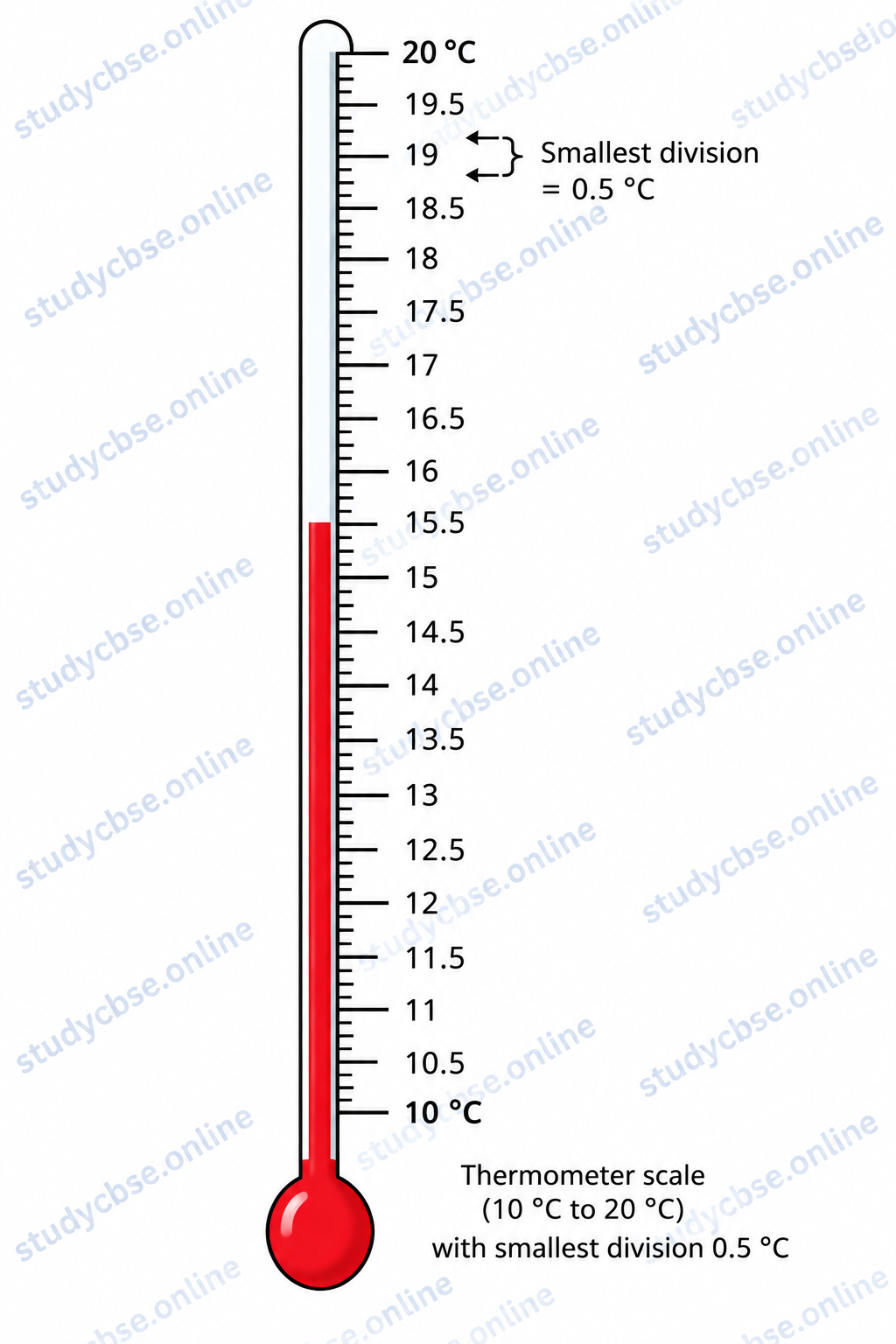
Class 6 Science Chapter 7 Temperature and Its Measurement – easy notes, concepts, NCERT book solutions, important questions, worksheet and answers. Learn about temperature, measuring temperature, thermometers, units of temperature and safe ways to measure temperature in simple language.
Class 6 Science
Easy Notes • Important Concepts • Textbook Questions & Solutions
In this chapter, we learn how to measure temperature correctly. We understand why our sense of touch is not always reliable, what temperature means, and how to use clinical, laboratory and room thermometers. We also learn about Celsius, Fahrenheit and Kelvin scales, thermometer readings, temperature ranges and correct precautions while measuring temperature.
1. Hot or Cold?
Can we judge temperature only by touching?
No. Our sense of touch can sometimes give us a wrong idea about whether something is hot or cold.
A thermometer gives us a more reliable measurement of temperature.
Activity 7.1: Let us investigate
Take three large containers and label them A, B and C. Put warm water in A, tap water in B and ice-cold water in C.
Fig. 7.1: Feeling hotness or coldness of water by dipping hands
If one hand is first placed in warm water and the other in ice-cold water, then both hands may feel the same tap water differently.
2. Temperature
What is temperature?
Temperature is a reliable measure of how hot or cold a body is.
A hotter body has a higher temperature than a colder body.
What is a thermometer?
A thermometer is a device used to measure temperature.
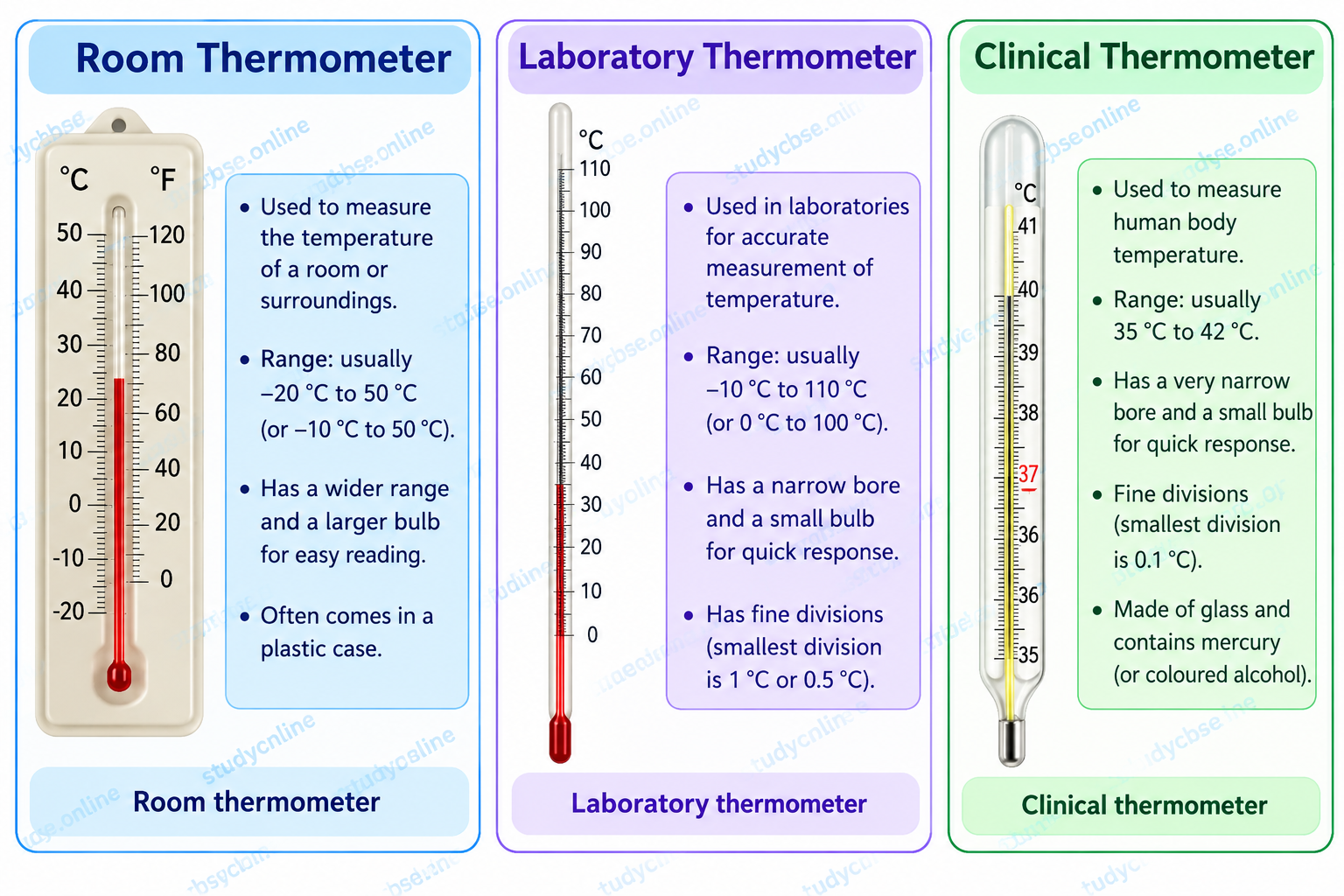
Clinical Thermometer
Used mainly to measure human body temperature.
Laboratory Thermometer
Used to measure the temperature of substances during experiments.
3. Measuring Temperature
3.1 Clinical Thermometer
A clinical thermometer is used for measuring our body temperature. Digital clinical thermometers show the temperature on a digital display and run on batteries.
Fig. 7.2: A digital clinical thermometer
Celsius Scale
Clinical thermometers generally use the Celsius scale. The unit is degree Celsius and its symbol is °C.
Digital Thermometers
Earlier, mercury thermometers were commonly used for measuring body temperature. Mercury is toxic, so digital thermometers are safer and easier to read.
Non-contact Thermometers
Infrared thermometers can measure temperature without touching the person’s body. They were especially useful during the COVID-19 pandemic.
Activity 7.2: Let us measure
Let us now use a digital clinical thermometer to measure body temperature. You may measure your own temperature as well as the temperature of some of your friends.
Steps
- Wash your hands and the tip of the digital thermometer with soap and water.
- Reset the thermometer by pressing the reset button.
- Place the thermometer under the tongue and close your mouth.
- Wait till the thermometer makes a beeping sound or flashes a light.
- Take it out from the mouth and read the temperature on the digital display.
- Record the temperature in Table 7.1.
- Clean the tip of the thermometer with soap and water, and dry it.
- Repeat the above steps for measuring the temperatures of your friends.
Table 7.1: Body temperatures of 10 persons
| S. no. | Name | Temperature (°C) |
|---|---|---|
| 1. | ||
| 2. | ||
| 3. | ||
| 4. | ||
| 5. | ||
| 6. | ||
| 7. | ||
| 8. | ||
| 9. | ||
| 10. |
Precautions to be taken while using a digital clinical thermometer
- Use it after reading the instruction manual.
- Wash the tip with soap and water before and after use.
- Keep the digital portion such as the display away from water.
- Do not hold the thermometer by the tip.
4. Normal Body Temperature
The temperature of every healthy person may not be exactly 37.0 °C. The normal temperature is an average value. Body temperature can change with age, time of day and activity level.
The human body normally does not have a temperature below 35 °C or above 42 °C.
Temperature in the Armpit
For small children or old people, a digital thermometer may also be placed in the armpit. The reading obtained this way is usually about 0.5 °C to 1 °C lower than the actual body temperature.
5. Temperature Scales
Celsius Scale
Unit: degree Celsius
Symbol: °C
Fahrenheit Scale
Unit: degree Fahrenheit
Symbol: °F
Kelvin Scale
Unit: kelvin
Symbol: K
SI Unit
The SI unit of temperature is kelvin (K).
Therefore, 37.0 °C = 310.15 K.
- Write °C for degree Celsius.
- Write °F for degree Fahrenheit.
- Write K for kelvin.
- Do not write the degree sign with K.
- Leave a space between the number and the unit, for example 37.0 °C.
More to know
Celsius scale, Fahrenheit scale and Kelvin scale are named in honour of the scientists associated with their development.
6. Laboratory Thermometer
A laboratory thermometer has a long, narrow glass tube and a bulb containing a liquid. It has a Celsius scale. The liquid column rises or falls when the temperature changes.
Fig. 7.3: Laboratory thermometer — simplified diagram
Activity 7.3: Let us observe
Take a laboratory thermometer and observe it carefully.
- What is the lowest temperature it can measure?
- What is the highest temperature it can measure?
- So, the range of this thermometer is ______.
Activity 7.4: Let us observe and calculate
Let us now try to find the smallest value that a given laboratory thermometer can read.
How to find the smallest division
First find the temperature difference between two bigger marks. Then count the number of small divisions between them.
For the thermometer shown in the textbook, the difference between 0 °C and 10 °C is 10 °C and there are 10 divisions.
Therefore: 10 ÷ 10 = 1 °C
So the smallest value that this thermometer can read is 1 °C.
7. Correct Way of Using a Laboratory Thermometer
Fig. 7.4: Measuring temperature of warm water
Important rules
- The bulb should be immersed in the water.
- The bulb should not touch the bottom or sides of the beaker.
- The thermometer should be held vertically.
- The temperature should be read while the thermometer is still immersed.
- The eye should be directly in line with the level of the liquid column.
Activity 7.5: Let us measure
Take some warm water in a beaker. Dip the thermometer in water so that the bulb is immersed in water. Observe the rise of liquid column in the thermometer. Wait till the column stops rising and note the temperature.
Activity 7.6: Let us compare
| Name | Temperature of boiling water (in °C) |
|---|---|
| Phiban | 97.8 |
| Shemphang | 98.0 |
| Onestar | 97.9 |
| Kloi | 98.0 |
| Bandarisha | 98.1 |
Caution
Experiments involving boiling water and burners should be performed strictly under the supervision of the teacher. Do not touch the experimental setups.
8. Air Temperature
Room Thermometer
Room thermometers give an approximate idea of room temperature. They may be found in schools, hospitals, clinics and other places.
Fig. 7.5: Room thermometer — simplified diagram
Activity 7.7: Let us analyse
Read or listen to the weather reports for a place for 10 successive days. Record the maximum and minimum air temperature for each day in Table 7.3. Analyse the data.
| S.no. | Date | Maximum air temperature | Minimum air temperature |
|---|---|---|---|
| 1. | |||
| 2. | |||
| 3. | |||
| 4. | |||
| 5. | |||
| 6. | |||
| 7. | |||
| 8. | |||
| 9. | |||
| 10. |
Weather and Temperature
Air temperature is an important weather parameter. Weather stations measure air temperature and other weather conditions to help prepare weather forecasts.
More to know: Anna Mani
Anna Mani (1918–2001) was an Indian scientist, also known as the “Weather Woman of India”. She worked on weather measurement instruments and explored wind and solar energy.
9. Summary
- The temperature of a body tells us how hot or cold it is.
- The three most-used scales of temperature are Celsius, Fahrenheit and Kelvin.
- The units are degree Celsius (°C), degree Fahrenheit (°F) and kelvin (K).
- The SI unit of temperature is kelvin.
- A clinical thermometer is used for measuring body temperature.
- Normal temperature of a healthy human adult is taken to be 37.0 °C or 98.6 °F.
- Laboratory thermometers typically have a temperature range from –10 °C to 110 °C.
10. Keywords
11. Let Us Enhance Our Learning – Textbook Solutions
Question 1
(i) 98.6 °C
(ii) 37.0 °C
(iii) 32.0 °C
(iv) 27.0 °C
The normal temperature of a healthy human being is taken to be about 37.0 °C.
Question 2
(i) 97.4 °F
(ii) 97.6 °F
(iii) 98.4 °F
(iv) 98.6 °F
37 °C is equal to 98.6 °F.
Question 3
(i) The hotness or coldness of a system is determined by its .
(ii) The temperature of ice-cold water cannot be measured by a thermometer.
(iii) The unit of temperature is degree .
(i) temperature
(ii) clinical
(iii) Celsius
Question 4
(i) 10 °C to 100 °C
(ii) –10 °C to 110 °C
(iii) 32 °C to 45 °C
(iv) 35 °C to 42 °C
A laboratory thermometer has a wider range and can measure temperatures from about –10 °C to 110 °C.
Question 5
Who do you think followed the correct way for measuring temperature?
(i) Student 1
(ii) Student 2
(iii) Student 3
(iv) Student 4
Fig. 7.6: Simplified illustration of the four methods
Student 2 follows the correct method. The thermometer is held vertically, the bulb is immersed in water and it does not touch the sides or bottom.
Question 6
14 °C 17 °C 7.5 °C
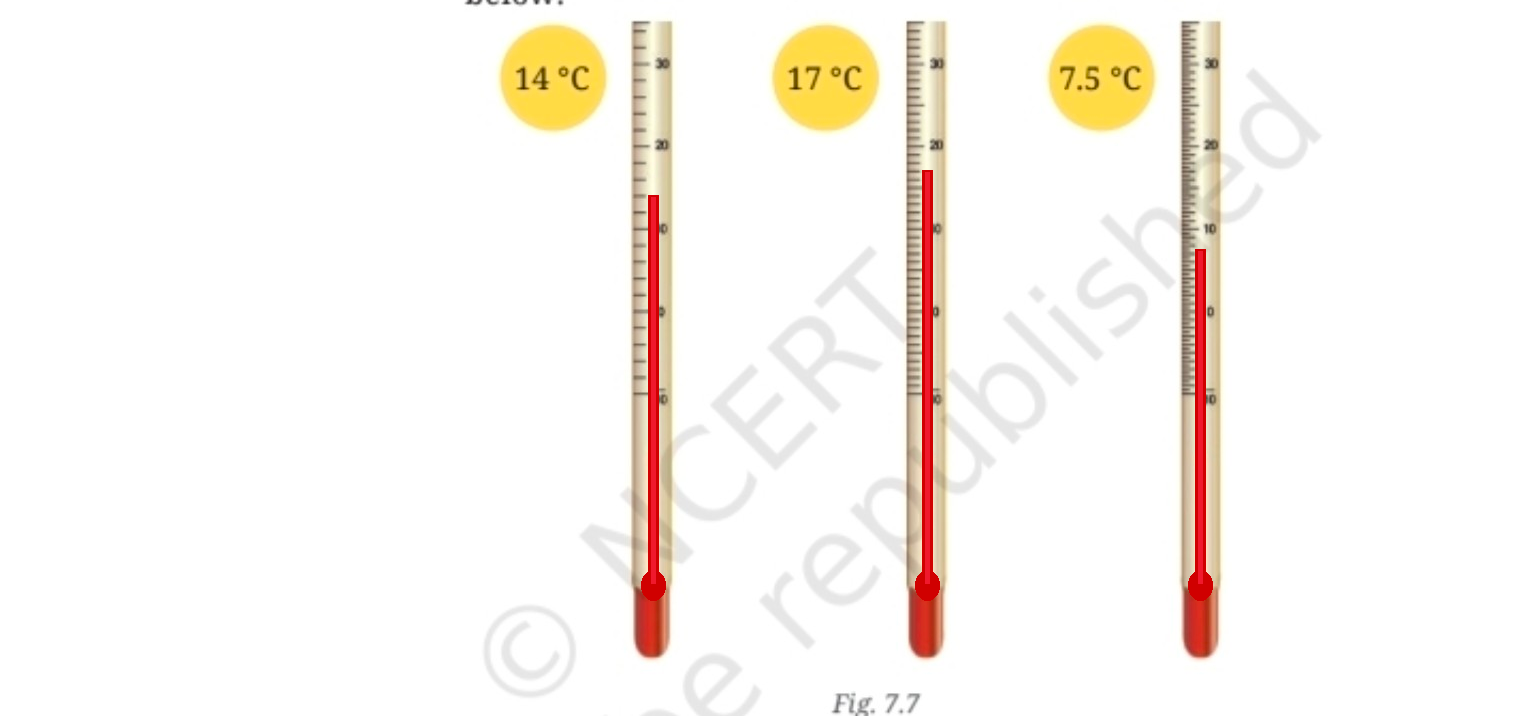
For 14 °C, colour the liquid column up to the 14 °C mark.
For 17 °C, colour the liquid column up to the 17 °C mark.
For 7.5 °C, colour the liquid column halfway between 7 °C and 8 °C.
 (i) What type of thermometer is it?