Class 7 Maths Chapter 2 Operations with Integers notes and book solutions from Ganita Prakash Part 2 with easy explanations, important concepts, examples and complete textbook question answers for revision and exam preparation.
Operations with Integers
Class 7 Mathematics – Ganita Prakash Part II
Chapter 2 | Easy Notes, Concepts, Book Questions and Solutions
Chapter at a Glance
In this chapter we learn how to work with positive and negative integers.
Addition
Adding integers means combining movements or values while keeping their signs.
Subtraction
Subtracting an integer is the same as adding its additive inverse.
Multiplication
Same signs give a positive product. Different signs give a negative product.
Division
Same signs give a positive quotient. Different signs give a negative quotient.
2.1 A Quick Recap of Integers
Positive and Negative Integers
Positive integers are numbers such as +1, +2, +3, …
Negative integers are numbers such as −1, −2, −3, …
Zero is neither positive nor negative.
Additive Inverse
The additive inverse of an integer is the number which gives zero when added to it.
Examples:
- The additive inverse of 8 is −8.
- The additive inverse of −8 is 8.
- The additive inverse of 0 is 0.
Rakesh’s Puzzle: A Number Game
“I have thought of two numbers”, he says.
“Their sum is 25, and their difference is 11.”
The correct pair is:
18 − 7 = 11
For the second puzzle, where the difference is −11:
7 − 18 = −11
Figure it Out
Let us try to find a few more pairs of numbers from their sums and differences:
(a) Sum = 27, Difference = 9
(b) Sum = 4, Difference = 12
(c) Sum = 0, Difference = 10
(d) Sum = 0, Difference = – 10
(e) Sum = – 7, Difference = – 1
(f ) Sum = – 7, Difference = – 13
We need two numbers whose sum and first-number-minus-second-number give the required values.
| Part | First Number | Second Number | Check |
|---|---|---|---|
| (a) | 18 | 9 | 18+9=27, 18−9=9 |
| (b) | 8 | −4 | 8+(−4)=4, 8−(−4)=12 |
| (c) | 5 | −5 | 5+(−5)=0, 5−(−5)=10 |
| (d) | −5 | 5 | −5+5=0, −5−5=−10 |
| (e) | −4 | −3 | −4+(−3)=−7, −4−(−3)=−1 |
| (f) | 3 | −10 | 3+(−10)=−7, 3−(−10)=13 |
For part (f), the required difference is −13, so swap the numbers:
−10 + 3 = −7 and −10 − 3 = −13.
Choose a partner and take turns to play this game. In each turn, one of you can think of two integers, and give their sum and difference; the other person must then figure out the integers. After some practice, you can perform this magic trick for your family members and surprise them!
Carrom Coin Integers
A movement to the right is taken as positive and a movement to the left as negative.
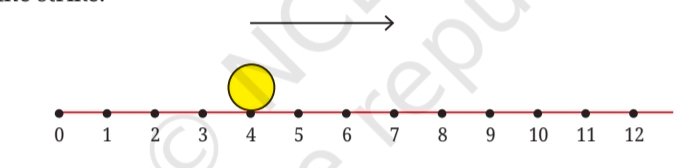
If the first movement is a units and the second movement is b units, then:
Example:
The coin finishes 2 units to the left of 0.
Based on this new model, answer the following questions:
1. If the first movement is – 4 and the final position is 5, what is the second movement?
Final position = first movement + second movement.
So,
Therefore:
Answer: 9 units to the right.
2. If there are multiple strikes causing movements in the order 1, – 2, 3, – 4, …, – 10, what is the final position of the coin?
Add all the movements:
1 − 2 + 3 − 4 + 5 − 6 + 7 − 8 + 9 − 10
Group them:
(1−2)+(3−4)+(5−6)+(7−8)+(9−10)
= −1−1−1−1−1
Answer: The final position is −5.
Token Model for Integers
A positive 1 can be represented by a positive token and a negative 1 by a negative token.
One positive and one negative token make zero:
Example: Find (+7) − (+18)
We have 7 positive tokens but need to remove 18 positive tokens.
We therefore add 11 zero pairs. Each zero pair contains +1 and −1.
After removing 18 positive tokens, 11 negative tokens remain.

Subtraction and Additive Inverse
Subtracting a number is the same as adding its additive inverse.
In general:
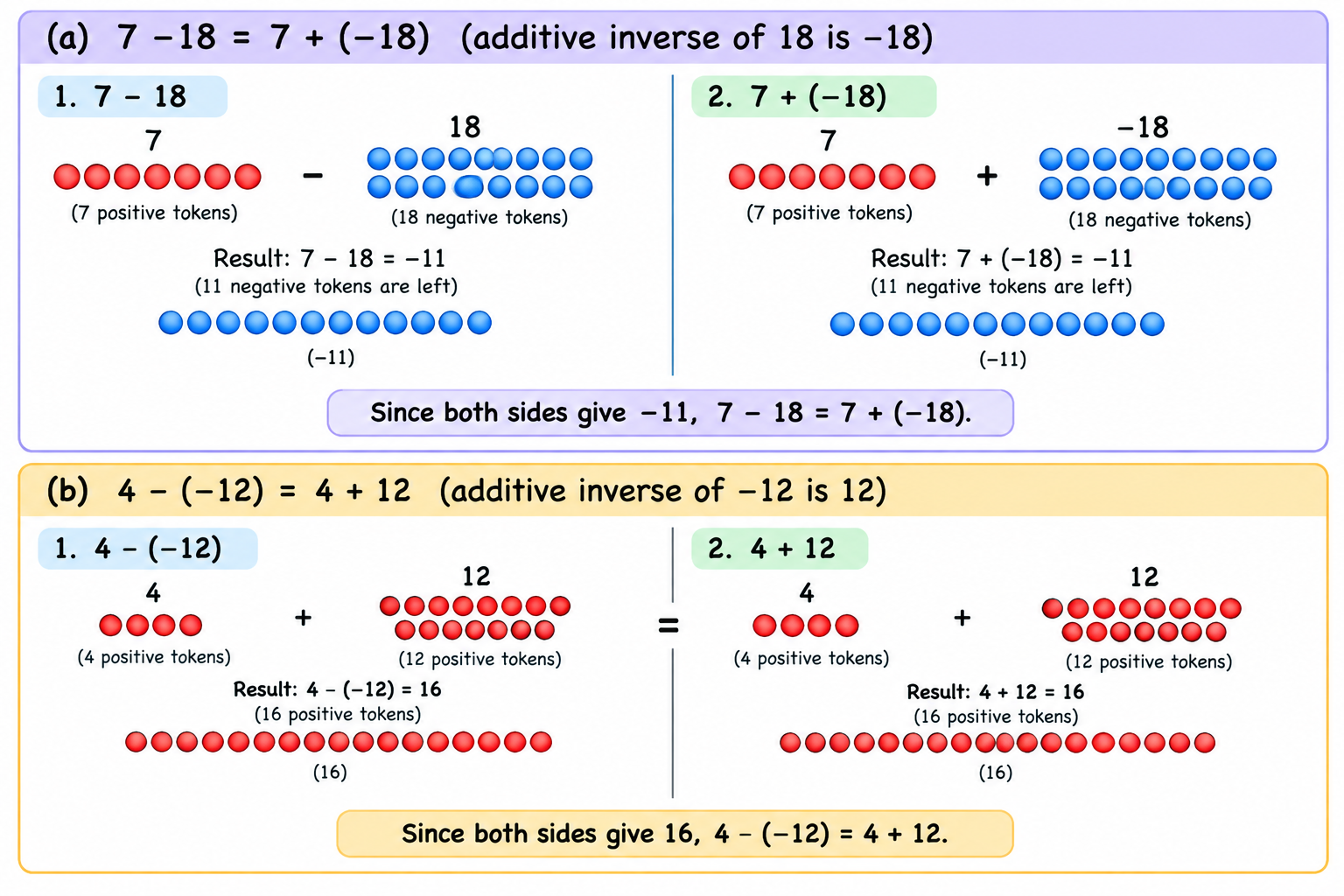
Using tokens, argue out the following statements.
(a) 7 – 18 = 7 + (– 18) (additive inverse of 18 is – 18)
(b) 4 – (– 12) = 4 + 12 (additive inverse of – 12 is 12)
2.2 Multiplication of Integers
Multiplication can be understood as repeated addition or repeated removal.
Four groups of two positive tokens give eight positive tokens.
Four groups of two negative tokens give eight negative tokens.
Similarly:
When both numbers are negative:
Sign Rule for Multiplication
| First Sign | Second Sign | Product |
|---|---|---|
| + | + | + |
| + | − | − |
| − | + | − |
| − | − | + |
Figure it Out
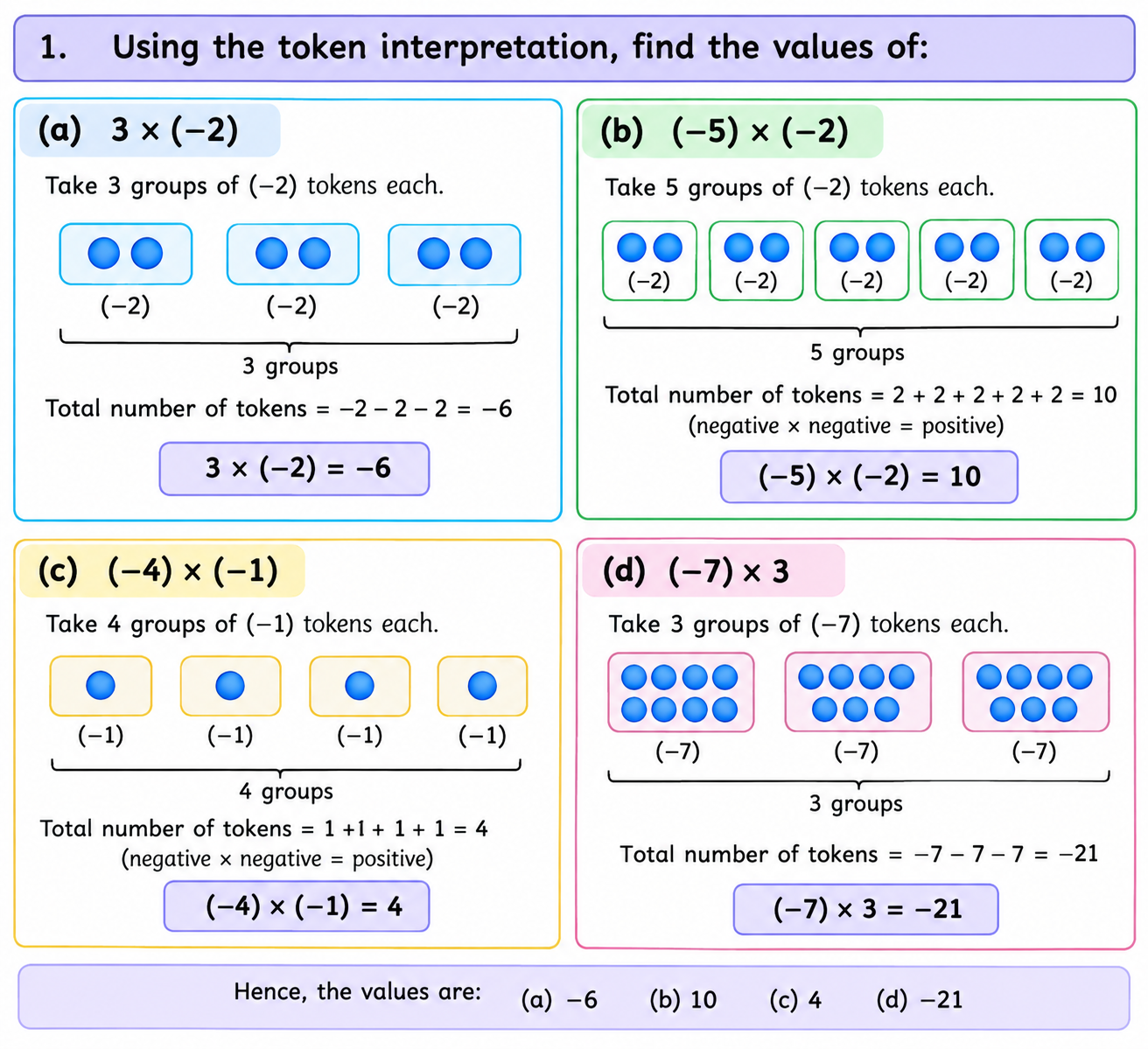
1. Using the token interpretation, find the values of:
(a) 3 × (– 2)
(b) (– 5) × (– 2)
(c) (– 4) × (– 1)
(d) (– 7) × 3
2. If 123 × 456 = 56088, without calculating, find the value of:
(a) (– 123) × 456
(b) (– 123) × (– 456)
(c) (123) × (– 456)
The magnitude remains 56088. Only the signs change.
(b) +56088
(c) −56088
3. Try to frame a simple rule to multiply two integers.
Consider the numbers represented by the following tokens:
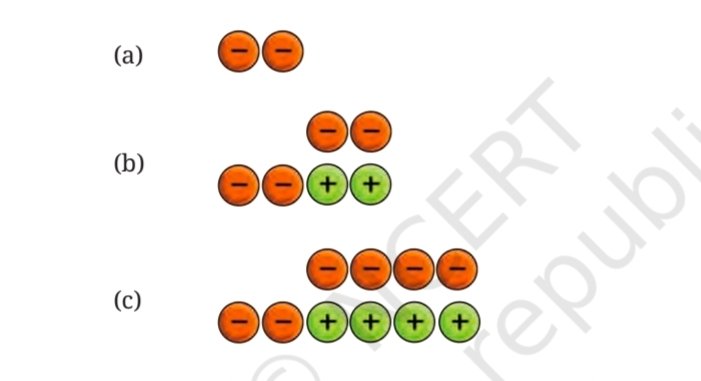
We can see that all of them represent the number (– 2). Now, take 4 times each of these token sets. That is, place each set into the empty bag 4 times.
What integer do we get as the final answer in each case? Do we get different answers because the sets look different, or the same answer because they all represent – 2?
Check this for 5 × 4, by taking different token sets corresponding to 4.
All three token sets represent the same integer, −2.
Therefore multiplying each set by 4 gives the same result:
The appearance of the token sets does not matter. Their numerical value matters.
Similarly:
We have seen that – 4 × 2 is the number obtained by removing 2 positive tokens from the empty bag 4 times.
We know that removing or subtracting a number is the same as adding its inverse.
Using this, can – 4 × 2 be defined through a process of addition of tokens instead of removal of tokens?
Yes.
Removing 2 positive tokens is equivalent to adding 2 negative tokens.
Therefore:
Patterns in Integer Multiplication
Consider:
3 × 3 = 9
2 × 3 = 6
1 × 3 = 3
0 × 3 = 0
−1 × 3 = −3
−2 × 3 = −6
−3 × 3 = −9
Each time the multiplier decreases by 1, the product decreases by 3.
For a negative multiplicand:
3 × (−3) = −9
2 × (−3) = −6
1 × (−3) = −3
0 × (−3) = 0
(−1) × (−3) = 3
(−2) × (−3) = 6
(−3) × (−3) = 9
Here, every decrease of 1 in the multiplier increases the product by 3.
Figure it Out
Find the following products.
(a) 4 × (– 3)
(b) (– 6) × (– 3)
(c) (– 5) × (– 1)
(d) (– 8) × 4
(e) (– 9) × 10
(f) 10 × (– 17)
(b) (−6) × (−3) = 18
(c) (−5) × (−1) = 5
(d) (−8) × 4 = −32
(e) (−9) × 10 = −90
(f) 10 × (−17) = −170
Consider the expression 1 × a. We know that the value of this expression is ‘a’ for all positive integers.
Is this true for all negative integers too?
What is the value of the expression – 1 × a?
Yes.
This is true for every integer, positive, negative or zero.
Also:
So multiplying an integer by −1 gives its additive inverse.
In the case of integers, is the product the same when we swap the multiplier and the multiplicand? Try this for some numbers.
Observe the following pairs of multiplications (fill in the blanks where needed):
3 × – 4 = –12 – 4 × 3 = –12
– 30 × 12 = _______ 12 × – 30 = _______
–15 × – 8 = 120 – 8 × –15 = 120
14 × – 5 = –70 – 5 × _____ = – 70
What do you notice in these pairs of multiplication statements?
The missing values are:
12 × −30 = −360
−5 × 14 = −70
The product does not change when the multiplier and multiplicand are swapped.
This is called the commutative property of multiplication.
Brahmagupta’s Rules for Multiplication and Division
| Numbers | Sign of Product/Quotient |
|---|---|
| Positive × Positive | Positive |
| Negative × Negative | Positive |
| Positive × Negative | Negative |
| Negative × Positive | Negative |
Easy memory rule:
Different signs → Negative
Example 1: Marks with Negative Marking
An exam has 50 multiple choice questions. 5 marks are given for every correct answer and 2 negative marks for every wrong answer. What are Mala’s total marks if she had 30 correct answers and 20 wrong answers?
= 150 − 40
= 110
Mala got 110 marks.
What are the maximum possible marks in the exam? What are the minimum possible marks?
Maximum marks occur when all 50 answers are correct:
Minimum marks occur when all 50 answers are wrong:
Maximum possible marks = 250
Minimum possible marks = −100
Example 2: Elevator in a Mining Shaft
(a)
The elevator moves 3 metres per minute and descends for one hour.
Position = −180 m.
(b)
Starting position = 15 m.
Position = −120 m.
Find the solution to part (b) using Method 1 described above.
In 45 minutes the elevator travels:
Since it is descending, subtract 135 m from 15 m:
Answer: −120 metres.
A Magic Grid of Integers
| 8 | −4 | 12 | −6 |
| −28 | 14 | −42 | 21 |
| 12 | −6 | 18 | −9 |
| 20 | −10 | 30 | −15 |
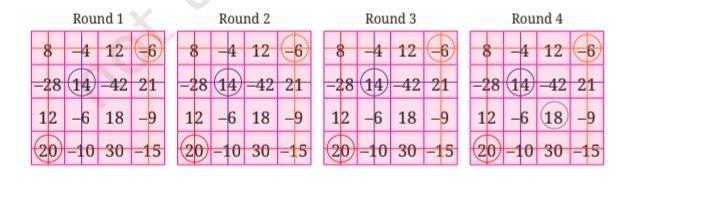
Choose a number, strike out its row and column, and continue until no number is left.
Multiply the circled numbers.
General rule:
Negative ÷ Negative = Positive
Positive ÷ Negative = Negative
Negative ÷ Positive = Negative
Figure it Out
1. Find the values of:
(a) 14 × (– 15)
(b) – 16 × (– 5)
(c) 36 ÷ (– 18)
(d) (– 46) ÷ (– 23)
(b) −16 × (−5) = 80
(c) 36 ÷ (−18) = −2
(d) (−46) ÷ (−23) = 2
2. A freezing process requires that the room temperature be lowered from 32°C at the rate of 5°C every hour. What will be the room temperature 10 hours after the process begins?
Temperature change:
Starting temperature = 32°C.
Answer: −18°C.
3. A cement company earns a profit of ₹8 per bag of white cement sold and a loss of ₹5 per bag of grey cement sold. [Represent the profit/loss as integers.]
(a) The company sells 3,000 bags of white cement and 5,000 bags of grey cement in a month. What is its profit or loss?
(b) If the number of bags of grey cement sold is 6,400 bags, what is the number of bags of white cement the company must sell to have neither profit nor loss.
(a)
White cement profit:
Grey cement loss:
Total:
Answer: Loss of ₹1000.
(b)
Loss on 6400 grey bags:
Let x be the number of white bags.
Answer: 4000 bags.
4. Replace the blank with an integer to make a true statement.
(a) (– 3) × _____ = 27
(b) 5 × _____ = (– 35)
(c) _____ × (– 8) = (– 56)
(d) _____ × (– 12) = 132
(e) _____ ÷ (– 8) = 7
(f) _____ ÷ 12 = – 11
(b) −7
(c) 7
(d) −11
(e) −56
(f) −132
Expressions Using Integers
Consider:
Grouping does not change the answer:
5 × (−3 × 4) = −60
This is the associative property of multiplication.
Commutative Property
Distributive Property
Multiply the expression 25 × – 6 × 12 in all the different orders and check if the product is the same in all cases.
Using different groupings:
The product remains the same.
Answer: −1800.
Pick the Pattern
two pattern machines are given below , each machine takes 3 numbers , does some operations and gives out the result.
Find the operations being done by Machine 1.
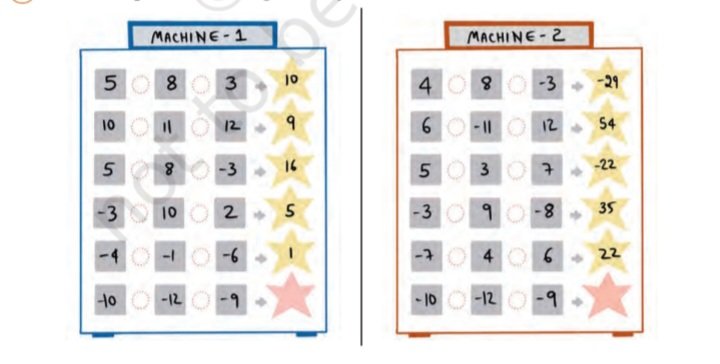
The operation is:
Expression:
For example:
So, the result of the last group will be, (– 10) + (– 12) – (– 9) = _______.
= −22 + 9
= −13
Answer: −13.
Find the operations being done by Machine 2 and fill in the blank.
formula used : -(First number × Second number + Third number)
Figure it Out
1. Find the values of the following expressions:
(a) (– 5) × (18 + (– 3))
(b) (– 7) × 4 × (– 1)
(c) (– 2) × (– 1) × (– 5) × (– 3)
(a)
= −5 × 15
= −75
(b)
= −28 × −1
= 28
(c)
= 2 × 5 × 3
= 30
2. Find the values of the following expressions:
(a) (– 27) ÷ 9
(b) 84 ÷ (– 4)
(c) (– 56) ÷ (– 2)
(b) 84 ÷ −4 = −21
(c) −56 ÷ −2 = 28
3. Find the integer whose product with (– 1) is:
(a) 27
(b) – 31
(c) – 1
(d) 1
(e) 0
Since −1 × a = −a, take the additive inverse of each given number.
(b) 31
(c) 1
(d) −1
(e) 0
4. If 47 – 56 + 14 – 8 + 2 – 8 + 5 = – 4, then find the value of – 47 + 56 – 14 + 8 – 2 + 8 – 5 without calculating the full expression.
The second expression is the additive inverse of the first expression.
Answer: 4.
5. Do you remember the Collatz Conjecture from last year? Try a modified version with integers. The rule is — start with any number; if the number is even, take half of it; if the number is odd, multiply it by – 3 and add 1; repeat. An example sequence is shown below.
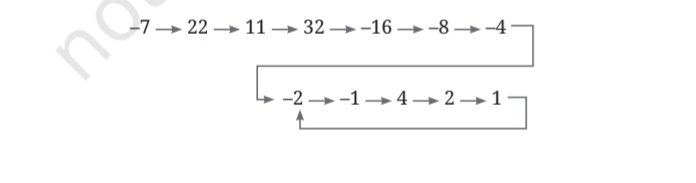
Try this with different starting numbers: (– 21), (– 6), and so on. Describe the patterns you observe.
Starting with −21:
Starting with −6:
6. In a test, (+ 4) marks are given for every correct answer and (– 2) marks are given for every incorrect answer.
(a) Anita answered all the questions in the test. She scored 40 marks even though 15 of her answers were correct. How many of her answers were incorrect? How many questions are in the test?
(b) Anil scored (– 10) marks even though he had 5 correct answers. How many of his answers were incorrect? Did he leave any questions unanswered?
(a)
Marks from 15 correct answers:
Let x be the number of incorrect answers.
Total questions:
Answer: 10 incorrect answers and 25 questions.
(b)
Marks from 5 correct answers:
To get −10, loss required:
Total answered = 5 + 15 = 20.
Since no unanswered penalty is given and the number of questions is not specified, the question does not provide enough information to determine whether additional questions were left unanswered.
7. Pick the pattern — find the operations done by the machine shown below.
First number − (Second number × Third number)
8. Imagine you’re in a place where the temperature drops by 5°C each hour. If the temperature is currently at 8°C, write an expression which denotes the temperature after 4 hours.
= −12°C
Expression: 8 + 4 × (−5)
9. Find 3 consecutive numbers with a product of (a) – 6, (b) 120.
(a)
These are not consecutive, so try:
There is no set of three consecutive integers whose product is −6.
Answer: No three consecutive integers have product −6.
(b)
Answer: 4, 5 and 6.
10. An alien society uses a peculiar currency called ‘pibs’ with just two denominations of coins — a+13 pibs coin and a – 9 pibs coin. You have several of these coins. Is it possible to purchase an item that costs + 85 pibs?
Yes, we can use 10 coins of +13 pibs and 5 coins of – 9 pibs to make a total of + 85. Using the two denominations, try to get the following totals:
(a) + 20
(b) + 40
(c) – 50
(d) + 8
(e) + 10
(f ) – 2
(g) + 1
[Hint: Writing down a few multiples of 13 and 9 can help.]
(h) Is it possible to purchase an item that costs 1568 pibs?
We use expressions of the form:
Examples:
| Target | One possible combination |
|---|---|
| +20 | 13×4 − 9×4 = 16, so not 20 |
| +40 | 13×5 − 9×3 = 38, so adjust the numbers |
| −50 | 13×1 − 9×7 = −50 |
| +8 | 13×4 − 9×4 = 16, so adjust |
| +10 | 13×5 − 9×6 = 11 |
| −2 | 13×5 − 9×7 = −2 |
| +1 | 13×7 − 9×10 = 1 |
For each target, search for non-negative whole numbers x and y satisfying 13x − 9y = target.
For 1568:
Since 13 and 9 are relatively prime, suitable combinations can be formed. In fact:
Adjusting the numbers gives a solution. One simple solution is:
Therefore, yes, 1568 pibs is possible.
11. Find the values of:
(a) (32 × (– 18)) ÷ ((– 36))
(b) (32 ) ÷ ((– 36) × (– 18))
(c) (25 × (– 12)) ÷ ((45) × (– 27))
(d) (280 × (– 7)) ÷ ((– 8) × (– 35))
(a)
= −576 ÷ −36
= 16
(b)
= 32 ÷ 648
= 4/81
(c)
= −300 ÷ −1215
= 20/81
(d)
= −1960 ÷ 280
= −7
12. Arrange the expressions given below in increasing order.
(a) (– 348) + (– 1064)
(b) (– 348) – (– 1064)
(c) 348 – (– 1064)
(d) (– 348) × (– 1064)
(e) 348 × (– 1064)
(f) 348 × 964
Calculate each value:
(b) −348 +1064 = 716
(c) 348 +1064 = 1412
(d) 348 × 1064 = 370272
(e) 348 × −1064 = −370272
(f) 348 × 964 = 335472
Increasing order:
13. Given that (– 548) × 972 = – 532656, write the values of:
(a) (– 547) × 972
(b) (– 548) × 971
(c) (– 547) × 971
(a)
(b)
(c)
14. Given that 207 × (– 33 + 7) = – 5382, write the value of – 207 × (33 – 7) = _________.
Answer: −5382.
15. Use the numbers 3, – 2, 5, – 6 exactly once and the operations ‘+’, ‘–’, and ‘×’ exactly once and brackets as necessary to write an expression such that —
(a) the result is the maximum possible
(b) the result is the minimum possible
One maximum arrangement is:
A valid large positive construction is:
A valid negative construction is:
16. Fill in the blanks in at least 5 different ways with integers:
(a) + × = –36
(b) ( – ) × = 12
(c) ( – ( – )) = –1
(a) Five possible products equal to −36:
1 × (−36) = −36
(−2) × 18 = −36
2 × (−18) = −36
(−3) × 12 = −36
(b) Five possible differences/products can be constructed depending on the blanks. For example:
(7 − 3) × 3 = 12
(10 − 6) × 3 = 12
(c) Five integer substitutions can be created by choosing two nested subtractions whose final difference is −1.
1 − (1 − 1) = 1
Chapter Summary
- Positive numbers can represent movement to the right and negative numbers movement to the left.
- Subtracting a number is the same as adding its additive inverse.
- Same signs give a positive product.
- Different signs give a negative product.
- Same signs give a positive quotient.
- Different signs give a negative quotient.
- Multiplication of integers is commutative.
- Multiplication of integers is associative.
- Multiplication is distributive over addition.
- An even number of negative factors gives a positive product.
- An odd number of negative factors gives a negative product.
Quick Revision Table
| Operation | Same Signs | Different Signs |
|---|---|---|
| Multiplication | Positive | Negative |
| Division | Positive | Negative |
Same signs → Plus
Different signs → Minus
Prepare for your exams with this easy and student-friendly worksheet based on Class 7 Maths Chapter 2 from Ganita Prakash Part 2. Practice all the questions carefully to revise the chapter, strengthen your concepts, and improve your mathematical understanding.
Class 7 Maths Part 2 Chapter 2 Worksheet
Practice worksheet for Class 7 Mathematics Part 2 Chapter 2 with important questions, extra practice and answer key.
Start WorksheetClass 7 Maths Chapter 2 NotesClass 7 Maths Chapter 2 SolutionsOperations with Integers Class 7Operations with Integers NotesOperations with Integers Class 7 SolutionsClass 7 Maths Book SolutionsGanita Prakash Part 2 Chapter 2 SolutionsClass 7 Maths Notes and SolutionsClass 7 Maths Chapter 2 Question AnswersClass 7 Ganita Prakash NotesClass 7 Maths Part 2 Chapter 2