Class 6 Maths Chapter 7 Fractions – easy notes, concepts, NCERT book solutions, important questions, worksheet and answers. Learn about fractions, equivalent fractions, comparing fractions, addition and subtraction of fractions with simple explanations and examples.
Class 6 Maths Chapter 7 Fractions Notes & Solutions
Make 1/3 using a paper strip. Can you use this to also make 1/6?
Paper strip divided into 3 equal parts
1/3
1/3
1/3
One part = 1/3
Yes, the same paper strip can be used to make 1/6.
Paper strip divided into 6 equal parts
1/6
1/6
1/6
1/6
1/6
1/6
Two adjacent 1/6 pieces make 1/3:
1/6 + 1/6 = 2/6 = 1/3
Therefore, 1/3 = 2/6.
Q4.
Draw a picture and write an addition statement as above to show:
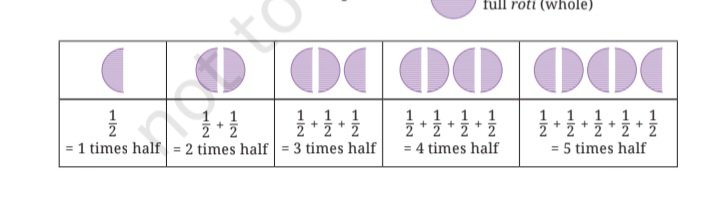
a. 5 times 1/4 of a roti
b. 9 times 1/4 of a roti
Q5.
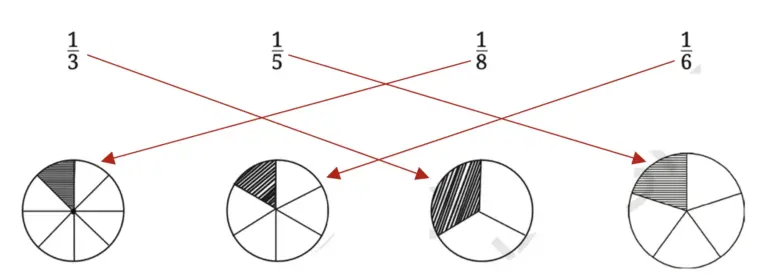
Match each fractional unit with the correct picture:
1/3 1/5 1/8 1/6
📄 Page 160 — Section 7.4
Q1.
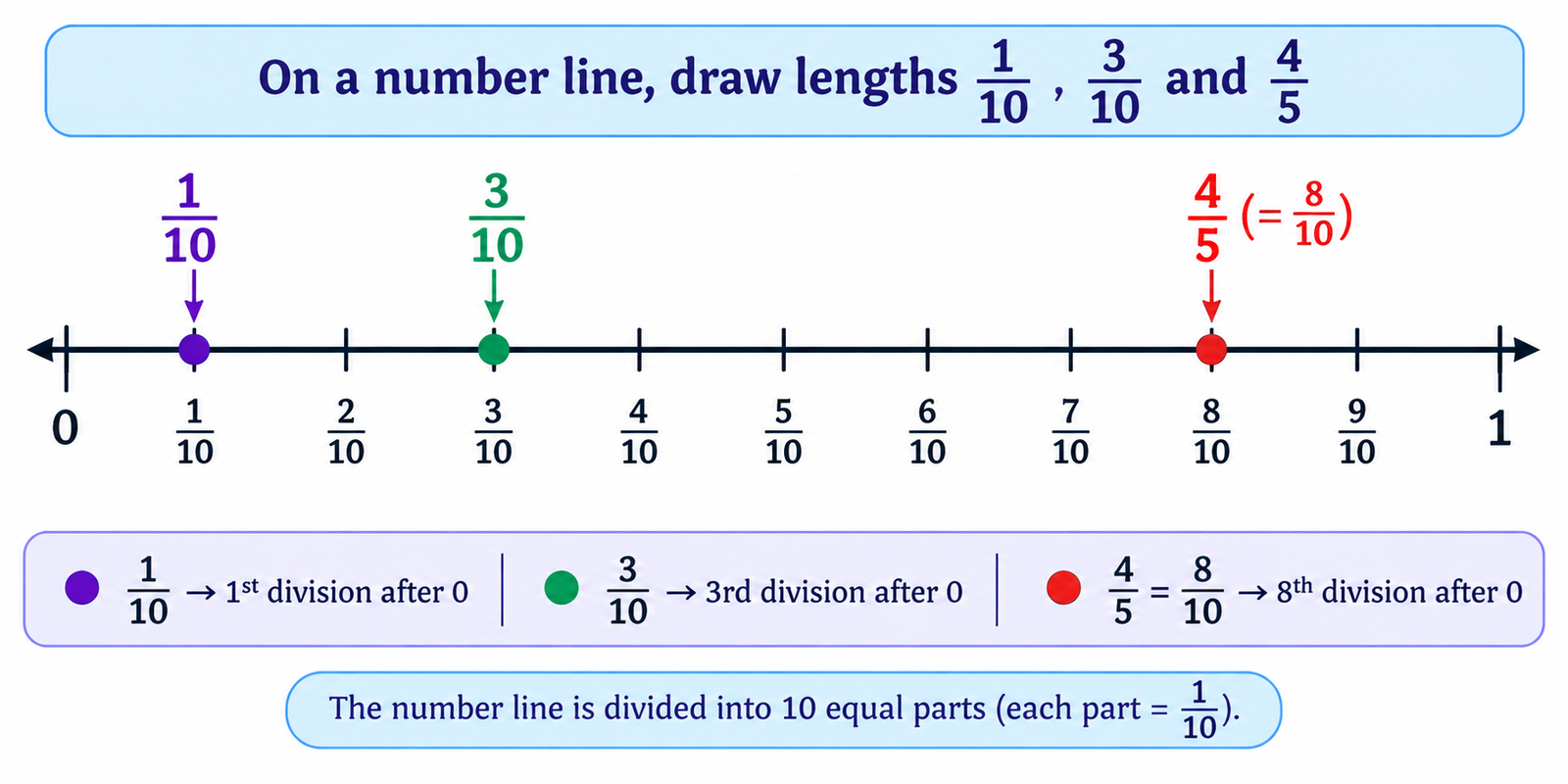
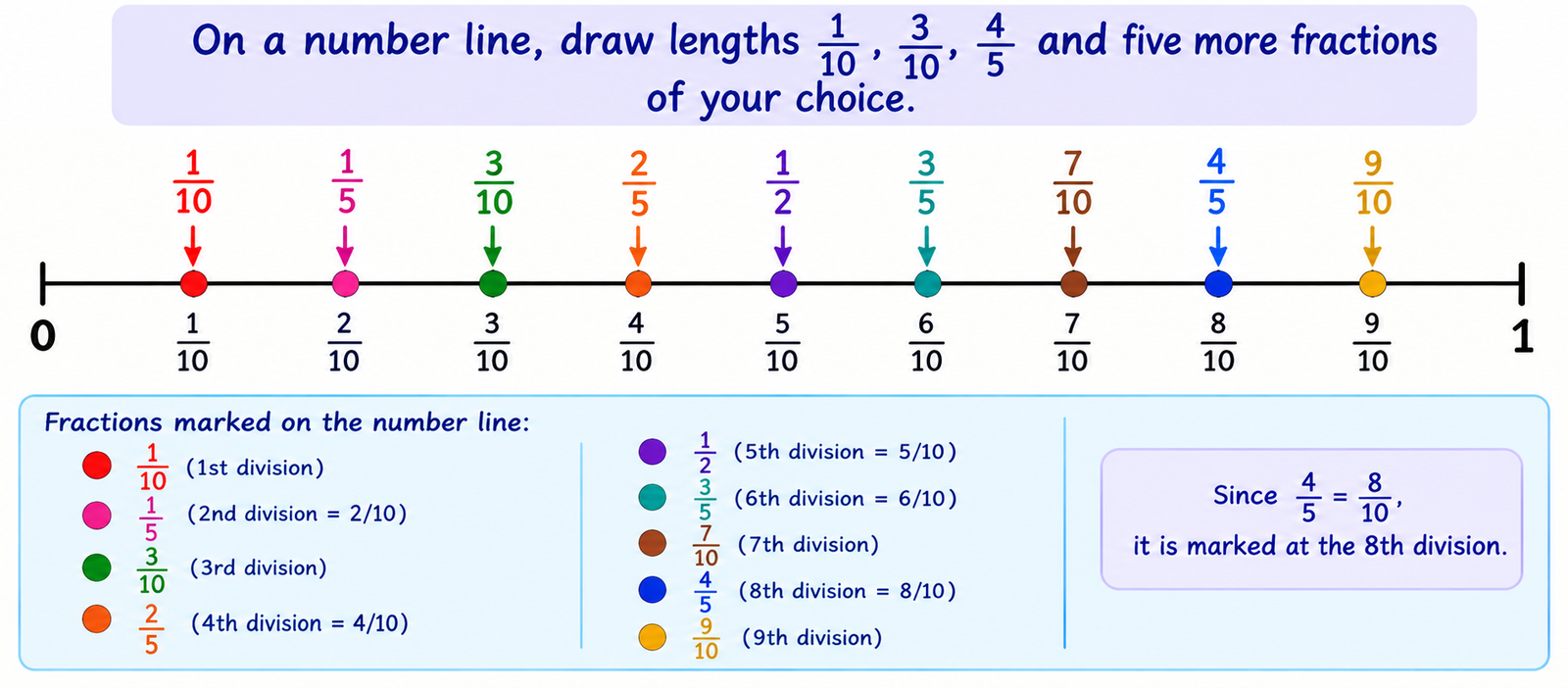
On a number line, draw lines of lengths 1/10, 3/10, and 4/5.
Q2.
Write five more fractions of your choice and mark them on the number line.
Different correct answers are possible.
Q3.
How many fractions lie between 0 and 1? Think, discuss with your classmates, and write your answer.
There are infinitely many fractions between 0 and 1.
For example:
1/2, 1/3, 1/4, 1/5, 1/6, 1/7, …
We can keep finding more fractions between 0 and 1 by increasing the denominator.
For example, even between 1/2 and 1/3 there are fractions such as 5/12, because:
1/3 = 4/12 < 5/12 < 6/12 = 1/2
Therefore, there are infinitely many fractions between 0 and 1.
Q4.
What is the length of the blue line and black line shown below? The distance between 0 and 1 is 1 unit long, and it is divided into two equal parts. The length of each part is 1/2. So the blue line is 1/2 units long. Write the fraction that gives the length of the black line in the box.
The interval from 0 to 1 is divided into 2 equal parts.
Each part = 1/2
The black line reaches three half-units:
1/2 + 1/2 + 1/2 = 3/2
Therefore, the length of the black line is:
3/2 units = 1 1/2 units.
Q5.
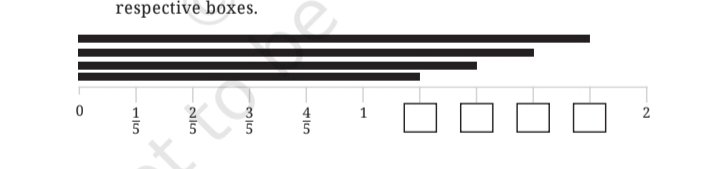
Write the fraction that gives the lengths of the black lines in the respective boxes.
Each whole unit is divided into 5 equal parts, so each small part represents 1/5.
Counting the fifths reached by each black line gives:
6/5, 7/5, 8/5, 9/5
Therefore, the required fractions are:
6/5, 7/5, 8/5 and 9/5.
📄 Page 162 — Section 7.5
Q1.
How many whole units are there in 7/2?
7/2 = 3 remainder 1
Therefore:
7/2 = 3 1/2
There are 3 whole units and an additional half unit.
Q2.
How many whole units are there in 4/3 and in 7/3?
For 4/3:
4/3 = 1 1/3
So there is 1 whole unit.
For 7/3:
7/3 = 2 1/3
So there are 2 whole units.
Q3.
Figure out the number of whole units in each of the following fractions:
a. 8/3 b. 11/5 c. 9/4
(a) 8/3
8/3 = 2 2/3
Whole units = 2.
(b) 11/5
11/5 = 2 1/5
Whole units = 2.
(c) 9/4
9/4 = 2 1/4
Whole units = 2.
Q4.
Can all fractions greater than 1 be written as such mixed numbers?
No, not every fraction greater than 1 has a non-zero fractional part in its mixed-number form.
For example:
8/4 = 2
Here the fraction is greater than 1, but it is exactly equal to a whole number.
So it is written simply as 2, not as a mixed number with a fractional part.
Q5.
Write the following fractions as mixed fractions (e.g., 9/2 = 4 1/2):
a. 9/2
b. 9/5
c. 21/19
d. 47/9
e. 12/11
f. 19/6
(a) 9/2
9 ÷ 2 = 4 remainder 1
9/2 = 4 1/2
(b) 9/5
9 ÷ 5 = 1 remainder 4
9/5 = 1 4/5
(c) 21/19
21 ÷ 19 = 1 remainder 2
21/19 = 1 2/19
(d) 47/9
47 ÷ 9 = 5 remainder 2
47/9 = 5 2/9
(e) 12/11
12 ÷ 11 = 1 remainder 1
12/11 = 1 1/11
(f) 19/6
19 ÷ 6 = 3 remainder 1
19/6 = 3 1/6
📄 Page 163 — Mixed Numbers
Q1.
Write the following mixed numbers as fractions:
a. 3 1/4
b. 7 2/3
c. 9 4/9
d. 3 1/6
e. 2 3/11
f. 3 9/10
Rule:
Mixed number = (Whole number × Denominator + Numerator) / Denominator
(a) 3 1/4
(3 × 4 + 1)/4
= 13/4
(b) 7 2/3
(7 × 3 + 2)/3
= 23/3
(c) 9 4/9
(9 × 9 + 4)/9
= 85/9
(d) 3 1/6
(3 × 6 + 1)/6
= 19/6
(e) 2 3/11
(2 × 11 + 3)/11
= 25/11
(f) 3 9/10
(3 × 10 + 9)/10
= 39/10
Therefore:
a. 13/4
b. 23/3
c. 85/9
d. 19/6
e. 25/11
f. 39/10
📄 Page 164 — Section 7.6 Equivalent Fractions
Q1.
Are the lengths 1/2 and 2/4 equal?
1/2 and 2/4 represent the same length
1/2
1/4
1/4
Yes.
2/4 = (2 ÷ 2)/(4 ÷ 2) = 1/2
Therefore, 1/2 = 2/4. They represent the same length.
Q2.
Are the lengths 2/4 and 4/8 equal?
2/4 = 1/2
4/8 = 1/2
Since both fractions are equal to 1/2:
2/4 = 4/8 = 1/2
Therefore, yes, the lengths are equal.
Q3.
Are 1/3 and 2/6 equivalent fractions or not, using paper strips.
Paper-strip demonstration: 1/3 = 2/6
First strip: 1/3
1/3
Second strip: 2/6
1/6
1/6
Two pieces of 1/6 make one piece of 1/3:
1/6 + 1/6 = 2/6 = 1/3
Therefore, 1/3 and 2/6 are equivalent fractions.
Q4.
Are the lengths 1/2 and 3/6 equal?
3/6 = (3 ÷ 3)/(6 ÷ 3) = 1/2
Therefore:
1/2 = 3/6
Hence, yes, the lengths are equal.
Q5.
Are 2/3 and 4/6 equivalent fractions? Why?
4/6 = (4 ÷ 2)/(6 ÷ 2)
= 2/3
Thus:
2/3 = 4/6
Therefore, yes, they are equivalent fractions.
Q6.
How many pieces of length 1/6 will make a length of 1/2?
Convert 1/2 into sixths:
1/2 = 3/6
Therefore:
1/6 + 1/6 + 1/6 = 3/6 = 1/2
Hence, 3 pieces of length 1/6 are needed.
Q7.
How many pieces of length 1/6 will make a length of 1/3?
1/3 = 2/6
Therefore:
1/6 + 1/6 = 2/6 = 1/3
Hence, 2 pieces are needed.
📄 Page 165 — Figure it Out
Q1.
Are 3/6, 4/8, 5/10 equivalent fractions? Why?
3/6 = 1/2
4/8 = 1/2
5/10 = 1/2
Since all three fractions are equal to 1/2:
3/6 = 4/8 = 5/10 = 1/2
Therefore, yes, all three are equivalent fractions.
Q2.
Write two equivalent fractions for 2/6.
We can divide both numerator and denominator by 2:
2/6 = 1/3
We can also multiply both numerator and denominator by 2:
2/6 = 4/12
Therefore, two equivalent fractions are:
1/3 and 4/12.
Q3.
4/6 = = = = ………… (Write as many as you can)
Start with 4/6.
Divide numerator and denominator by 2:
4/6 = 2/3
Now multiply numerator and denominator of 4/6 by 2, 3, 4 and 5:
4/6 = 8/12 = 12/18 = 16/24 = 20/30
Therefore:
4/6 = 2/3 = 8/12 = 12/18 = 16/24 = 20/30 = …
There are infinitely many equivalent fractions.
📄 Page 166 — Equal Shares
Q1.
Three rotis are shared equally by four children. Show the division in the picture and write a fraction for how much each child gets. Also, write the corresponding division facts, addition facts, and multiplication facts.
Fraction of roti each child gets is ______.
Division fact:
Addition fact:
Multiplication fact:
Each roti is divided into 4 equal parts.
There are 3 quarters for each child:
3 ÷ 4 = 3/4
Fraction of roti each child gets:
3/4 roti
Division fact:
3 ÷ 4 = 3/4
Addition fact:
3/4 + 3/4 + 3/4 + 3/4 = 12/4 = 3
Multiplication fact:
4 × 3/4 = 12/4 = 3
Q2.
Draw a picture to show how much each child gets when 2 rotis are shared equally by 4 children. Also, write the corresponding division facts, addition facts, and multiplication facts.
2 rotis shared equally among 4 children
Roti 1
Roti 2
Each roti is divided into 4 equal parts.
2 ÷ 4 = 2/4 = 1/2
Each child gets half a roti.
Each child gets:
2/4 = 1/2 roti
Division fact:
2 ÷ 4 = 2/4 = 1/2
Addition fact:
1/2 + 1/2 + 1/2 + 1/2 = 2
Multiplication fact:
4 × 1/2 = 2
Q3.
Anil was in a group where 2 cakes were divided equally among 5 children. How much cake would Anil get?
Total cakes = 2.
Number of children = 5.
Each child’s share = 2 ÷ 5 = 2/5
Therefore, Anil gets 2/5 cake.
Q4.
Now, if there are 10 children in my group, how many cakes will I need so that they get same amount of cake as Anil?
Anil gets:
2/5 cake
Each of the 10 children should also get 2/5 cake.
Therefore, total cakes needed are:
10 × 2/5
= 20/5
= 4
Hence, 4 cakes are needed.
📄 Pages 168–169 — Equivalent Fractions
Q1.
Find some more fractions equivalent to 1/2. Write them in the boxes here:
Multiply both numerator and denominator of 1/2 by the same number.
Equally divide the rotis in the situations shown below and write down the share of each child. Are the shares in each of these cases the same? Why?
The share of each child is found by dividing:
Number of rotis ÷ Number of children
For example:
2/3, 4/6 and 6/9
These are equivalent because:
2/3 = 4/6 = 6/9
So the shares are the same whenever the fractions are equivalent.
Yes, equivalent fractions represent the same share.
Q3.
Find the missing numbers:
a. 5 glasses of juice shared equally among 4 friends is the same as ____ glasses of juice shared equally among 8 friends.
So, 5/4 = 8/____.
b. 4 kg of potatoes divided equally in 3 bags is the same as 12 kgs of potatoes divided equally in ___ bags.
So, 4/3 = 12/____.
(a)
We need an equivalent fraction for 5/4 with denominator 8.
4 × 2 = 8
So multiply the numerator by 2 as well:
5 × 2 = 10
Therefore:
5/4 = 10/8
The missing number is 10.
(b)
We need an equivalent fraction for 4/3 with numerator 12.
4 × 3 = 12
Therefore multiply the denominator by 3:
3 × 3 = 9
Hence:
4/3 = 12/9
The missing number is 9.
Q4.
7 rotis divided among 5 children is the same as ____ rotis divided among _____ children. So, 7/5 = .
We can multiply numerator and denominator by the same number.
For example, multiply both by 2:
7/5 × 2/2 = 14/10
Therefore:
7/5 = 14/10
So, one possible answer is:
14 rotis divided among 10 children.
Q5.
In which group will each child get more chikki?
1 chikki divided between 2 children or 5 chikkis divided among 8 children.
Share in the first group:
1 ÷ 2 = 1/2
Share in the second group:
5 ÷ 8 = 5/8
Convert 1/2 into eighths:
1/2 = 4/8
Now compare:
4/8 < 5/8
Therefore, each child gets more chikki when:
5 chikkis are divided among 8 children.
Q6.
1 chikki divided between 2 children or 4 chikkis divided among 7 children. Shabnam: The children of which group will get more chikki this time?
Share in the first group:
1/2
Share in the second group:
4/7
Convert 1/2 into a fraction with denominator 14:
1/2 = 7/14
And:
4/7 = 8/14
Therefore:
7/14 < 8/14
Hence, the children in the group where 4 chikkis are divided among 7 children get more chikki.
📄 Page 170 — Comparing Shares
Q1.
Suppose the number of children is kept the same, but the number of units that are being shared is increased? What can you say about each child’s share now? Why? Discuss how your reasoning explains 1/5 < 2/5, 3/7 < 4/7, and 1/2 < 5/8.
If the number of children remains the same but the number of units being shared increases, each child receives a larger share.
For example:
1/5 < 2/5
The denominator is the same, 5, but 2 parts are greater than 1 part.
Similarly:
3/7 < 4/7
Again, the denominator is the same, and 4 parts are greater than 3 parts.
For 1/2 and 5/8, use a common denominator:
1/2 = 4/8
Therefore:
4/8 < 5/8
Hence:
1/5 < 2/5, 3/7 < 4/7 and 1/2 < 5/8.
Q2.
Now, decide in which of the two groups will each child get a larger share:
1. Group 1 : 3 glasses of sugarcane juice divided equally among 4 children.
Group 2: 7 glasses of sugarcane juice divided equally among 10 children.
2. Group 1 : 4 glasses of sugarcane juice divided equally among 7 children.
Group 2: 5 glasses of sugarcane juice divided equally among 7 children.
Which groups were easier to compare? Why?
1. Compare Group 1 and Group 2
Group 1 share:
3/4
Group 2 share:
7/10
Find a common denominator of 20:
3/4 = 15/20
7/10 = 14/20
Therefore:
15/20 > 14/20
So Group 1 gives the larger share.
2. Compare Group 1 and Group 2
Group 1 share = 4/7.
Group 2 share = 5/7.
The denominators are already the same:
4/7 < 5/7
Therefore, Group 2 gives the larger share.
The second comparison is easier because the denominators are the same and we only need to compare the numerators.
Answers: 1. Group 1 2. Group 2.
📄 Page 172 — Section 7.6
Q1.
Find equivalent fractions for the given pairs of fractions such that the fractional units are the same.
a. 7/2 and 3/5
b. 8/3 and 5/6
c. 3/4 and 3/5
d. 6/7 and 8/5
e. 9/4 and 5/2
f. 1/10 and 2/9
g. 8/3 and 11/4
h. 13/6 and 1/9
The fractional units must have the same denominator. We use a common denominator for each pair.
(a) 7/2 and 3/5
LCM of 2 and 5 = 10
7/2 = 35/10
3/5 = 6/10
(b) 8/3 and 5/6
LCM of 3 and 6 = 6
8/3 = 16/6
5/6 = 5/6
(c) 3/4 and 3/5
LCM of 4 and 5 = 20
3/4 = 15/20
3/5 = 12/20
(d) 6/7 and 8/5
LCM of 7 and 5 = 35
6/7 = 30/35
8/5 = 56/35
(e) 9/4 and 5/2
LCM of 4 and 2 = 4
9/4 = 9/4
5/2 = 10/4
(f) 1/10 and 2/9
LCM of 10 and 9 = 90
1/10 = 9/90
2/9 = 20/90
(g) 8/3 and 11/4
LCM of 3 and 4 = 12
8/3 = 32/12
11/4 = 33/12
(h) 13/6 and 1/9
LCM of 6 and 9 = 18
13/6 = 39/18
1/9 = 2/18
Therefore, the answers are:
a. 35/10 and 6/10
b. 16/6 and 5/6
c. 15/20 and 12/20
d. 30/35 and 56/35
e. 9/4 and 10/4
f. 9/90 and 20/90
g. 32/12 and 33/12
h. 39/18 and 2/18
📄 Page 173 — Lowest Terms
Q1.
Express the following fractions in lowest terms:
a. 17/51
b. 64/144
c. 126/147
d. 525/112
(a) 17/51
17/51 = (17 ÷ 17)/(51 ÷ 17)
= 1/3
(b) 64/144
64/144 = 32/72 = 16/36 = 8/18 = 4/9
Therefore, 64/144 = 4/9.
(c) 126/147
126/147 = 18/21 = 6/7
Therefore, 126/147 = 6/7.
(d) 525/112
The numerator and denominator have no common factor greater than 1.
Therefore, the fraction is already in lowest terms:
525/112
Answer: 525/112
📄 Page 174 — Section 7.7 Comparing Fractions
Q1.
Compare the following fractions and justify your answers:
a. 8/3, 5/2
b. 4/9, 3/7
c. 7/10, 9/14
d. 12/5, 8/5
e. 9/4, 5/2
(a) 8/3 and 5/2
8/3 = 16/6
5/2 = 15/6
Since 16/6 > 15/6:
8/3 > 5/2
(b) 4/9 and 3/7
4/9 = 28/63
3/7 = 27/63
Therefore:
4/9 > 3/7
(c) 7/10 and 9/14
7/10 = 49/70
9/14 = 45/70
Therefore:
7/10 > 9/14
(d) 12/5 and 8/5
The denominators are the same.
12/5 > 8/5
Therefore:
12/5 > 8/5
(e) 9/4 and 5/2
9/4 = 9/4
5/2 = 10/4
Therefore:
9/4 < 5/2
Q2.
Write the following fractions in ascending order.
a. 7/10, 11/15, 2/5
b. 19/24, 5/6, 7/12
(a) LCM of 10, 15 and 5 is 30.
7/10 = 21/30
11/15 = 22/30
2/5 = 12/30
Ascending order:
2/5, 7/10, 11/15
(b) LCM of 24, 6 and 12 is 24.
19/24 = 19/24
5/6 = 20/24
7/12 = 14/24
Ascending order:
7/12, 19/24, 5/6
Q3.
Write the following fractions in descending order.
a. 25/16, 7/8, 13/4, 17/32
b. 3/4, 12/5, 7/12, 5/4
Meena’s father made some chikki. Meena ate 1/2 of it and her younger brother ate 1/4 of it. How much of the total chikki did Meena and her brother eat together?
Meena ate:
1/2
Her brother ate:
1/4
Convert 1/2 into fourths:
1/2 = 2/4
Now add:
2/4 + 1/4 = 3/4
Therefore, together they ate 3/4 of the total chikki.
📄 Page 177 — Addition
Q1.
Try adding 4/7 + 6/7 using a number line. Do you get the same answer?
Since the denominators are the same, add the numerators:
4/7 + 6/7 = 10/7
Convert 10/7 into a mixed number:
10/7 = 1 3/7
Number line: 4/7 + 6/7
0
4/7
1 3/7
Move 4/7 units from 0, then move another 6/7 units.
The total reaches 10/7 = 1 3/7.
Yes, the number line gives the same answer:
4/7 + 6/7 = 10/7 = 1 3/7.
📄 Page 179 — Figure it Out
Q1.
Add the following fractions using Brahmagupta’s method:
a. 2/7 + 5/7 + 6/7
b. 3/4 + 1/3
c. 2/3 + 5/6
d. 2/3 + 2/7
e. 3/4 + 1/3 + 1/5
f. 2/3 + 4/5
g. 4/5 + 2/3
h. 3/5 + 5/8
i. 9/2 + 5/4
j. 8/3 + 2/7
k. 3/4 + 1/3 + 1/5
l. 2/3 + 4/5 + 3/7
m. 9/2 + 5/4 + 7/6
a. 13/7 = 1 6/7
b. 13/12 = 1 1/12
c. 3/2 = 1 1/2
d. 20/21
e. 77/60 = 1 17/60
f. 22/15 = 1 7/15
g. 22/15 = 1 7/15
h. 49/40 = 1 9/40
i. 23/4 = 5 3/4
j. 62/21 = 2 20/21
k. 77/60 = 1 17/60
l. 199/105 = 1 94/105
m. 83/12 = 6 11/12
Q2.
Rahim mixes 2/3 litres of yellow paint with 3/4 litres of blue paint to make green paint. What is the volume of green paint he has made?
We need to add:
2/3 + 3/4
The denominators are different. Using Brahmagupta’s method:
(2 × 4 + 3 × 3)/(3 × 4)
= (8 + 9)/12
= 17/12
Convert to a mixed number:
17/12 = 1 5/12
Therefore, Rahim has made 1 5/12 litres of green paint.
Q3.
Geeta bought 2/5 meter of lace and Shamim bought 3/4 meter of the same lace to put a complete border on a table cloth whose perimeter is 1 meter long. Find the total length of the lace they both have bought. Will the lace be sufficient to cover the whole border?
Solve the following problems:
a. Jaya’s school is 7/10 km from her home. She takes an auto for 1/2 km from her home daily, and then walks the remaining distance to reach her school. How much does she walk daily to reach the school?
b. Jeevika takes 10/3 minutes to take a complete round of the park and her friend Namit takes 13/4 minutes to do the same. Who takes less time and by how much?
(a)
Total distance from home to school:
7/10 km
Distance travelled by auto:
1/2 km
Remaining distance is:
7/10 − 1/2
Convert 1/2 into tenths:
1/2 = 5/10
Therefore:
7/10 − 5/10 = 2/10 = 1/5
Hence, Jaya walks 1/5 km daily.
(b)
Jeevika’s time:
10/3 minutes
Namit’s time:
13/4 minutes
Use a common denominator of 12:
10/3 = 40/12
13/4 = 39/12
Therefore:
40/12 − 39/12 = 1/12
Since 39/12 is smaller than 40/12, Namit takes less time.
Namit takes less time by 1/12 minute.
📄 Page 184 — Puzzle!
Q1.
Can you find three different fractional units that add up to 1?
We need three different unit fractions whose sum is 1.
One such combination is:
1/2 + 1/3 + 1/6
Take the common denominator 6:
1/2 = 3/6
1/3 = 2/6
1/6 = 1/6
Now add:
3/6 + 2/6 + 1/6
= 6/6
= 1
Therefore:
1/2 + 1/3 + 1/6 = 1
📄 Page 185 — Try This
Q2.
Can you find four different fractional units that add up to 1?
We need four different unit fractions.
Consider:
1/2 + 1/3 + 1/7 + 1/42
The LCM of 2, 3, 7 and 42 is 42.
1/2 = 21/42
1/3 = 14/42
1/7 = 6/42
1/42 = 1/42
Now add:
21/42 + 14/42 + 6/42 + 1/42
= 42/42
= 1
All four fractional units are different:
1/2, 1/3, 1/7 and 1/42
Therefore:
1/2 + 1/3 + 1/7 + 1/42 = 1
Q3.
It turns out that this problem has six solutions! Can you find at least one of them? Can you find them all?
One solution is:
1/2 + 1/3 + 1/7 + 1/42 = 1
Check:
1/2 = 21/42
1/3 = 14/42
1/7 = 6/42
1/42 = 1/42
21/42 + 14/42 + 6/42 + 1/42
= 42/42
= 1
So one valid solution is:
1/2 + 1/3 + 1/7 + 1/42 = 1
Other arrangements of the same four fractional units are not considered different solutions because they contain the same set of fractions in a different order.
The important idea is that the four fractional units must be different unit fractions and their sum must be exactly 1.
⭐ Quick Revision
A fraction represents an equal share.
The top number is the numerator.
The bottom number is the denominator.
Equivalent fractions represent the same quantity.
A fraction in lowest terms has no common factor except 1.
Mixed numbers contain a whole number and a fractional part.
For addition/subtraction, use a common denominator when denominators are different.
Always simplify the final answer when possible.
Brahmagupta’s addition method: a/b + c/d = (ad + bc)/bd.
Brahmagupta’s subtraction method: a/b − c/d = (ad − bc)/bd.
When denominators are the same, add or subtract only the numerators.
Equivalent fractions are made by multiplying or dividing numerator and denominator by the same non-zero number.
A fraction greater than 1 can be expressed as a mixed number unless it is exactly a whole number.
Practice Class 6 Maths Chapter 7 with this easy and engaging worksheet. This worksheet is useful for practice, revision and exam preparation.Class 6 Maths Chapter 7, Fractions, Class 6 Maths notes,
ass 6 Maths solutions, NCERT Class 6 Maths Chapter 7, Class 6 Maths worksheet, fractions, equivalent fractions, comparing fractions, addition of fractions, subtraction of fractions, Class 6 Maths questions and answers.