Class 7 Khel Yatra Unit 2 easy Notes, Solutions, Questions & Answers and Worksheet. Learn the chapter concepts with simple and student-friendly Class 7 Khel Yatra study material.
Physical and Motor Fitness
Khel Yatra – Unit 2
Easy Notes • Activities • Questions & Solutions • Fitness
What is Physical and Motor Fitness?
Physical and motor fitness means being able to move our body efficiently, safely and confidently. Different games and activities help us develop coordination, balance, strength, speed, agility and endurance.
Work together and help team members.
Move different parts of the body together.
Change direction and speed quickly.
Continue an activity for a longer time.

Caterpillar-style team activity
1. Caterpillar Race
Caterpillar Race is a fun team activity. Every team member has an important role. The activity develops teamwork, coordination and timing.
How to Play
- Form different teams.
- Students sit in a straight line, one behind another.
- Each student holds the ankles of the student behind them.
- The team moves forward together on the ground.
- Everyone must coordinate their arms and legs.
- The first connected team to cross the finish line wins.
Circle Time – Working with others
Question: Discuss the movements which helped you move better together and discuss the movements which created an obstacle or hindrance.
2. Count and Connect Game
This activity combines movement and teamwork. Students form groups according to the number called by the teacher.
How to Play
- Mark a circle on the ground.
- Students move around the circle.
- The teacher gives movement instructions such as frog jumps or running.
- The teacher suddenly calls a number.
- Students quickly form groups of exactly that number.
- Students who cannot form the correct group follow the teacher’s safe challenge and then rejoin.
Circle Time – Types of Resistance
Question: While performing different actions (e.g. jumping like a frog, turning directions, running against the wind, swimming) you must have felt different resistance on your body. Name new activities and identify their respective resistance.
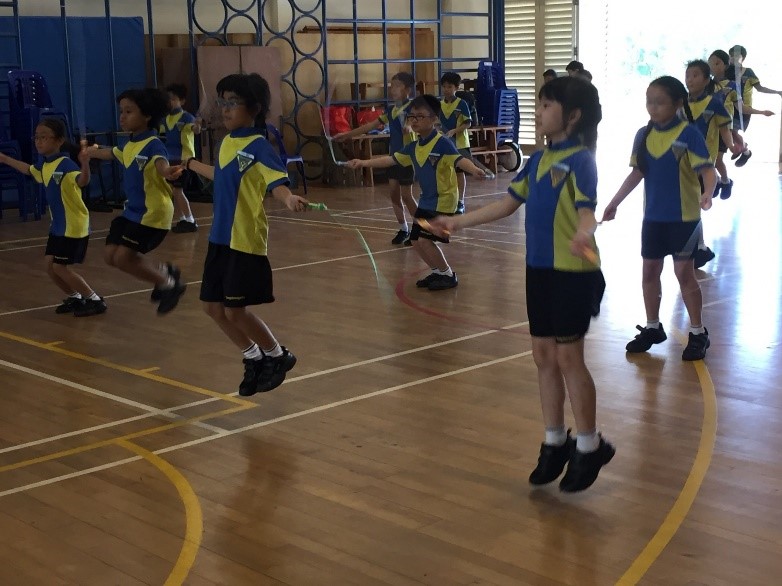
Children practising rope skipping
3. Skipping Race
Skipping Race is an energetic activity that develops coordination and balance.
How to Play
- Mark a starting and finishing line.
- The distance may be 20–40 metres.
- Divide students into teams.
- The first student skips to the finish line.
- The student returns to the starting line.
- The skipping rope is passed to the next student.
- The sequence continues until everyone gets a turn.
- The team finishing first wins.
Circle Time – Good Technique and Form
Question 1: Identify different techniques adopted by the students and relate it with the ease of doing it.
Question 2: Identify the techniques which helped the student to move faster.
4. Atya-patya
Atya-patya is a traditional Indian tag and running game. It develops speed, agility, quick decision-making and teamwork.
How to Play
- Make two teams: runners and defenders.
- Runners try to cross the nine lanes.
- Defenders stand in their assigned lanes.
- Defenders try to tag the runners.
- Runners score points for every lane crossed successfully.
- A tagged runner is out.
- Teams change roles after all runners get their turns.
- The team with more points wins.
- Players should use controlled movements and good sportsmanship.
Circle Time – Prerequisites for playing the game
Question: Discuss the prerequisite skills that influence the outcome of the game, for example, changing the direction while running. Describe more such skills.

A balanced plate should contain a variety of healthy foods.
5. Food for Health
Food gives our body energy and nutrients needed for growth, activity and good health. A healthy diet should include different types of food.
Grains
Choose a variety of grains and include whole grains.
Vegetables
Eat different vegetables, including green and orange vegetables.
Fruits
Eat a variety of fruits and prefer whole fruits to too much juice.
Milk Foods
Milk and other calcium-rich foods help support healthy bones.
Protein-rich Foods
Protein sources include pulses, beans, nuts, seeds, eggs and other foods.
Food for Health Game
- Students are divided into two groups.
- One group represents types of food.
- The other group represents sources of food.
- Students run in the designated area.
- The food-type group tries to catch its food sources.
- Roles are reversed in the next round.
Circle Time – Make Your Own Plate
The teacher discusses a balanced diet. Students can make or draw a thali using local or regional foods that together represent a balanced meal.
6. Dapo Nyarka Sunam
Dapo Nyarka Sunam, also called Bamboo Wrestling, is a traditional wrestling game associated with tribes of Northeast India. It develops strength, technique, balance and strategy.
How to Play
- Two students face each other.
- Each student grips one corner of a bamboo stick.
- The aim is to push the opponent out of the marked circle.
- Players use footwork, body position and leverage.
- Balance and control are important.
- The player who successfully pushes the opponent out or makes them fall wins the round.
Circle Time – Feeling the different muscles
Question: Try to remember the name of muscles as discussed with the teacher in Unit 1 and enlist the muscles which you felt while performing the activity.
7. Madhu and Manu
Madhu and Manu is a tag game that develops agility, speed, reaction and quick decision-making.
How to Play
- Make two groups: Madhu and Manu.
- Both groups face each other near the centre.
- The leader calls either “Madhu” or “Manu”.
- If Madhu is called, Madhu chases Manu.
- If Manu is called, Manu chases Madhu.
- Caught students join the opposite group.
- The aim is to capture as many students as possible.
Circle Time – Agility
Question: Discuss with your teacher about the difference between running straight and changing direction while running.
8. Skipping Song
Skipping combines two locomotor skills: a step and a hop. It creates a light, rhythmic and gliding movement.
How to Play
- Mark an area of about 20 × 10 metres.
- Students stand at the starting line with a skipping rope.
- Students skip using one or both legs.
- They continue for as long as they can without a break.
- Students can learn through practice, imitation or with a partner.
- They can later try circles, curves and zig-zag paths.
Circle Time – Cardiovascular endurance
Question 1: Discuss how skipping for a long time feels like and enlist the reasons which helped you to perform the activity even when you were already tired.
Question 2: Discuss the need for such exercises that are done for long durations and what kind of fitness is required to do so.
9. Fitness Assessment
The fitness tests help students record their starting level, set a goal and check their progress later.
Agility
Test: T-Test
Baseline Time: seconds
Goal (Improve by 1–2 sec): seconds
Cardiovascular Endurance
Test: 600-m Run/Walk
Baseline Time: minutes
Goal (Improve by 10–20 sec): minutes
OR
Test: 3-Minute Step Test (Measure heart rate after)
Baseline HR: bpm
Goal (Lower HR over time): bpm
Strength & Muscular Endurance
Push-Ups (Max in 1 Min)
Baseline: reps
Goal (Increase by 3–5 reps): reps
Squats (Max in 1 Min)
Baseline: reps
Goal (Increase by 5–10 reps): reps
Plank Hold (Time)
Baseline: seconds
Goal (Hold 10–15 sec longer): seconds
Flexibility
Sit-and-Reach Test (Measure reach in inches past toes)
Baseline: inches
Goal (Improve by 1–2 inches): inches
Speed
50-Metre Sprint
Baseline Time: seconds
Goal (Improve by 0.2–0.5 sec): seconds
Reflection & Progress
Question 1: In which area maximum improvement was observed?
Question 2: What was the biggest challenge?
Question 3: How can I improve further?
Quick Revision
- Caterpillar Race: Teamwork, coordination and timing.
- Count and Connect: Listening, movement and quick group formation.
- Skipping Race: Coordination, balance and correct technique.
- Atya-patya: Agility, speed, strategy and teamwork.
- Food for Health: Healthy food provides energy and nutrients.
- Dapo Nyarka Sunam: Strength, balance, technique and strategy.
- Madhu and Manu: Agility, speed and quick reaction.
- Skipping Song: Coordination and cardiovascular endurance.
- Fitness Assessment: Helps us measure progress and set goals.
Easy Revision Questions
Practice important questions and revision exercises with this easy Class 7 Khel Yatra worksheet for unit 2 It is useful for chapter revision, practice and exam preparation.
Class 7 Khel Yatra Unit 2 Worksheet, Class 7 Khel Yatra Unit 2, Physical and Motor Fitness Class 7, Physical and Motor Fitness Worksheet, Class 7 Physical Education Worksheet, Class 7 Khel Yatra Practice Worksheet, Class 7 Khel Yatra Revision Worksheet, Class 7 Khel Yatra Unit 2 Questions, Class 7 Khel Yatra Questions and Answers, Class 7 Khel Yatra Study Material, Class 7 Khel Yatra Worksheet